
The Army is paying to find out whether a ramjet-powered missile can reach drones that today's Stinger-armed air defense vehicles cannot. L3Harris Technologies announced Oct. 23, 2026 that it has received a three-year contract, valued at up to $60 million, to advance a long-range, maneuverable interceptor for the Xtended Range Counter-sUAS Missile (XRC) program run by the U.S. Army Combat Capabilities Development Command Aviation & Missile Center (DEVCOM AvMC). The award moves L3Harris into the project's second phase, where a fully integrated interceptor goes into flight performance testing.
The interceptor is designed to counter small- to medium-size unmanned aircraft systems as well as traditional Short Range Air Defense threats. L3Harris says it delivers "greater range, speed and operational flexibility than current systems," though the company has not published range, speed or other performance figures.
What the $60M XRC Phase Two Buys
The contract covers a fully integrated round, not a single subsystem. According to the L3Harris release, the second phase centers on flight performance testing of the complete interceptor. The company describes the design as modular and deployable from existing launch platforms, and says it is also evolving the counter-sUAS solution for compatibility with existing U.S. military platforms so it can integrate into current operational architectures.
"We are leveraging L3Harris’ deep technical expertise across propulsion, guidance and advanced manufacturing to deliver a next-generation interceptor that meets the Army’s evolving mission requirements," said Scott Alexander, President, Propulsion Systems, Missile Solutions, L3Harris.
Alexander added: "This design combines innovative propulsion with advanced seeker technologies to provide a highly capable, modular and cost-effective solution deployable from existing launch platforms."
The $60 million figure is a ceiling. The release's forward-looking statements list "continued funding up to the full contract value" among the risks that could cause results to differ. Defense War Room reported that the contract runs to late 2029.
Why a Ramjet Matters for Counter-Drone Range
Propulsion is the center of the L3Harris pitch. The company calls its design "a novel approach to air-breathing ramjet engines by enabling greater fuel efficiency and extended engagement range."
Defense War Room explained the trade-off. A solid rocket motor carries both fuel and oxidizer, burns out within seconds and leaves the missile coasting. A ramjet draws oxygen from the atmosphere once a booster brings it to operating speed, freeing internal volume for fuel and sustaining thrust later in flight. Against a maneuvering target at altitude, that retained energy can decide whether the missile hits.
The outlet noted that L3Harris has not released range, speed, diameter, mass, warhead type or seeker modality, and has not confirmed that the round fits the launcher envelope the Army set as a baseline. Ramjet interceptors still need solid rocket boosters to reach operating speed. Defense War Room linked that to L3Harris' Camden, Arkansas, site, which it said produces more than 115,000 solid rocket motors a year, and to the propulsion base L3Harris acquired with its $4.7 billion Aerojet Rocketdyne purchase in July 2023.
Where XRC Sits in the Army's M-SHORAD Plans
XRC is not a procurement program. Defense War Room reported that "XRC is a science and technology (S&T) effort, not a program of record, built around the Maneuver Short Range Air Defense (M-SHORAD) mission." DEVCOM AvMC's market research sought a missile compatible with the Stinger Vehicle Universal Launcher (SVUL) that would outrange the FIM-92 Stinger, shorten reaction and reload times, and defeat Group 2 and Group 3 drones flying higher and at greater standoff distances.
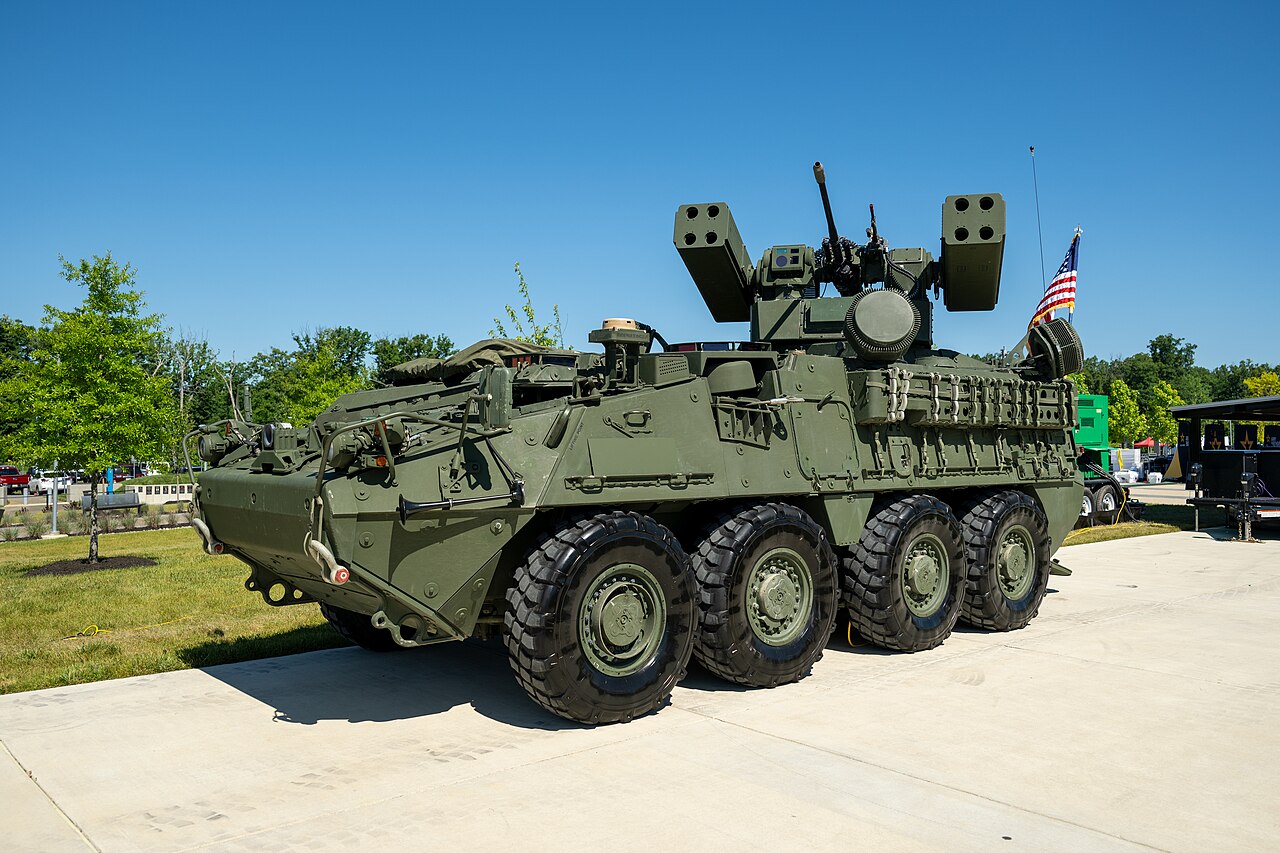
The SVUL arms the SGT STOUT, the Stryker-based M-SHORAD Increment 1 vehicle, whose armament the outlet, citing the Congressional Research Service, listed as eight Stinger missiles in a dual launcher plus a 30mm cannon and a machine gun. A round that fits that launcher would need no new launchers.
XRC is also not the Stinger's designated replacement. Defense War Room identified that role with the Next Generation Short Range Interceptor (NGSRI), the M-SHORAD Increment 3 effort in which Lockheed Martin and RTX's Raytheon won competing development contracts in 2023. The outlet reported that a June 2026 Army request for information plans for 11,000 NGSRI missiles starting in fiscal 2028 and that the FY2027 budget request carries $215.1 million for that program. How XRC technology would transition into NGSRI or another program has not been made public.
L3Harris is not the only XRC performer working on ramjets. Defense War Room reported that Northrop Grumman announced an $18.8 million DEVCOM AvMC contract in late September 2026 to integrate solid-fuel ramjet propulsion into XRC prototypes at its Allegany Ballistics Laboratory in West Virginia. That award covers propulsion, while the L3Harris contract covers an integrated interceptor. The Army has not said how many performers are in phase two or whether the efforts will converge.
The other benchmark is cost. Defense War Room pointed to an Aug. 4, 2026 Army sources-sought notice for a Coyote-launched Next Generation Counter-sUAS Missile (NGCM) with a unit cost under $150,000 across at least 5,000 rounds and a threshold range of 16-plus kilometers at 6 kilometers altitude. XRC's own targets remain unpublished.
What It Means for Contractors
The award shows DEVCOM AvMC buying integrated counter-UAS interceptors through science-and-technology contracts before any program of record exists. Firms that want a role in extended-range drone defense should track AvMC market research and sources-sought notices, not only formal program solicitations.
For suppliers, the L3Harris design points to several technology areas: air-breathing propulsion, solid rocket boosters, seekers and guidance. Alexander's statement credits propulsion, guidance and advanced manufacturing, and the release stresses compatibility with existing launch platforms. Subcontractors that can work within the constraints of fielded launchers, including the SVUL baseline the Army set in its market research, may find openings as phase two flight testing proceeds.
Cost will shape what happens next. Defense War Room set the NGCM ceiling of $150,000 per round as the yardstick and noted that air-breathing engines have largely been confined to expensive weapons. If L3Harris cannot show ramjet range near that price, the outlet wrote, XRC is likely to remain a technology feeder for NGSRI or NGCM rather than a fielded round. Watch for phase two flight results, FY2027 appropriations for M-SHORAD and counter-UAS lines, and the planned start of NGSRI production in fiscal 2028.
The full $60 million also depends on continued funding. Companies teaming with L3Harris should plan around incremental funding, not the contract ceiling.
Sources
- L3Harris Receives Contract to Develop Long-Range Drone Interceptor (L3Harris press release, Oct. 23, 2026)
- L3Harris Long-Range Drone Interceptor Advances to Flight Testing Under $60M US Army Contract (Defense War Room)
- L3Harris receives three-year contract for C-sUAS interceptor development (Unmanned Airspace)
