
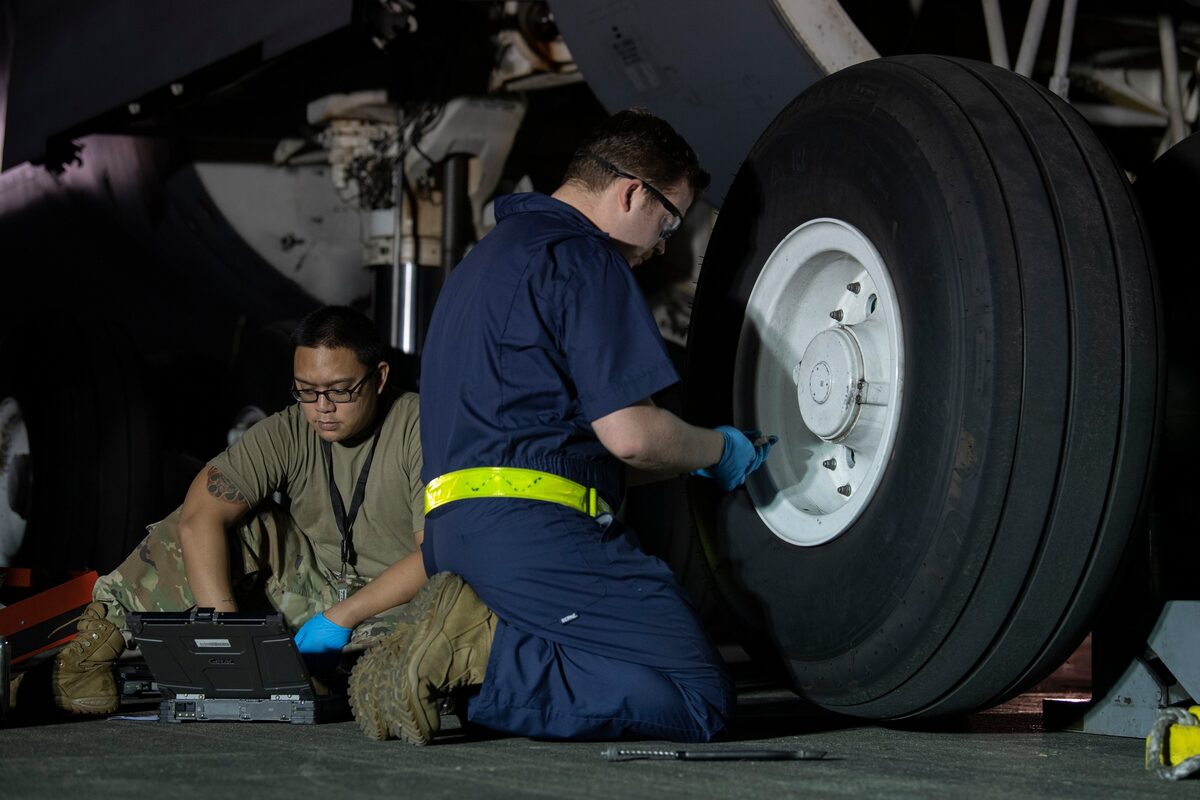
The Air Force has locked in software support for its aging C-5M Super Galaxy fleet through the next decade, awarding Lockheed Martin Aeronautics Co. a $142.9 million sole-source contract for C-5 Galaxy software sustainment, according to the Department of War's July 6, 2026 daily contract announcement.
Background
The C-5M Super Galaxy remains the largest aircraft in the Air Force inventory, hauling outsized cargo, vehicles, and helicopters across intercontinental distances that smaller airlifters like the C-17 cannot manage in a single load. Lockheed Martin has produced and supported the Galaxy family since the 1960s, and the Marietta, Georgia plant that built the original C-5 airframes has evolved into the aircraft's long-term sustainment hub. Keeping a fleet this old flying reliably depends less on new hardware than on continuously updated software, diagnostic tools, and certification paperwork that let the Air Force safely modify and operate the jets.
This is not Lockheed's only active C-5M support contract. The company also holds a separate $211.3 million IDIQ, funded in fiscal year 2025 with $34.9 million obligated at award, covering structural work and deficiency investigations on the same aircraft, with performance running through September 2030. That contract spans the Aircraft Structural Integrity Program, the Functional Systems Integrity Program, the Corrosion Prevention and Control Program, and the Deficiency Investigation Program, funding engineering investigations, deficiency-resolution concepts, and proof-of-concept design and testing work as airframe hardware problems surface. The new $142.9 million contract is a distinct effort focused on the software and systems side of sustainment, and it extends Lockheed's C-5M support commitment nearly two years beyond the structural contract's end date, to May 2032.
Having two active, separately scoped IDIQs running in parallel on the same aircraft is itself informative about how the Air Force structures long-term sustainment for a low-volume, high-complexity platform. Rather than bundling structural and software work into a single omnibus contract, the service keeps the two disciplines on separate vehicles with different funding profiles and different end dates, which gives contracting officers more flexibility to adjust scope, funding, and schedule for each without renegotiating the whole sustainment relationship every time one workstream shifts.
Key Details
The Air Force awarded the new contract as a combination cost-plus-fixed-fee and firm-fixed-price indefinite-delivery/indefinite-quantity vehicle. The IDIQ structure lets the service issue task orders for software work as requirements emerge over the six-year performance window rather than defining every deliverable up front. The contracting office is the C-5 Contracting Branch at Robins Air Force Base, Georgia, which manages sustainment for the Galaxy fleet, and the Air Force procured the deal sole-source, meaning it did not run a competition before selecting Lockheed.
Work will be split between Lockheed's Marietta, Georgia facility and its Greenville, South Carolina site. The scope covers software updates and maintenance for the aircraft's systems, generation of certification artifacts needed to field those updates, upkeep of the systems integration laboratory used to test software changes before they reach the fleet, and broader engineering and technical support tied to the C-5M's software baseline. None of that work touches the airframe structural issues covered under the separate 2025 contract.
At the time of award, the Air Force obligated $19.3 million in fiscal year 2026 operations and maintenance funds — a fraction of the contract's $142.9 million ceiling. That gap is typical of IDIQ awards: the headline figure represents the maximum value across all potential task orders over the life of the contract, while the initial obligation covers only the funded work the Air Force is ready to order now. Additional obligations will follow as the service issues further task orders and funds them through future budget cycles.
The award notice does not disclose a total estimated task-order volume beyond the $142.9 million ceiling, nor does it break out how obligations will be phased across the six-plus years of performance. What is clear from the notice is the division of labor between the two Lockheed sites: Marietta serves as the aircraft's historical home plant, while the Greenville, South Carolina facility will handle a share of the software and technical support work alongside it.
What It Means for Contractors
The award reinforces a pattern that shows up across legacy platform sustainment: the original manufacturer typically retains software and technical-data support work sole-source, because the certification artifacts, systems integration labs, and engineering baselines needed to safely modify decades-old aircraft are not easily transferable to a new vendor. Companies chasing a piece of C-5M sustainment work through open competition will find limited entry points on the software side specifically; the more realistic access points are subcontracting relationships with Lockheed's Marietta and Greenville operations, or competition for adjacent scopes — ground support equipment, training systems, or logistics — that the prime does not directly perform.
The six-year performance period through May 2032 also signals that the Air Force expects to keep flying the C-5M well past the current decade, despite periodic discussions in defense circles about eventual airlift fleet modernization. For suppliers of software tools, cybersecurity services, or systems-engineering support that feed into aircraft sustainment programs, a long IDIQ term like this one creates a stable, multi-year demand signal even though the specific task orders will be awarded incrementally and the near-term funded value remains modest relative to the ceiling.
Small businesses and niche technical firms should watch for individual task-order solicitations issued under this IDIQ rather than expecting a fresh full-and-open competition for the base contract itself, since the vehicle is already locked to Lockheed. The more actionable opportunity is positioning as a subcontractor on software certification, systems integration lab operations, or specialized engineering disciplines that a prime contractor of this scale routinely brings in outside expertise to cover, particularly as task orders ramp beyond the initial $19.3 million obligation over the coming budget years.
Contractors tracking Robins Air Force Base's C-5 Contracting Branch should also note the sole-source justification pattern here, which typically rests on the original manufacturer's unique technical data rights and organic sustainment infrastructure. Firms hoping to break into legacy-aircraft software sustainment more broadly may find better openings on newer platforms where technical data packages were negotiated with future competition in mind, rather than attempting to displace an incumbent with five-plus decades of program history on a single airframe.
