
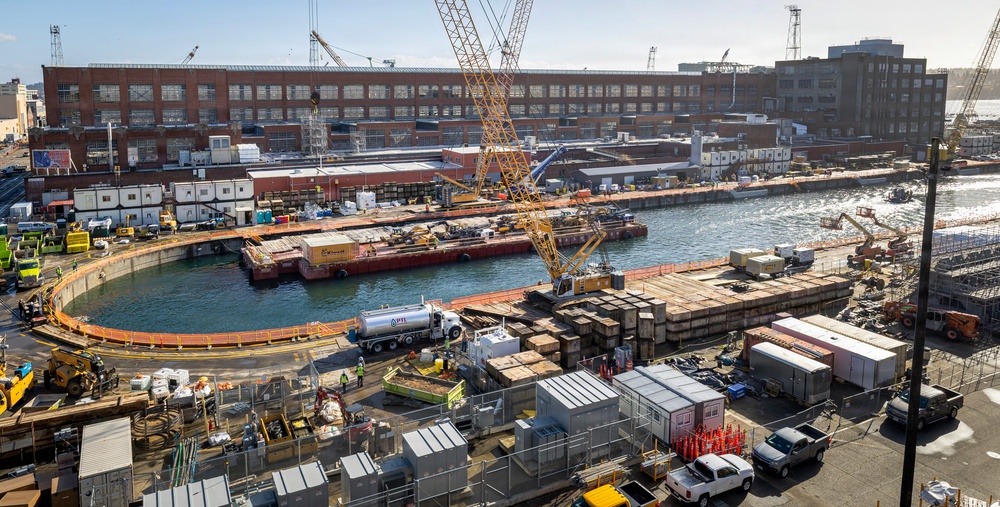
Eleven small businesses — spanning Idaho, two Alaska cities and Guam — now have a shot at a combined $1 billion in Navy construction work across the Pacific Northwest, after the Naval Facilities Engineering Systems Command (NAVFAC) Northwest awarded a small-business multiple-award-construction contract on Sept. 24. The indefinite-delivery/indefinite-quantity vehicle lets the Navy pull from any of the 11 firms for waterfront repairs, airfield upgrades and industrial-shop projects through September 2028, giving the command a standing bench of vetted small businesses instead of competing every job individually.
The award, a small business indefinite-delivery/indefinite-quantity multiple-award-construction contract (MACC), carries a combined ceiling of $1 billion. It was competitively procured through SAM.gov, drawing 31 proposals before NAVFAC Northwest split the work among the 11 winners, according to the Department of War's daily contract announcement for Sept. 25, mirrored by GlobalSecurity.org. Each awardee receives $5,000 at contract award, and NAVFAC Northwest, headquartered in Silverdale, Washington, is the contracting activity for the vehicle.
Who Won a Piece of the $1 Billion Ceiling
The 11 companies span the West Coast and beyond, a mix that includes Pacific Northwest regulars, a Gulf Coast firm and an Idaho-based firm whose name signals Native American ownership:
- Advanced Technology Construction Co., Tacoma, Washington
- HCPA-GARCO JV1, Allyn, Washington
- Barlovento LLC, Dothan, Alabama
- Shape Construction Inc., Poulsbo, Washington
- A&R Pacific Garney Federal JV II, Tamuning, Guam
- AMS Dahlgren JV LLC, Lafayette, Colorado
- National Native American Construction Inc., Coeur d'Alene, Idaho
- Salt Marsh Consulting Group LLC, Savannah, Georgia
- STG Pacific LLC, Anchorage, Alaska
- Pacific Tech Construction Inc., Kelso, Washington
- Bristol General Contractors LLC, Anchorage, Alaska
National Native American Construction Inc.'s name signals Native American ownership, though neither cited source details the firm's formal ownership structure. Two Anchorage companies, STG Pacific and Bristol General Contractors, and Guam-based A&R Pacific Garney Federal JV II extend the geographic reach beyond the Pacific Northwest, even though NAVFAC Northwest expects most of the actual construction to land in Washington state. The mix of joint ventures on the list — HCPA-GARCO JV1, A&R Pacific Garney Federal JV II and AMS Dahlgren JV LLC — also shows how small businesses are teaming up to meet bonding capacity and past-performance thresholds large enough to compete for shore-infrastructure work at this scale.
How the Task-Order Competition Will Work
A multiple-award IDIQ does not guarantee any single company a dollar figure. Instead, NAVFAC Northwest will issue individual task orders against the $1 billion ceiling, and the 11 awardees compete against each other for each one — a structure meant to keep pricing competitive over the life of the contract while giving the Navy faster access to pre-cleared builders. The scope covers new design, construction, supervision, equipment, material and labor for renovation, repair and new construction at government sites across NAVFAC Northwest's area of operations, according to the Department of War announcement mirrored by GlobalSecurity.org, which described the winners as "awarded a combined-maximum-value $1,000,000,000 indefinite-delivery/indefinite-quantity, multiple-award-construction contract for new design, construction, supervision, equipment, material and labor" tied to the Sept. 24 date and the 31-proposal competition. That 31-proposal count signals how much interest a $1 billion small-business ceiling draws in a single geographic market, and it means the firms that didn't make the cut this round will be watching how quickly NAVFAC Northwest burns through the vehicle's task orders for a read on when the next recompete might open.
What the Contract Will Build Across the Region
NAVFAC Northwest's announcement lists a broad set of project types that could be tasked under the vehicle: waterfront facilities, operational infrastructure, industrial support shops, quality-of-life improvements and airfield systems. That range reflects the command's mission set, which spans everything from pier and drydock work supporting the fleet to barracks and other facilities that affect day-to-day life for sailors stationed in the region. With a completion date of September 2028, the Navy has roughly two years to task out work before the vehicle's period of performance closes.
A Record Fiscal Year for Navy Recapitalization
NAVFAC Northwest describes this as a record-setting fiscal year, noting the command had already awarded $1 billion in separate contract actions before this MACC — meaning the command has now tied roughly $2 billion in combined construction contract actions and ceiling value to its pipeline in a single fiscal year. The command frames the pace as part of an unprecedented era of recapitalization across regional naval infrastructure, tied directly to two priorities: the Shipyard Infrastructure Optimization Program (SIOP) and the Navy's Nuclear Deterrence Mission.
"This contract positions the Navy and our business partners to move with greater speed and agility throughout the acquisition lifecycle," said Capt. Bob Stiles, NAVFAC Northwest's commanding officer. "Whether advancing monumental recapitalization efforts under the Shipyard Infrastructure Optimization Program (SIOP), bolstering the infrastructure that underpins our Navy's Nuclear Deterrence Mission, or executing high-priority military construction and facility sustainment projects, this contracting capability ensures we deliver mission-ready shore platforms to the Fleet when and where they need them the most."
What It Means for Contractors
For the 11 winners, the MACC is an entry ticket, not a guaranteed payday — the real competition starts now, task order by task order, over the next two years. Firms outside Washington state, like Barlovento in Alabama, Salt Marsh Consulting Group in Georgia and AMS Dahlgren JV in Colorado, will need to weigh travel and mobilization costs against each opportunity NAVFAC Northwest releases, since the command expects most work to stay concentrated in-state. For small businesses that didn't make this vehicle, the door isn't fully closed: NAVFAC routinely lets task orders under multiple-award contracts flow to subcontractors, and the command's stated pace of recapitalization suggests more solicitations — for this MACC and others — are likely as SIOP and Nuclear Deterrence Mission funding continues to move.
Native American-owned firms watching National Native American Construction's inclusion here have a concrete data point that NAVFAC Northwest is willing to route large-dollar shore infrastructure work to a firm with that name recognition, which could shape how similar firms position themselves for the command's next small-business vehicle. And for the region's prime contractors more broadly, the fact that NAVFAC Northwest is publicly framing this MACC as one piece of a roughly $2 billion fiscal year of contract actions and ceiling value — on top of separate awards already booked — is itself a signal: the command's backlog tied to SIOP and Nuclear Deterrence Mission facility work is deep enough that task orders under this vehicle are likely to keep coming at a steady clip through the September 2028 completion date, rather than front-loading early and going quiet.
