
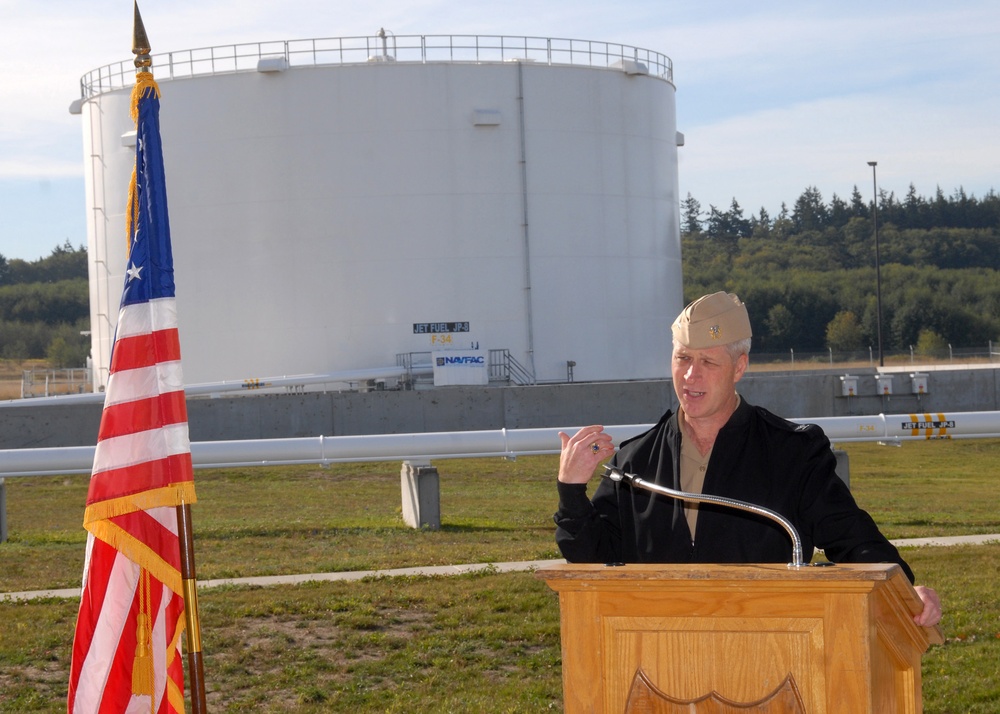
Ten construction and engineering firms — half of them small businesses — will share as much as $997 million of Navy work rebuilding the service's fuel backbone: the pipelines, storage tanks and petroleum-handling plants that keep ships and aircraft supplied at bases around the world. The Defense Department's Aug. 21 contract announcement lists the award as a firm-fixed-price, indefinite-delivery/indefinite-quantity multiple-award construction contract, or MACC, covering "construction, maintenance, repair, and engineering services for pipelines, fuel storage tanks, and associated petroleum oil lubricant facilities and equipment."
The Naval Facilities Engineering and Expeditionary Warfare Center in Port Hueneme, California, is the contracting activity, and the vehicle runs on a five-year base period with work expected to finish by August 2031. Work will be split evenly between Navy and Marine Corps locations inside the continental United States and installations overseas — a 50/50 division that puts half of a nearly billion-dollar construction program at OCONUS sites, where mobilization runs costlier and qualified specialty labor is harder to source.
Who Shares the $997 Million
The ten awardees, holding contract numbers N39430-26-D-2001 through N39430-26-D-2010, are Aptim Federal Services LLC of Baton Rouge, Louisiana; Bristol Engineering Services Co. LLC of Anchorage, Alaska; CMS Corp. of Bargersville, Indiana; Dawson Technical Inc. of San Antonio, Texas; Environmental Chemical Corp. of Burlingame, California; Pacific Design Builders LLC of Tamuning, Guam; PCI Bhate JV LLC of Atmore, Alabama; Tepa & Pond Constructors JV of Kansas City, Missouri; Weston Solutions Inc. of West Chester, Pennsylvania; and WSP USA Government Solutions Inc. of New York.
Five of the ten — Bristol Engineering Services, Dawson Technical, Pacific Design Builders, PCI Bhate and Tepa & Pond — are small businesses, giving the pool an even split between large primes and small firms. The roster mixes national engineering houses like Aptim, Weston Solutions and WSP with regional firms based in Alaska, Guam, Texas, Indiana and Alabama.
Competition for a seat was real. "This contract was competitively procured via the SAM.gov website, with 17 offers received," the announcement states — meaning seven bidders were left out of a pool that will control fuel-infrastructure construction for Navy and Marine Corps installations into the next decade. The procurement traces to a March 2025 request for proposals, solicitation N3943025R2001, which set a $45 million small-business size standard under NAICS code 237120, the oil and gas pipeline construction classification.
A 50/50 Split Between Overseas and Stateside Fuel Work
Petroleum-oil-lubricant, or POL, infrastructure is the unglamorous plumbing of naval power: bulk storage tanks, transfer pipelines, fuel piers, hydrant systems and the pumps, valves and controls that tie them together. The new MACC consolidates construction, maintenance, repair and engineering for all of it under one competitive umbrella, letting the Expeditionary Warfare Center issue task orders to its pre-qualified pool instead of running a full procurement for every tank repair or pipeline replacement.
The announcement's even OCONUS/CONUS division is notable for a construction vehicle of this size. Overseas fuel projects carry premiums for mobilization, host-nation permitting and logistics, and the inclusion of a Guam-based awardee suggests the Pacific will see its share of task orders. The Defence Blog, which covered the award on Aug. 23 under the headline "U.S. Navy awards nearly $1B contract for global fuel infrastructure," notes that Guam — where Pacific Design Builders is based — hosts Andersen Air Force Base and Naval Base Guam, both dependent on bulk fuel infrastructure under the Expeditionary Warfare Center's global petroleum program.
Each awardee receives only a token guarantee up front. Fiscal 2026 Navy working capital funds in the amount of $10,000 per contractor will be obligated at award to satisfy the minimum guarantee, alongside a single seed task order worth $587,438. Those funds expire at the end of the current fiscal year; everything beyond the seed order must be won task by task.
Why the Ceiling Number Is the Whole Pie, Not a Per-Company Award
As with any MACC, the headline figure is shared capacity rather than guaranteed revenue. "The maximum dollar value, including the base period of five years, for all 10 contracts is $997,000,000," the announcement states. No firm is promised anything beyond its $10,000 minimum; the money flows to whichever pool members win individual task-order competitions between now and 2031.
That structure rewards contractors who can price overseas mobilization accurately and staff quickly. Task orders under fuel-infrastructure MACCs typically range from small tank-coating and cathodic-protection repairs to eight-figure pipeline and fuel-farm recapitalizations, and the awardees best positioned near the work — or with existing NAVFAC past performance in POL construction — tend to capture an outsized share. The 50 percent OCONUS weighting also means firms with established footprints in Guam, Alaska and other overseas locations start with a structural advantage over stateside-only competitors.
For the Expeditionary Warfare Center, whose global petroleum, oil and lubricants program manages fuel-handling infrastructure at Navy and Marine Corps sites worldwide, the vehicle provides five years of ready contract capacity without new solicitations. The construction MACC also runs alongside a separate architect-engineer design services contract for the same program, capped at $145 million and covering design work rather than construction itself.
What It Means for Contractors
For the ten winners, the real competition starts now. A seat on the MACC is a hunting license, not a paycheck: with only $10,000 guaranteed per firm and a single $587,438 seed order obligated, the difference between a marginal contract and a franchise will be task-order win rate. Firms should expect head-to-head pricing among all ten pool members, with the 50/50 OCONUS split favoring those who can mobilize to Pacific and other overseas installations without learning-curve costs.
For firms outside the pool, the award closes a major door on Navy POL construction for five years — 17 offers chased these ten seats — but it also signals where NAVFAC's money is going. Subcontracting to pool members, particularly on OCONUS task orders where local labor and specialty trades are scarce, is the realistic entry point. And because five awardees are small businesses, large firms shut out of the prime pool may find teaming opportunities with small primes that need capacity to execute bigger orders.
Finally, between this $997 million construction pool and the companion $145 million design contract, the Navy has now stood up more than $1.1 billion of dedicated contract capacity for its fuel infrastructure — and task orders under these vehicles are where that money will be spent.
