
The Navy is adding another source of Virginia-class submarine hardware, and it is paying for it against demonstrated output. Anduril Industries will build Arsenal-2, a software-defined shipyard at Sparrows Point in Baltimore County, Maryland, backed by $3.7 billion of the company's own capital, while the Navy has awarded Anduril a contract of up to $2.9 billion with payments tied to demonstrated production outcomes. The yard will fabricate submarine components and large assemblies and ship them to General Dynamics Electric Boat and HII's Newport News Shipbuilding, the two prime yards, for final assembly.
Anduril and the government put the combined figure at $6.6 billion. President Donald Trump and Secretary of War Pete Hegseth announced the project at a ceremony on the future site, GovConWire reported. Initial operations are expected in 2030.
How the Up-to-$2.9B Navy Contract Shifts Risk to Anduril
The contract structure is the unusual part. Rather than funding construction up front, the Navy ties its payments to Anduril's demonstrated production outcomes. In its announcement, Anduril said the arrangement "ensures that Anduril, not the taxpayer, takes on the majority of the execution risk, aligning incentives to ensure on-time, high-quality submarine production." GovConWire described the same terms: the company invests $3.7 billion, and the Navy accounts for the remaining $2.9 billion "through a contract with payments tied to demonstrated production outcomes."
The deal also carries political terms that sit outside the company's release. Trump said American taxpayers will receive a 40 percent stake in the shipyard and raised the prospect of $21 billion in future purchases from the site, according to GovConWire. Anduril's announcement does not mention either figure, and neither source describes how the stake would be structured or which agency would hold it.
Which Virginia-Class Parts Will Arsenal-2 Build First?
Anduril framed the yard as a feeder to the existing prime shipbuilders, not a competitor to them. "Arsenal-2 will build complex components and large scale assemblies of the Virginia-class submarine and deliver them to Electric Boat and Newport News Shipbuilding for final assembly," the company said. Adding another source of that work, it said, will let more submarine construction happen in parallel across the industrial base.
Production will start with precision torpedo tubes and impulse tanks before moving to complex rafted module assemblies, GovConWire reported. Vice Adm. Rob Gaucher, director of submarine programs, said the site's position between the two prime yards, connected by sea, rail and road, lets Electric Boat and Newport News concentrate on work only they can perform: final module outfitting, nuclear reactor integration, assembly, testing and delivery.
Ahead of the Maryland opening, Anduril is building a 160,000-square-foot facility in Orange County, California, to validate manufacturing methods and produce Virginia-class test assets and torpedo tubes, according to GovConWire and Anduril, which says the site gives it a two-year operational head start.
Can 9 Million Production Hours Close the Submarine Gap?
The Navy's target is a cadence of one Columbia-class and two Virginia-class hulls per year. Gaucher said the submarine enterprise currently delivers about half the tonnage required. Anduril cited domestic fleet requirements and AUKUS commitments as the drivers behind the needed growth.
By Gaucher's estimate, Arsenal-2 will add up to 9 million production hours per year to the submarine supply chain, a 15 percent increase in total capacity. That figure is meaningful but partial: on the Navy's own numbers, a 15 percent capacity gain does not by itself close a gap in which the enterprise delivers roughly half of what it needs. The yard's contribution also depends on hitting the 2030 start and then scaling, which Anduril said will happen "progressively" as it builds its workforce, supplier base, infrastructure and manufacturing throughput.
What the 187-Acre Sparrows Point Yard Will Include
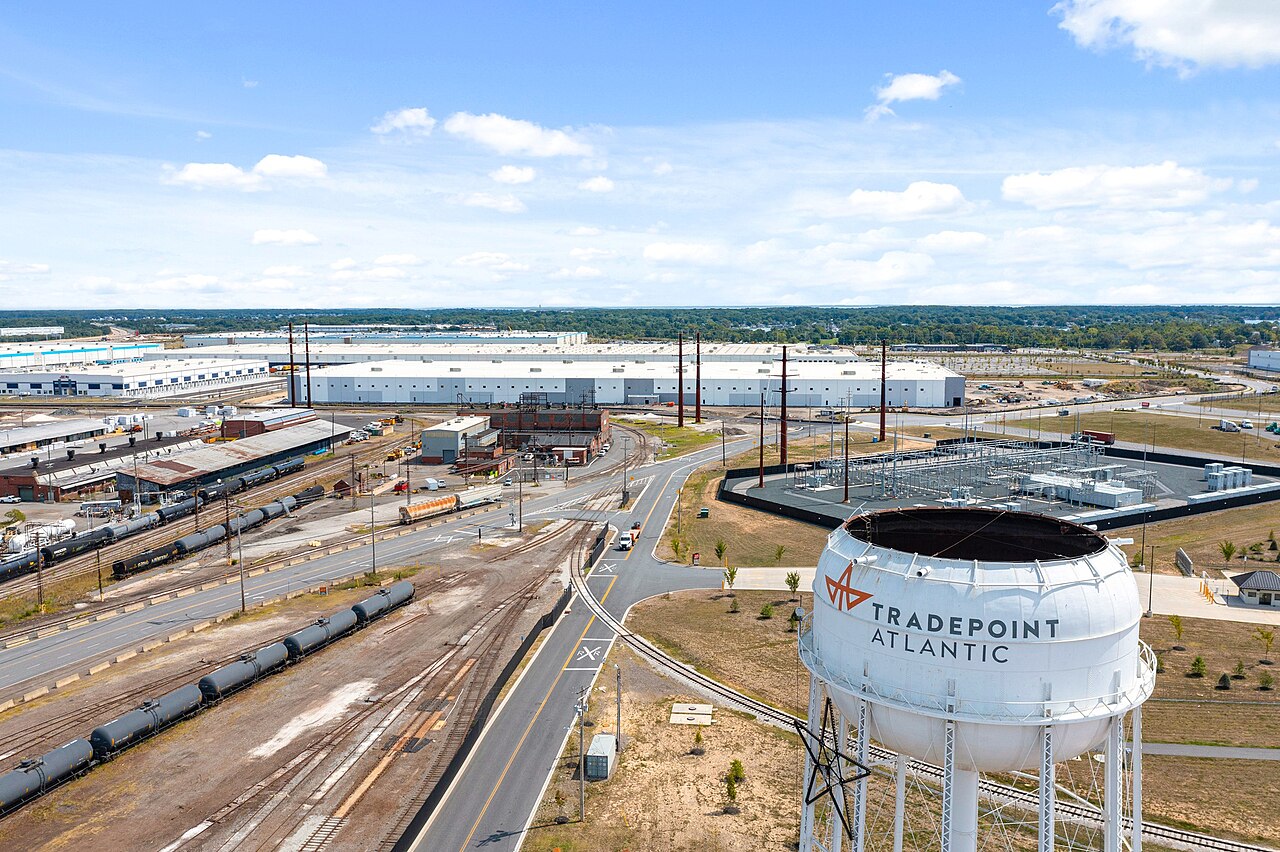
Arsenal-2 will cover more than 2 million square feet on a 187-acre site at Tradepoint Atlantic, within the Sparrows Point complex. Plans include a functional 1,200-foot graving dock, high-bay assembly halls, adjacent fabrication areas and reconfigurable production lines. Existing road, rail and maritime infrastructure connects the site to suppliers and to the two prime builders, according to Anduril.
The company's industrial software platform, ArsenalOS, will tie together fabrication workflows, outfitting sequences, material movement, inspection protocols and documentation in a single system. Anduril said digital work instructions and embedded quality controls are meant to help new workers, including welders, pipefitters, electricians and shipfitters, train faster.
Anduril said the project will create 3,100 direct jobs and support more than 11,000 indirect jobs, with $2 billion in annual economic output. Site preparation and permitting have started; construction is waiting on approvals, GovConWire reported.
Why the Navy Turned to Anduril
Anduril CEO Brian Schimpf said the Navy approached the company more than two years ago and Anduril initially declined, because its work on autonomous aircraft, missiles and connecting software sat at a different order of complexity than a Virginia-class boat, according to GovConWire. The company then worked with Electric Boat and Newport News to identify where production constraints exist.
Arsenal-2 follows the model of Arsenal-1 near Columbus, Ohio. Anduril's production network also includes a maritime factory at Quonset Point, Rhode Island, a Ghost Shark factory in Sydney and a rocket motor facility in McHenry, Mississippi.
Acting Navy Secretary Hung Cao tied the project to the service's autonomy push. "As you know, the secretary of war announced last week the establishment of the Autonomous Warfare Command and the Navy’s ready to lead the charge in modernizing autonomous warfare," Cao said during the ceremony, as quoted by GovConWire.
What It Means for Contractors
The payment model is the signal to watch. A Navy award of up to $2.9 billion that pays against demonstrated output, paired with $3.7 billion in private capital, may be a template the department tries elsewhere in the maritime industrial base. Firms pursuing shipbuilding infrastructure work should expect more questions about how much of their own balance sheet they will put at risk.
Suppliers may find a nearer-term opening. Anduril said the yard's scaling depends on building a supplier base along with its workforce, and the yard's first products, torpedo tubes, impulse tanks and then rafted module assemblies, point to demand for materials, machining, inspection and skilled trades, though neither source gives a timeline for supplier awards. Electric Boat and Newport News subcontractors should also track how work shifts between the primes and Arsenal-2 as Gaucher's added production hours come online.
Open questions remain: the contract number and award vehicle were not published in either source, and the 40 percent government stake Trump described has no public terms yet.

