
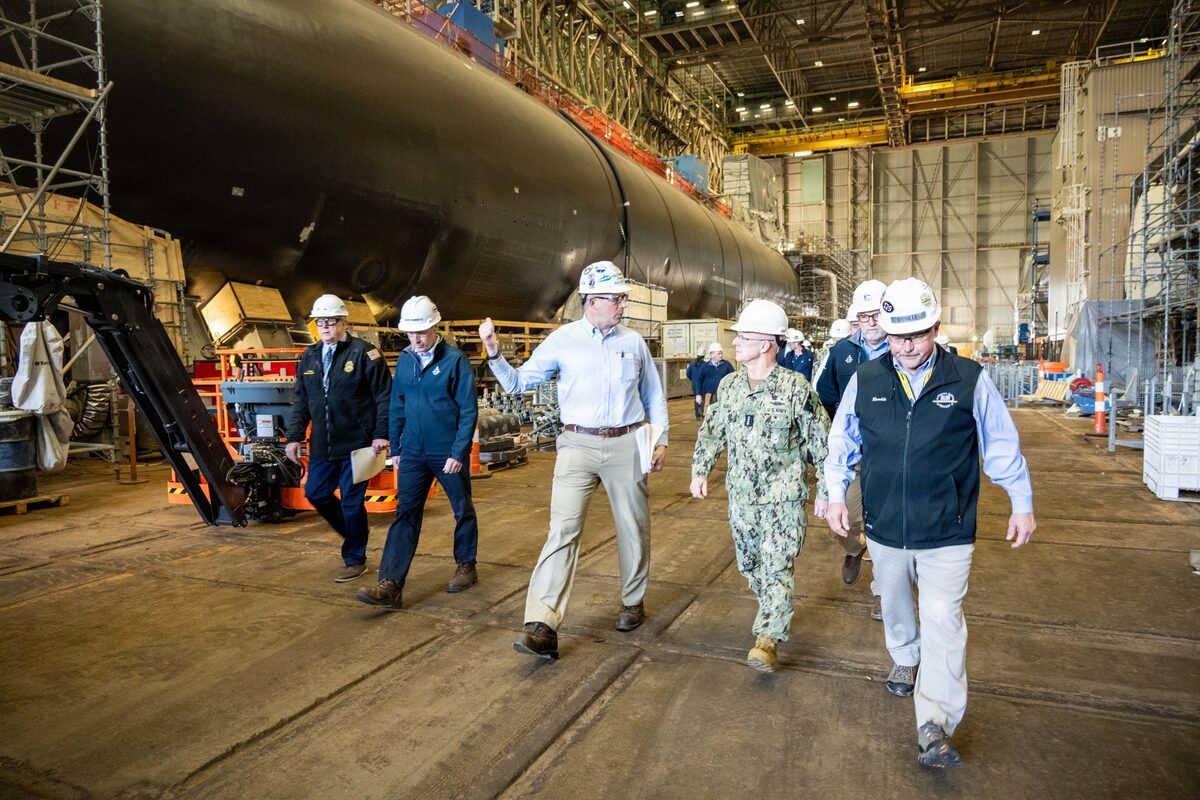
The Navy has awarded General Dynamics Electric Boat and Huntington Ingalls Inc. an $11,878,200,668 incentive contract modification to keep construction of five Columbia-class ballistic missile submarines and nine Virginia-class Block VI attack submarines on schedule, the Department of War announced July 29, 2026.
Background
The submarine industrial base has spent the past several years racing to expand capacity for two overlapping programs at once. The Columbia class is the Navy's replacement for the aging Ohio-class ballistic missile submarines that carry the sea-based leg of the nuclear triad, and the service has treated its schedule as effectively non-negotiable. The Virginia class, meanwhile, remains the Navy's primary fast-attack submarine, with Block VI representing the newest iteration of a design that has been in continuous production for more than two decades.
Building both classes simultaneously has strained the same shipyards, the same skilled trades, and the same supplier base. Electric Boat, based in Groton, Connecticut, serves as lead yard for Columbia and shares Virginia-class construction with Huntington Ingalls' Newport News Shipbuilding division in Virginia. That division of labor has long defined U.S. submarine construction, and it means funding certainty at both yards has to move in lockstep for the schedule to hold.
This modification folds funding for both submarine classes into a single incentive action covering both shipbuilders, rather than issuing separate awards for Columbia and Virginia-class work — a structure that reflects how tightly the two programs' schedules are now linked at the shipyard level. The award is a funded construction modification tied to the full 14-boat effort, not a preliminary or budget-line action.
Key Details
The Department of War's contract announcement lists the award to General Dynamics Electric Boat Corp., Groton, Connecticut, and Huntington Ingalls Inc., Newport News, Virginia, as a modification worth $11,878,200,668. The work covers construction of five Columbia-class submarines, designated SSBN 828 through 832, and nine Virginia-class Block VI attack submarines, designated SSN 814 through 822. The modification also funds "investments in shipbuilder productivity efforts" — language that points to capital investment in tooling, facilities, and workforce capacity rather than the hulls themselves. The Department of War lists an expected completion date of July 2038, a timeline that spans more than a decade of concurrent Columbia and Virginia construction. The funding is drawn from fiscal 2024, 2025 and 2026 Navy shipbuilding and conversion accounts, plus fiscal 2025 maritime industrial base funds and a fiscal 2026 national sea-based deterrence fund allocation, all obligated at the time of award, according to the contract notice. Naval Sea Systems Command, in Washington, D.C., is listed as the contracting activity.
Electric Boat's own July 29 announcement placed the modification inside a much larger figure: a $76.6 billion total Navy award covering all 14 submarines. According to the company, that total breaks down into $29.5 billion for the five Columbia-class boats and $42.1 billion for the nine Virginia-class boats, with the remainder tied to shipyard infrastructure funding. The $11.9 billion figure recorded in the Department of War's daily contract announcement represents the funding obligated on this specific modification, while the $76.6 billion figure from Electric Boat appears to describe the broader multi-year construction program the modification supports.
Electric Boat president Mark Rayha framed the award around workforce and supplier planning rather than the dollar figure alone. "These important contract modifications provide Electric Boat and our suppliers with the demand certainty we need to continue investing in capacity and hiring the workforce necessary to ensure we deliver these important national security assets on schedule," Rayha said in the company's release. Electric Boat currently employs more than 27,000 people in Groton.
The Department of War's notice does not break out a separate dollar figure by class or by shipyard within the $11.9 billion modification, nor does it specify the split of work between Electric Boat and Huntington Ingalls on the Virginia-class portion, consistent with how the daily contract announcements typically summarize large multi-party awards.
What It Means for Contractors
The award functions as a funding backstop for two programs that were already underway, which is a different signal than a new-start contract. For companies already embedded in the Columbia and Virginia supply chains, the modification's "demand certainty" language matters more than the headline number: it tells second- and third-tier suppliers that the construction pace behind SSBN 828-832 and SSN 814-822 is funded through to a 2038 completion horizon, reducing the risk that a supplier invests in tooling or hires machinists only to see orders slow.
The explicit reference to "shipbuilder productivity efforts" is worth watching for companies in industrial engineering, automation, and workforce training. That funding line, layered on top of the hull construction dollars in the same modification, aligns with construction throughput and capacity being a real constraint on both programs, not just component sourcing or design work. Firms that sell shipyard automation, digital twin and production-scheduling tools, or skilled-trades training programs have a credible entry point into this funding line, distinct from the traditional path of bidding on ship components.
The gap between the Department of War's $11.9 billion modification figure and Electric Boat's $76.6 billion program total is also a reminder for smaller contractors and analysts tracking the submarine industrial base: a single daily contract announcement rarely captures the full multi-year value of a program this large. Electric Boat's separate disclosure of the $29.5 billion Columbia and $42.1 billion Virginia splits gives subcontractors a clearer sense of relative program size than the Navy's own notice, and companies bidding into the supply chain should treat prime contractor releases as a necessary complement to the Department of War's daily listings rather than a duplicate of them.
Finally, the concurrent timeline is itself a planning signal. With Columbia and Virginia-class Block VI construction now funded on parallel tracks through 2038, companies serving either program should expect steady, overlapping demand rather than a sequential handoff between the two submarine classes.
Contractors evaluating whether to pursue subcontract work under either class should also note that the 2038 completion date covers construction of the hulls named in this modification, not the full service life of the boats or follow-on maintenance work that typically follows delivery. Sustainment, overhaul, and lifecycle support contracts tend to be issued separately once individual hulls are commissioned, meaning today's award is best read as a construction-phase funding commitment rather than an end-to-end program guarantee for the full 14 submarines involved.
