
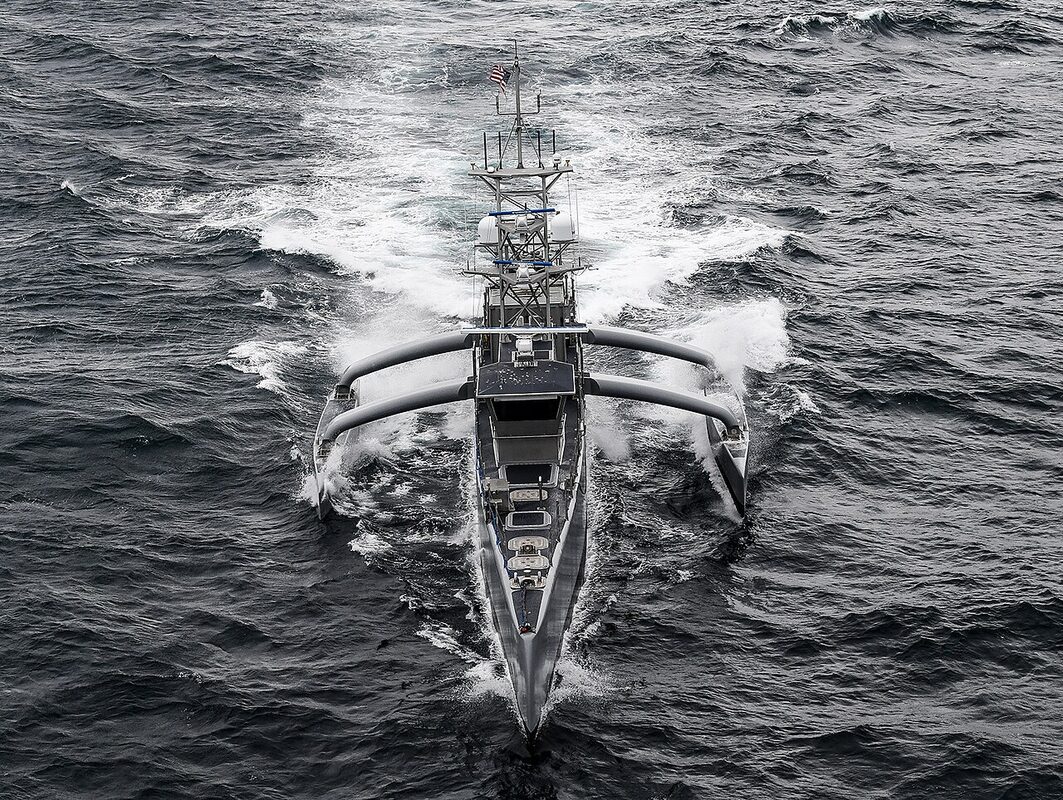
The Navy says a drone boat now sails with a deployed carrier strike group for the first time, a step that would move unmanned surface vessels from test programs into frontline fleet operations. The service has not said which vessel it is, and ship-tracking data shows the likeliest candidate left port well after the carrier did, TWZ reported on Oct. 17.
Acting Navy Secretary Hung Cao made the claim on Thursday, Oct. 15, during a panel with Defense Secretary Pete Hegseth and other senior officials at the Army's annual AUSA conference, DefenseScoop reported. He said the Theodore Roosevelt Carrier Strike Group deployed Oct. 8 with an unmanned surface vessel (USV). Navy spokespersons did not clarify which one.
What Cao Said About the Roosevelt Drone Boat
Cao described the deployment in a single breath that used two different size classes. "The Teddy Roosevelt Carrier Strike Group just deployed on October 8 with a medium-sized unmanned surface vessel. This is the first carrier strike group to ever deploy with a large-size unmanned surface vessel, and this is a force multiplier," Cao said, according to DefenseScoop. He added: "Imagine having more guns out there."
The medium-versus-large wording matters because the Navy has treated those as separate categories. DefenseScoop noted that the service merged its Large Unmanned Surface Vessel (LUSV) and Medium Unmanned Surface Vessel (MUSV) programs into the Modular Attack Surface Craft (MASC) program last year. The outlet said the systems were equipped with varying assets depending on mission, including containerized weapons and sensors or other electronic payloads.
DefenseScoop said multiple Navy spokespersons did not clarify the USV model in response to its requests during the week. Pentagon officials referred questions to the Navy. The outlet also asked Leidos whether either of its MUSV prototypes, Sea Hunter or Seahawk, was deploying with the group. A Leidos source referred DefenseScoop to the Navy, because both are now Navy-owned vessels. DefenseScoop reported that the two prototypes were delivered for real-world surface fleet missions this year.
Why the Oct. 8 Date Does Not Match the Carrier's Departure
TWZ's weekly carrier tracker supplies the most specific answer available. "Multiple reports indicated that medium unmanned surface vessel (MUSV) Seahawk deployed with the group, which would represent a significant operational achievement and the first time a drone boat was assigned to a CSG," TWZ wrote. But the outlet found that the MUSV "quietly slipped out of Point Loma on October 8, more than ten days after Roosevelt."
Roosevelt and the cruiser USS Chosin left the U.S. at the end of September, according to TWZ. By the date Cao cited, TWZ said, Roosevelt was more than halfway to Japan. The carrier and Chosin arrived at Commander, Fleet Activities Yokosuka, Japan, on the morning of Friday, Oct. 16, making Roosevelt the first non-resident U.S. carrier to visit the port in more than four years, TWZ reported. DefenseScoop's account, published the same day, described the carrier as moving toward the Middle East.
Seahawk's own route ran separately. TWZ reported that the drone boat reappeared on public Automatic Identification System (AIS) data, docked in Hawaii for a couple of days, and continued westbound across the Pacific on Oct. 16. Whether it will join Roosevelt for exercise Keen Sword 27 is unknown, TWZ said.
TWZ asked the Secretary's office to clarify and confirm the deployment and received no response. A Navy official did comment on the vessel itself: "Seahawk's operations represent continued progress in the Navy's efforts to integrate unmanned systems into Fleet operations. As with any emerging capability, we continue to learn, adapt, and refine how these systems are employed."
How a Disaggregated Strike Group Changes the "Deployed With" Question
The gap between Cao's framing and the tracking data may come down to how the Navy counts ships in a strike group. TWZ reported that the five-ship group, whose composition a Navy official confirmed, is operating on a disaggregated basis, which the outlet called a common practice for strike groups with multiple ongoing missions.
The group's ships have left on staggered timelines. TWZ said the Pearl Harbor-based destroyer USS Decatur linked up with Roosevelt and Chosin as they passed the Hawaiian Islands and arrived in Yokosuka a day after the carrier. USS Carl M. Levin, also stationed in Hawaii, deployed first, on Sept. 9, and is operating at an undisclosed location. USS Paul Hamilton left San Diego on Oct. 10 and moored at Joint Base Pearl Harbor-Hickam on Oct. 15, according to AIS data cited by TWZ.
Under that model, a drone boat that departs San Diego on Oct. 8 and later passes through Hawaii could be assigned to the strike group without sailing alongside the carrier. TWZ put it conditionally: if Seahawk is assigned to Carrier Strike Group 9, it is currently disaggregated. Neither source shows the Navy confirming the assignment, so Cao's "first" remains an official claim without a named vessel behind it.
Where the PAE for Robotic and Autonomous Systems Fits
Cao's remarks came in a busy week for the Navy's unmanned portfolio. DefenseScoop reported that Cao announced in an online post on Tuesday, Oct. 13, that he had appointed Christopher Miller as portfolio acquisition executive for robotic and autonomous systems (PAE RAS). The Navy launched that organization earlier this year as part of an effort to connect surface, undersea and aerial drones and swarms across the fleet.
Cao also pointed to operational use. He cited the Navy's deployment of Saronic's Corsair USV to rescue a downed helicopter pilot and gunner in the Strait of Hormuz over the summer. "Then we also use the unmanned underwater vehicles to de-mine that area," Cao said, according to DefenseScoop. "It can't be done in an uncontested area unless it's using unmanned underwater vehicles."
DefenseScoop tied the push to the Navy's "Golden Fleet" concept, a hybrid force that pairs AI and robotic platforms with traditional crewed ships.
What It Means for Contractors
For USV builders and payload suppliers, a carrier strike group deployment would be a notable operational proof point for the MASC program. If the Navy confirms Seahawk, the Leidos prototype could become a reference case for how a medium drone boat supports a carrier group on a long transit, and the lessons the Navy official described as "learn, adapt, and refine" may inform how MASC craft carrying containerized weapons, sensors and electronic payloads are employed.
The ambiguity is also instructive. Cao's mix of "medium-sized" and "large-size" in one statement, and the Navy's silence on the model, leave companies without a clear signal on which size class the service treats as fleet-ready. Firms tracking MASC should watch for a formal Navy statement naming the vessel, any sign Seahawk joins Keen Sword 27, and early moves by Miller's PAE RAS office, which the Navy created to connect surface, undersea and aerial drones. Cao's citing of Saronic's Corsair rescue in the Strait of Hormuz shows the Navy is publicly crediting a commercial unmanned surface vessel with a real mission, which may strengthen the case for faster buys outside traditional programs.
