
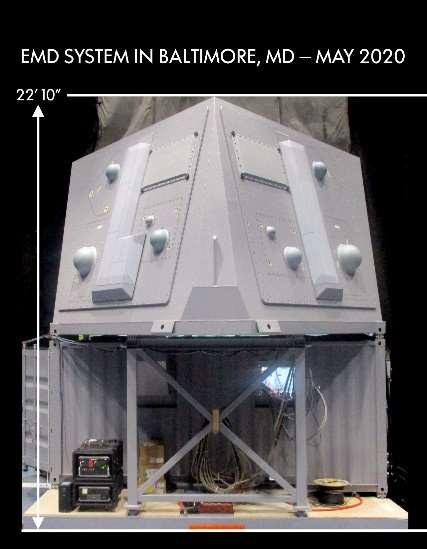
The Navy is locking in more production of the electronic warfare system that warns its surface ships of incoming anti-ship missiles, and the deal could keep Lockheed Martin's Syracuse-area electronic warfare line busy through the end of the decade. Naval Sea Systems Command awarded Lockheed Martin a $209 million firm-fixed-price modification on Sept. 30 to build more AN/SLQ-32(V)6 systems under the Surface Electronic Warfare Improvement Program (SEWIP), GovConWire reported. If the Navy exercises every option, the cumulative value of the contract rises to about $1.71 billion.
The Department of War announced the award Monday. The work runs through September 2029.
What the $209M SEWIP Modification Buys
The AN/SLQ-32(V)6 is the Block II product of SEWIP, the Navy's long-running effort to modernize its shipboard electronic warfare suite. In Defence Blog's words, the Navy "has awarded Lockheed Martin a $209 million contract modification to keep building the AN/SLQ-32(V)6, the electronic warfare system that warns U.S. Navy surface ships of incoming anti-ship missiles and the radars guiding them."
The system works passively: it listens rather than emits. GovConWire describes how the (V)6 "uses passive electronic warfare capabilities to identify potential anti-ship missile threats and alert ship crews." It also supplies data that supports electronic jamming, decoys and other countermeasures.
According to Defence Blog, the (V)6 adds new antennas, a more capable receiver and an open interface to the ship's combat system, along with a high-gain, high-sensitivity sensor developed under an earlier SEWIP phase. It picks up radar and radio signals from enemy ships, aircraft and missiles, identifies them and pinpoints their direction. Crews can operate it manually from a console, or the ship's combat management system can control it automatically.
The AN/SLQ-32 family, which sailors call the "Slick-32," has served as the Navy's main shipboard electronic warfare system for decades. The (V)6 is the receiver-side upgrade; the jamming side belongs to a different program and a different contractor.
Where the Work Happens: Liverpool, N.Y., and Lansdale, Pa.
Lockheed Martin Rotary and Mission Systems will perform 78 percent of the work at its facility in Liverpool, New York, near Syracuse, where the company runs its electronic warfare business. The remaining 22 percent will take place in Lansdale, Pennsylvania. Naval Sea Systems Command in Washington, D.C., is the contracting activity.
The firm-fixed-price structure puts cost risk on Lockheed for the production quantities covered. That fits a system that has been in full-rate production since 2016: the Navy has a long production record for the (V)6 to price against.
How Shipbuilding Money Pays for Most of the (V)6 Order
The Navy obligated the full $209 million at the time of award, drawing on four accounts across two fiscal years:
- $129.5 million (62 percent) in fiscal 2026 shipbuilding and conversion funds
- $58.1 million (28 percent) in fiscal 2026 other procurement funds
- $20.3 million (10 percent) in fiscal 2025 other procurement funds
- $1 million in fiscal 2026 research, development, test and evaluation funds
None of the money expires at the end of the current fiscal year.
The split says something about where these systems are going. Defence Blog notes that shipbuilding and conversion funding typically pays for equipment going onto ships under construction, while other procurement funds are generally used to upgrade ships already in service. With roughly 62 percent of the obligation coming from the shipbuilding account, most of this buy appears tied to new hulls, with the balance supporting backfits on the existing fleet.
How SEWIP Block II Got Here
Lockheed Martin won the SEWIP Block 2 development contract in 2009. The first AN/SLQ-32(V)6 went aboard the destroyer USS Bainbridge (DDG 96) in 2014 for at-sea testing, and the system entered full-rate production in 2016. In January 2020, the Navy awarded a follow-on full-rate production contract that covered the standard (V)6 and smaller variants, including a "Lite" version sized for ships with less room and power to spare.
The program's next step, SEWIP Block 3, adds an electronic attack capability that can actively jam threats. That version, designated AN/SLQ-32(V)7, is built by Northrop Grumman. Lockheed's Block II work and Northrop's Block 3 work run on parallel tracks: the (V)6 senses and warns, the (V)7 jams.
Why the $7.13B NAVSEA Solicitation Matters Next
This modification sits inside a larger competitive picture. GovConWire reports that "The modification follows a February solicitation from Naval Sea Systems Command for a potential $7.13 billion multiple-award contract covering AN/SLQ-32 full-rate production, design agent engineering and system integration."
That solicitation suggests NAVSEA may be looking to move future AN/SLQ-32 production and engineering under a multiple-award vehicle rather than a single incumbent channel. The $1.71 billion potential value of Lockheed's modification would give the Navy production continuity while that larger competition plays out.
Lockheed has also been building out its sustainment role. Also in February, the Navy awarded the company a $249 million contract for SEWIP Block II spares, repairs and engineering services tied to integration of the electronic support anti-ship missile defense system. Between production and sustainment, Lockheed now holds deep positions on both ends of the Block II lifecycle.
What It Means for Contractors
For prime contractors eyeing the $7.13 billion multiple-award opportunity, this modification sets a baseline. Lockheed would enter any AN/SLQ-32 competition with a decade of full-rate (V)6 production experience and a fresh firm-fixed-price production order. Competitors will need to show they can match its cost and schedule performance on a mature, fixed-price product, not just its technical capability.
For the supply chain, the $209 million base and the option structure point to steady demand through September 2029. Suppliers of antennas, receivers, RF components and cabling to Lockheed's Liverpool and Lansdale sites should plan around production continuing at least through that period, with upside if the Navy exercises options toward the $1.71 billion cumulative value.
The funding mix matters for business development, too. Because most of the obligation comes from shipbuilding and conversion dollars, (V)6 deliveries are likely linked to new-construction schedules for surface combatants. Delays in shipyard output can shift when systems are needed, while other procurement funds tie the backfit side to fleet modernization availabilities. Firms that perform shipboard installation, integration and test work should track both pipelines.
Finally, the split between Block II passive sensing (Lockheed) and Block 3 electronic attack (Northrop Grumman) means the surface EW market has two primes with distinct franchises. Subcontractors and small businesses looking for entry points should map their capabilities to one track or the other, and watch how NAVSEA structures task orders if a multiple-award contract is put in place.
