
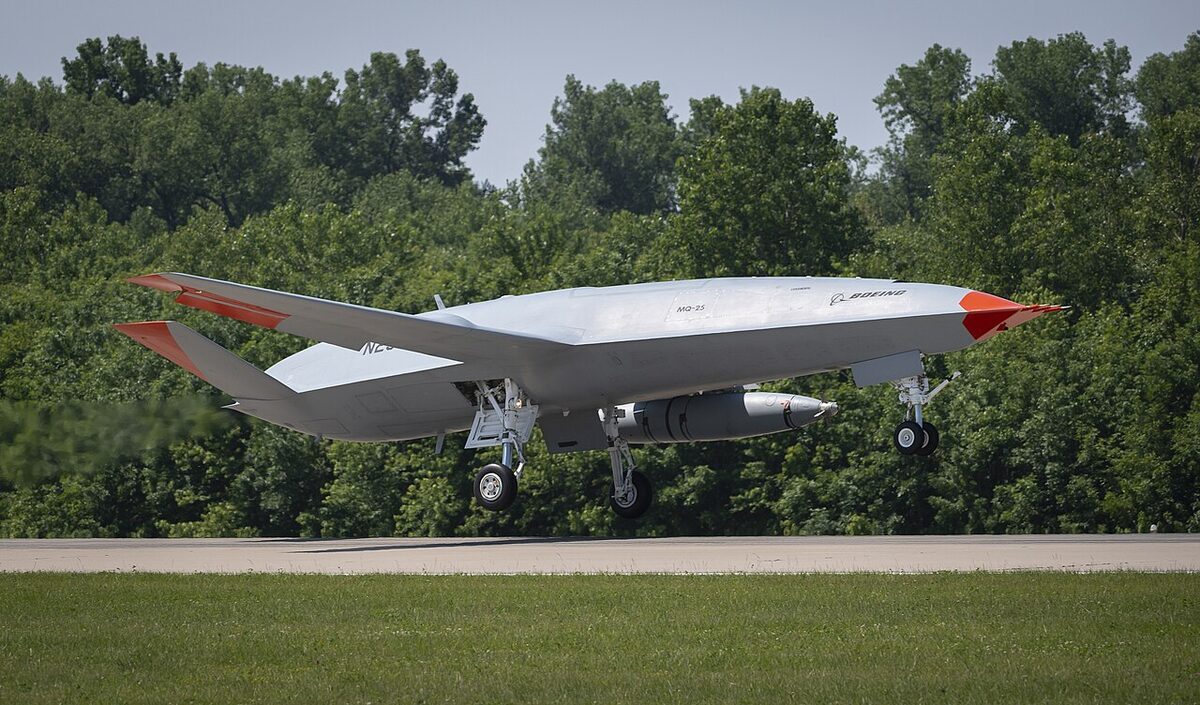
The Navy just locked in its first production order for a robotic tanker meant to free F/A-18 Super Hornet pilots from refueling duty and stretch the carrier air wing's reach. The Boeing Co. received a not-to-exceed $552,053,000 modification to begin building the first three MQ-25A Stingray unmanned aircraft, according to the Department of War's Sept. 14, 2026 daily contracts list.
The award, modification P00017 to Boeing's existing contract N0001922C0048, is an undefinitized, fixed-price-incentive action covering production and delivery of three MQ-25A Stingray Lot One low-rate-initial-production aircraft. It also funds advance acquisition of long-lead components for three additional Lot Two aircraft, locking in parts before final pricing on the follow-on order is settled. Work is spread across Boeing's St. Louis, Missouri facility (56 percent), with smaller shares in Torrance, California; Indianapolis, Indiana; Quebec and Ontario, Canada; McKinney, Texas; and Kansas City, Missouri.
The Navy's own newsroom described the same award in slightly different terms. A war.gov News-Stories item published the following day, headlined "Navy Awards First Production Contract for MQ-25A Stingray," put the figure at "a contract valued at $562 million for initial production of the MQ-25A Stingray carrier-based unmanned aircraft." That figure runs nearly $10 million above the $552,053,000 ceiling listed on the formal contracts page — a gap the Navy has not explained, but one that leaves no doubt about the headline number: Boeing's Stingray line is now in production.
What the $552 Million Modification Buys
The MQ-25A is designed to solve a problem the Navy has talked about for years: strike fighters spending flight hours as gas stations instead of shooters. Today, F/A-18E/F Super Hornets flying the "buddy tanking" role burn airframe life and sortie generation capacity refueling other jets before a carrier air wing can even reach its intended target. The Stingray is built to take over that mission from the flight deck, carrying enough fuel to extend the range of a full strike package and, eventually, taking on intelligence, surveillance and reconnaissance work as a secondary role.
Lot One's three aircraft are the first Stingrays built under a production contract rather than a development one. The Navy cleared MQ-25 for low-rate initial production with a Milestone C decision in May 2026, more than two years after the program's original 2024 target for initial operational capability. Breaking Defense reported at the time that an LRIP Lot 1 contract covering three aircraft was expected "this summer," with priced options for three more Lot 2 aircraft and five Lot 3 aircraft to follow — a trajectory the Sept. 14 award now confirms. That structure gives the Navy contractual leverage to keep the Stingray line moving in predictable increments rather than negotiating each lot from scratch, while still letting the government walk away from later lots if testing surfaces problems.
The modification's use of an undefinitized, fixed-price-incentive structure is itself notable. It lets Boeing start cutting metal on Lot One aircraft before every cost and schedule term is finalized, a common tool the Pentagon uses to avoid delaying production while final pricing details are negotiated. The Navy still caps its exposure with the $552,053,000 not-to-exceed ceiling, meaning Boeing bears the risk of any costs beyond that figure once the contract is definitized.
Why the Navy Wants Unmanned Tankers on the Flight Deck
Navy leadership has framed the program as a range problem as much as a maintenance one. "Unmanned refueling extends our reach against any adversary," Acting Secretary of the Navy Hung Cao said when the program reached Milestone C in May. The sentiment reflects a broader carrier air wing concern: as potential adversaries field longer-range weapons, a carrier's aircraft need to operate — and refuel — farther from the ship than manned tankers can sustainably support without eating into strike capacity.
Boeing has echoed that urgency from the contractor side. "We remain focused on getting this game-changing unmanned aircraft into the hands of the fleet and integrated into the carrier air wing," said Troy Rutherford, Boeing's MQ-25 vice president, after the Milestone C decision. The Lot One award is the first concrete step toward that promise turning into deployed hardware rather than a program office milestone.
A Program That Slipped Five Years Before Reaching Production
The MQ-25's path to this contract has been long. The Navy originally targeted initial operational capability for the Stingray in 2024. That date has since moved to fiscal year 2029, a five-year slip from the original schedule even as the program cleared its engineering and manufacturing development milestones and moved into production testing. The Sept. 14 Lot One award does not compress that timeline on its own, but it does mark the first time government money has flowed into building operational — rather than test and development — airframes.
The advance acquisition funding bundled into the same modification, covering long-lead items for three Lot Two aircraft, is a standard hedge against production gaps: buying forgings, castings and other slow-lead-time components now so a Lot Two order doesn't stall the assembly line waiting on parts. It signals the Navy expects to place that follow-on order rather than pause after Lot One, though the contracts list does not disclose a Lot Two award value or date.
What It Means for Contractors
For Boeing and its MQ-25 supply chain, the Lot One award converts years of engineering and manufacturing development work into an actual production line, with Lot Two long-lead funding already flowing before Lot One aircraft are delivered. Suppliers in St. Louis, Torrance, Indianapolis, and the Canadian sites sharing the 44 percent of work outside St. Louis should expect follow-on solicitations tied to Lot Two and Lot Three as the Navy works through the production ramp Breaking Defense described in May.
For other contractors watching the unmanned carrier aviation market, the award confirms the Navy is committed to fielding MQ-25 as a program of record rather than revisiting the requirement, despite the five-year schedule slip. Companies supplying carrier-deck support equipment, unmanned aircraft sustainment services, or competing ISR payloads should treat FY2029 as the Navy's working IOC date for planning purposes, with Lot Two and Lot Three orders the next milestones to track for entry points into the supply chain. The discrepancy between the contracts list's $552,053,000 figure and the Navy newsroom's $562 million figure is also a reminder to source contract values from the formal award notice rather than secondary Navy communications when the two disagree.
