
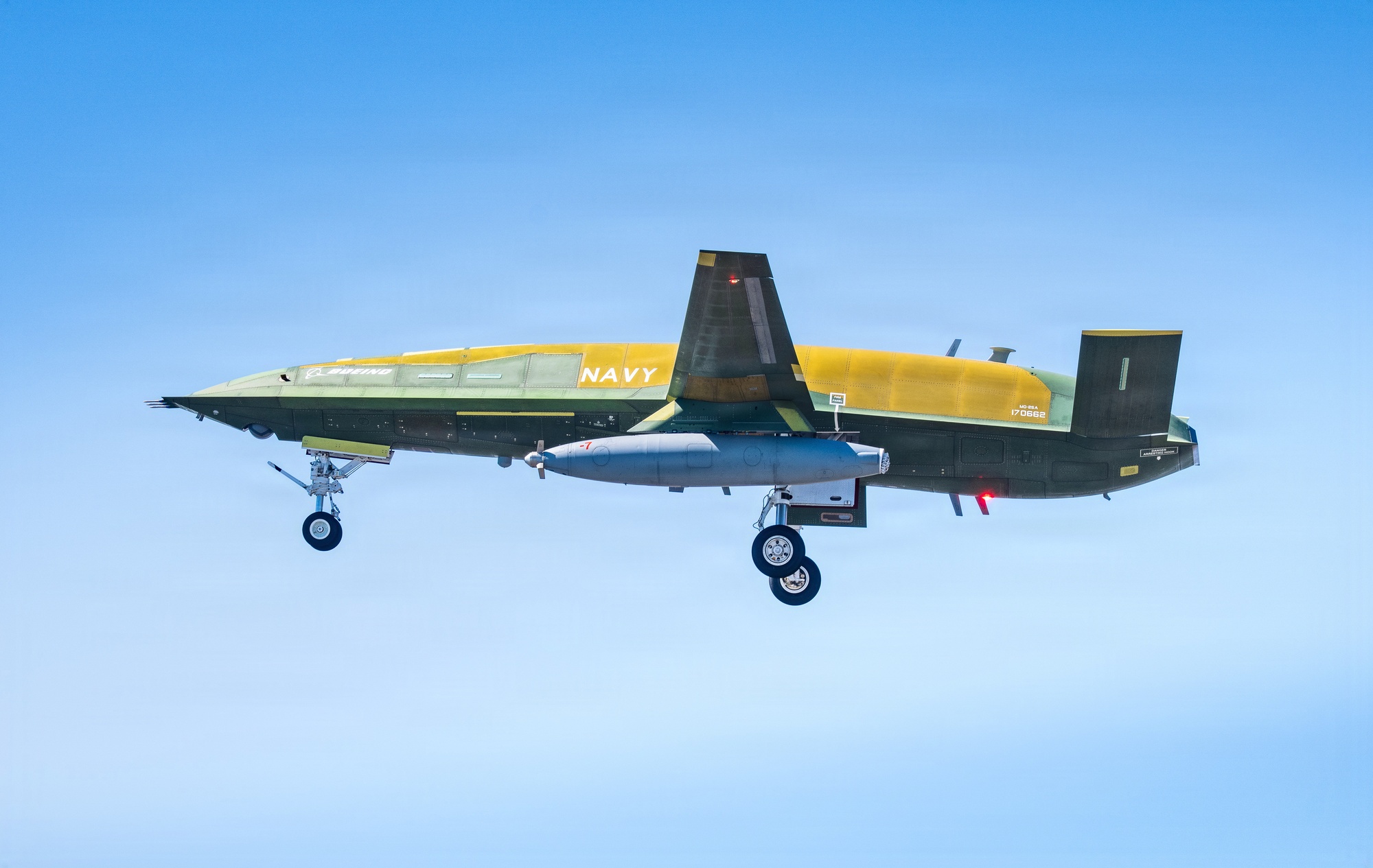
The Navy has committed to building the East Coast's first home for its carrier-based refueling drones. On July 17, 2026, the Defense Department announced that Grunley Construction Co., Inc., of Rockville, Maryland, won a $117,755,087 firm-fixed-price contract to build MQ-25 Aircraft Laydown Facilities at Naval Station Norfolk, Virginia. The award funds the ground infrastructure the Navy needs to base, operate, and maintain the MQ-25A Stingray, the unmanned aerial-refueling aircraft designed to extend the reach of the carrier air wing. It is a MILCON commitment that ties directly to a named program, a named installation, and a construction timeline the Navy has already published.
Background
The MQ-25A Stingray is the Navy's first carrier-based unmanned aircraft built for operational service. Its primary mission is aerial refueling, freeing F/A-18 Super Hornets from tanker duty and extending the strike range of the carrier air wing. Navy leaders have framed the aircraft as an early example of a broader shift, describing the future fight as a mix of unmanned and manned systems operating together from the same flight deck. Getting the drone to sea requires more than the aircraft itself. Shore facilities handle maintenance, control-station operations, parking, and the day-to-day work of a squadron, and those buildings have to exist before the aircraft arrive.
Naval Station Norfolk is set to become the East Coast hub for that mission. The Navy approved a plan for a new squadron to operate and maintain the Stingray at Norfolk, with base construction scheduled to begin in 2026 and continue through 2029. That window lines up precisely with the Grunley contract, which carries an expected completion date of April 2029. Norfolk is expected to host 20 MQ-25 drones by 2035, with the first East Coast aircraft arriving in 2031. The squadron will add an estimated 600 to 700 sailors to the installation. The Navy determined that no environmental impact statement was necessary for the work.
Key Details
The contract, N40085-26-C-0017, is a firm-fixed-price award for construction services covering the MQ-25 Aircraft Laydown Facilities. Work will be performed at Naval Station Norfolk and is expected to finish by April 2029. Naval Facilities Engineering Systems Command Mid-Atlantic in Norfolk is the contracting activity, keeping the buy inside the same regional command that will manage the installation the facilities serve.
The Navy is funding the project incrementally rather than all at once. At award, $65,817,578 in fiscal 2024 and fiscal 2026 military construction (Navy) funds was obligated to cover the first increment, leaving the balance to be obligated as the project advances. That structure is common on multi-year military construction jobs, where the government commits money against annual appropriations as the work proceeds rather than locking up the full ceiling on day one.
The award was competitive. NAVFAC procured it through the SAM.gov website and received four offers before selecting Grunley. Four offers on a construction package this size is a healthy field, and it signals that the Navy had real competition on price and approach rather than a single qualified bidder.
Grunley is a Rockville-based construction firm with a long record of federal building work across the National Capital Region and beyond. The Laydown Facilities award places the company at the center of one of the Navy's higher-profile shore-infrastructure efforts, tied directly to a new and closely watched unmanned aviation program. The term "laydown" refers to the full footprint an aviation unit needs on the ground, and the phrase signals that the Norfolk work is meant to give the incoming squadron a complete operating base rather than a single building.
What It Means for Contractors
The Stingray's arrival on the East Coast is a construction story before it is a flight story, and that sequencing is the opportunity. Standing up a squadron at Norfolk means hangars, maintenance space, control-station facilities, utilities, paving, and the supporting trades that follow a MILCON prime onto a large job site. The Grunley award is the anchor, but a package this size pulls a long tail of subcontracts, material supply, and specialty work behind it. Firms in the Hampton Roads construction market and beyond have a defined, multi-year build to pursue through 2029, and the prime's subcontracting plan becomes the near-term entry point for small and mid-tier trades looking to attach to the program.
The funding structure is worth reading closely. Incremental obligation means the government has committed roughly $66 million of the $117.8 million ceiling so far and will release the rest against future appropriations. For subcontractors and suppliers, that reinforces the value of watching the annual MILCON (Navy) budget lines that feed the remaining increments, because the pace of the money shapes the pace of the work. A slip in a future appropriation can stretch a schedule even when the ceiling is already on contract, so cash-flow planning on a job like this tracks the federal budget cycle as much as the build sequence itself.
More broadly, the award is a marker of where Navy infrastructure spending is heading. Unmanned carrier aviation is not a concept study anymore; it is generating physical requirements at named installations on published timelines. Norfolk's build runs through 2029, first aircraft land in 2031, and the drone count climbs toward 20 by 2035. Each of those milestones represents follow-on demand, from additional facilities to sustainment and support services, at a base that is about to add several hundred sailors. Contractors who track program-driven MILCON, rather than waiting for the flying units to show up, get the earliest read on where the next requirements will land. The competitive, four-offer result on this package also confirms the Navy is running these buys as open competitions, which keeps the door open for qualified firms that position early. For a program still years from its first East Coast flight, the shore infrastructure is where the money is moving today, and Norfolk is where the trail begins.
