
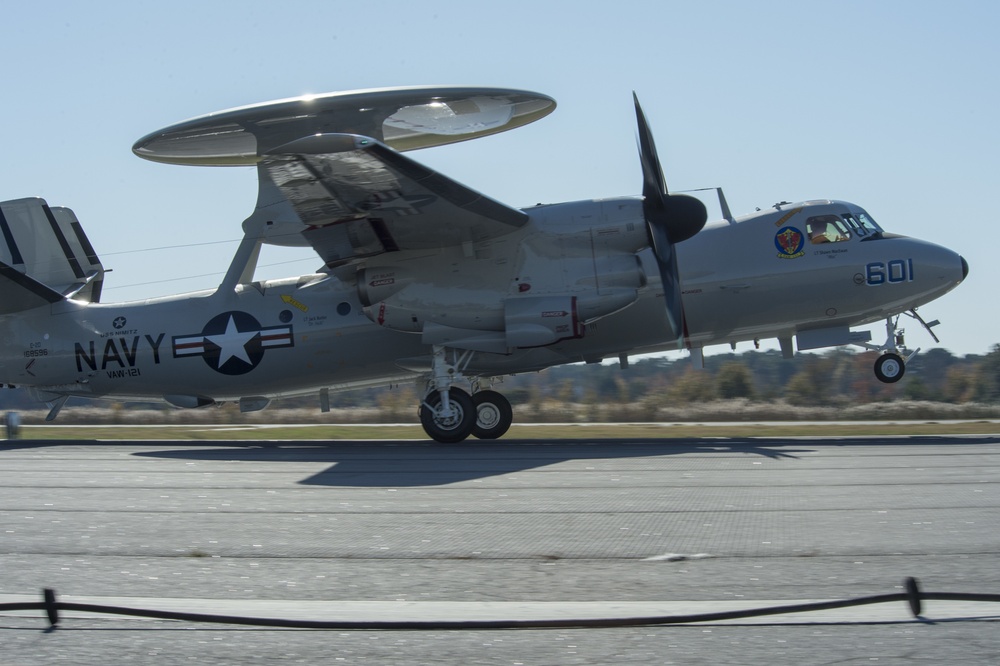
The Navy has awarded Northrop Grumman Systems Corp. a $21,081,363 contract modification to integrate a NATO-standard anti-jam radio into the E-2D Advanced Hawkeye, the carrier-based airborne early warning aircraft that serves as the fleet's eyes in contested airspace.
Background
The Naval Air Systems Command, based at Patuxent River, Maryland, announced the award on July 28, 2026, as part of the Department of War's daily contract listing. The work goes to Northrop Grumman's Melbourne, Florida facility, where the E-2D program is based and where the company serves as the aircraft's prime avionics integrator.
The order, issued as a combined cost-plus-fixed-fee and firm-fixed-price action against a previously established basic ordering agreement, funds integration of the Second Generation Anti-jam Tactical Ultra High Frequency Radio for NATO, known by the acronym SATURN, into the E-2D's avionics. SATURN is intended to replace the aging HAVE QUICK anti-jam radio system that has equipped U.S. and allied military aircraft for decades. According to trade publication Military Aerospace, SATURN is designed to "improve resistance to electronic attack while enhancing secure interoperability among allied forces," a capability the Navy has prioritized as it expects to operate alongside NATO partners in increasingly contested electromagnetic environments.
HAVE QUICK dates to the 1980s and has been the standard anti-jam UHF waveform across NATO air forces for decades. As adversary electronic-warfare capabilities have advanced, NATO members have coordinated on SATURN as the common successor waveform, meaning aircraft across the alliance are working through related hardware and software upgrades on their own timelines. The E-2D upgrade places the Navy's airborne early warning fleet on that same modernization track rather than leaving it on a legacy waveform while fighters and other coalition aircraft move to the new standard.
The E-2D Advanced Hawkeye is the Navy's primary carrier-based command-and-control aircraft, tracking airborne and surface threats and directing fighters and missile-defense assets from its radar picture. Keeping the aircraft's communications resistant to jamming is a standing requirement as adversaries invest in electronic-warfare capabilities meant to blind or isolate U.S. and allied forces. Because the E-2D functions as a networking hub for the carrier air wing, a radio downgrade or communications gap on that single aircraft type could have an outsized effect on the wider strike group's situational awareness.
Key Details
The $21,081,363 award covers non-recurring engineering work, including software development, systems engineering, integration and test activities, and modifications to the E-2D's Avionics Flight Management Computer, needed to fold the SATURN radio into the aircraft's existing systems. The contract also funds production and delivery of 94 SATURN modification kits that will be installed across the E-2D fleet.
Work is split across four locations. The bulk of the effort, 99.1 percent, will happen at Northrop Grumman's Melbourne, Florida site. The remainder is spread across West Chester, Ohio (0.6 percent); Ronkonkoma, New York (0.2 percent); and Laval, Quebec, Canada (0.1 percent), reflecting the supplier network that feeds the E-2D avionics line. The Navy expects the work to be complete by April 2028.
The Navy awarded the modification without competition, issuing it under a previously established basic ordering agreement with Northrop Grumman rather than running a new competitive solicitation. That is standard practice for engineering changes to an aircraft already under a single manufacturer's production and sustainment umbrella, since the E-2D's airframe, avionics architecture, and integration knowledge sit almost entirely with Northrop Grumman. The Navy is funding the work with fiscal year 2026 aircraft procurement money, with the full $21,081,363 obligated at the time of award.
The award appeared in the same July 28 Department of War contracts release that included a $56,789,419 Sikorsky modification for UH-60M Black Hawk advance procurement and a $213 million Boeing award to reconfigure P-8A Poseidon maritime patrol aircraft, underscoring how a single day's contracting activity spans programs across the Navy and Army aviation portfolios.
The scope of the modification is narrow by design: it covers engineering, software, and the flight management computer changes needed to make SATURN function inside the E-2D's existing avionics suite, plus the kits themselves, rather than a broader aircraft upgrade. That keeps the dollar figure modest relative to major E-2D production or sustainment contracts, but it is a necessary step before the fleet can retire HAVE QUICK-era hardware on this aircraft type.
What It Means for Contractors
The award is a reminder that the Navy's electronic-warfare modernization push extends well beyond flagship radar and missile programs into the communications equipment that keeps existing aircraft networked and jam-resistant. SATURN integration is happening fleet-wide, not just on new-build aircraft, which means the Navy is treating anti-jam radio upgrades as a baseline sustainment requirement for platforms already in service.
For Northrop Grumman, the modification extends the company's role as the integrator for E-2D avionics changes, work that flows through the existing basic ordering agreement rather than new competitions. Subcontractors and suppliers tied to the Ohio, New York, and Quebec work locations stand to see incremental follow-on orders as the 94-kit production run proceeds toward the April 2028 completion date, even though those sites account for less than one percent of the total award value between them.
More broadly, the award illustrates a contracting pattern worth watching: platform prime contractors capturing non-recurring engineering funds tied to a single subsystem upgrade, in this case an anti-jam radio, rather than a full aircraft modernization. Smaller firms that supply radio hardware, secure-communications components, or software integration services for legacy avionics buses may find opportunities as subcontractors on similar SATURN integration efforts across other Navy and NATO-interoperable aircraft, since the underlying driver, replacing HAVE QUICK-era anti-jam radios fleet-wide, is not unique to the E-2D.
Companies tracking NAVAIR's basic ordering agreements should note that awards like this one move quickly once a BOA is in place, without a public solicitation window. Firms that want visibility into follow-on SATURN kit production or related avionics integration work will need to build relationships with the prime, or with Patuxent River program offices directly, well before funding is obligated.
The April 2028 completion date also gives contractors a rough timeline for when the bulk of the 94-kit installation effort will wrap, which is useful for planning any downstream sustainment, testing, or spares work tied to the newly integrated radios once they reach the fleet.
