
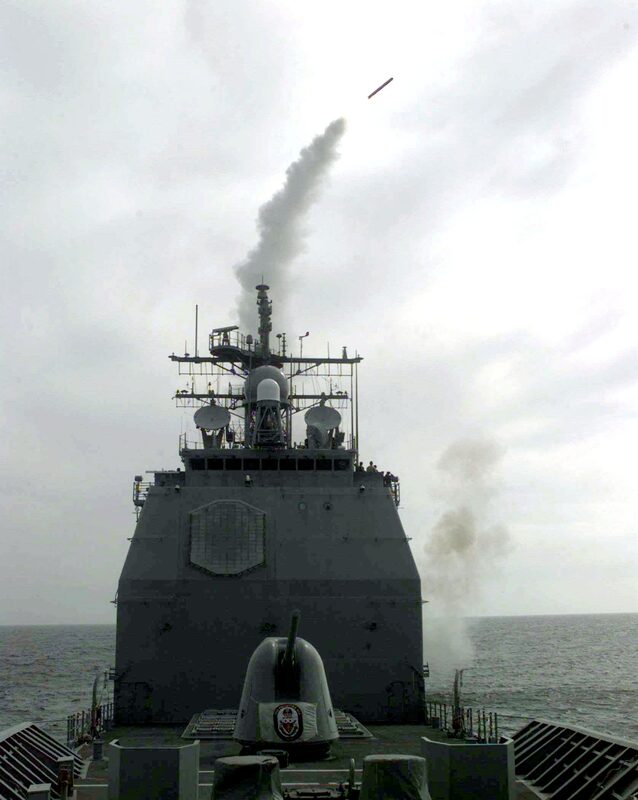
The U.S. Navy has awarded Raytheon, an RTX business, a $22.9 billion, seven-year contract to accelerate production of the Tomahawk cruise missile, the Department of War and RTX announced August 17, 2026. The award targets output of more than 1,000 Tomahawks a year, a sharp jump from current annual production, and is managed under the Navy's Portfolio Acquisition Executive (PAE) Munitions organization.
Background
Tomahawk has served as the Navy's primary long-range land-attack cruise missile for decades, launched from surface ships and submarines to strike targets hundreds of miles inland without exposing crews to enemy air defenses. That standoff capability lets commanders deliver precision effects against high-value targets while preserving expensive strike platforms for follow-on missions, a reach that has made Tomahawk a central tool for projecting distributed maritime firepower in theaters such as the Indo-Pacific.
Demand for the weapon accelerated after Operation Epic Fury, the U.S. military's campaign against Iran that ran from February 28 to early April 2026. Over 38 days, the Joint Force struck more than 13,000 targets using air, maritime, cyber and space capabilities, with Tomahawks employed from the operation's opening phase onward. The pace of that campaign exposed how quickly a high-intensity fight can draw down precision-guided munitions inventories, underscoring that a strike platform's combat power depends not only on its sensors and survivability but on how many weapons remain in its magazine and how fast industry can restock them. That lesson pushed the Department of War to press industry for faster, larger production runs.
RTX had already begun ramping output ahead of the new award, delivering three times more Tomahawks in the first half of 2026 than in the first half of 2025. The company says it is now investing further in facilities, workforce and a network of hundreds of small and mid-tier U.S. suppliers to sustain that pace. The August 17 contract locks in Navy demand over a seven-year horizon, giving Raytheon and its supplier base the order visibility needed to justify further capital spending on tooling, testing capacity and hiring.
Key Details
The $22.9 billion contract was awarded by the U.S. Navy to Raytheon, an RTX business, and is structured to run seven years. It targets sustained production of more than 1,000 Tomahawk missiles annually, up from RTX's current delivery rate, according to the joint announcement from the Department of War and RTX.
Under Secretary of War for Acquisition and Sustainment Michael P. Duffey framed the award as a direct response to a Department-wide call for expanded munitions output. "The Department called upon industry to expand munitions production, and RTX has answered that call," Duffey said. "This Tomahawk award increases our ability to equip the Joint Force, ensuring our Warfighters never face a fair fight."
Acting Secretary of the Navy Hung Cao called the deal a "landmark $22.9 billion investment" that will "accelerate Tomahawk missile delivery to our warfighters at unprecedented speed." Cao said the Department is "utilizing every available tool" to expand the munitions industrial base's capacity to meet the demands of current operations.
The contract is administered through PAE Munitions, a Department of the Navy organization that unifies weapons programs and aligns the weapons industrial base to accelerate production, expand capacity and equip the fleet. The Department of War says the award advances its Acquisition Transformation Strategy, which is intended to reduce procurement lead times and accelerate delivery of critical weapons systems. Officials also cast the seven-year term as a stability measure, giving RTX and its supplier network the predictable demand needed to expand their workforce, increase manufacturing throughput and fortify supply chains, rather than scaling up production only to face a demand cliff later.
RTX says it is putting the new order to work by expanding across its Tomahawk supply chain, adding investment in facilities, technology and skilled labor while coordinating growth across propulsion, guidance electronics, testing and other lower-tier suppliers needed to hit the 1,000-missile-a-year target. Raytheon President Phil Jasper has pointed to Tomahawk's role as the Navy's most important strike weapon, citing its ability to hold targets hundreds of miles away at risk without putting sailors in harm's way.
What It Means for Contractors
The award is the latest signal that the Department of War is willing to commit multi-year, multi-billion-dollar funding to lock in munitions production capacity rather than buying missiles year to year. For prime contractors in the strike-weapons sector, the seven-year structure offers a template: sustained demand signals of this size let a prime justify capital investment in new tooling, expanded test infrastructure and permanent hiring, rather than relying on incremental annual buys that make long-term capacity planning difficult.
The contract's emphasis on supplier-base expansion also creates a direct opening for small and mid-tier manufacturers. RTX has already stated it is investing in hundreds of U.S. suppliers to support the Tomahawk ramp, meaning subcontractors in propulsion, guidance electronics and specialized testing could see new subcontracting opportunities as Raytheon scales toward the 1,000-missile-a-year target. Companies in those supply chains should watch for RTX subcontracting announcements and supplier-day events tied to the award.
PAE Munitions' role as the contracting and integration authority is also worth noting for firms tracking Navy weapons acquisition. The organization unifies munitions programs and aligns the weapons industrial base under a single acquisition structure, and its management of this award suggests it will be a recurring point of contact for future large-scale munitions production contracts. Contractors pursuing Navy strike-weapons work should track PAE Munitions announcements as a growing channel for future acquisition activity.
Finally, the award reinforces that the Department is treating industrial-base capacity itself as a deterrence asset, not just a procurement line item. The Department of War explicitly tied the contract's stability to workforce expansion and supply-chain resilience under the Acquisition Transformation Strategy. Contractors positioning for future munitions work should expect similar long-duration, capacity-focused awards in other precision-strike programs as the Department continues responding to the consumption rates demonstrated during Operation Epic Fury.
