
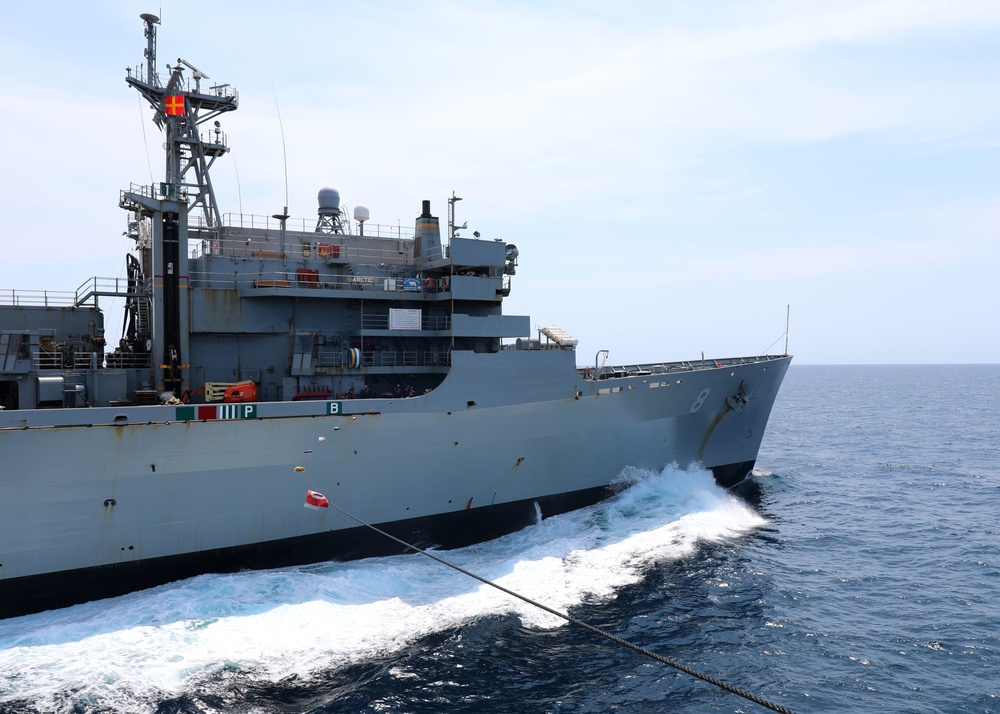
The Navy has awarded StratasCorp Technologies a $99,000,000 sole-source bridge contract to keep command, control, communications and computers support flowing to Military Sealift Command's fleet while the service works out a longer-term deal.
Background
Military Sealift Command runs the Navy's fleet of support and logistics ships, and those vessels depend on C4 systems to stay connected to shore-based operations centers and to each other while at sea. Stratascor LLC, doing business as StratasCorp Technologies and based in Chesapeake, Virginia, has been the incumbent contractor providing C4 afloat operations and sustainment support for that network, including the MSC Network Operations Centers that monitor and manage the fleet's connectivity around the clock.
Rather than let that support lapse or run a fresh competition on a compressed timeline, the Navy issued a sole-source bridge contract directly to StratasCorp. According to the award notice, proposals were solicited directly from the incumbent contractor, with no other companies invited to bid. Bridge contracts of this kind are typically used to maintain continuity of an existing service while an agency finalizes a follow-on acquisition strategy, whether that means a full and open recompete, a small business set-aside, or another sole-source vehicle.
The timing of the award matters. Performance under the bridge began June 30, 2026, the day before the contract was publicly announced, indicating the Navy moved to keep the existing support arrangement in place without any gap between the prior period of performance and the new one. That kind of same-day or next-day continuity is a hallmark of bridge contracts issued specifically to avoid a lapse in an operationally sensitive service, as opposed to a routine follow-on award negotiated well ahead of an expiration date.
Key Details
The contract, numbered N3220526D1012, is an indefinite-delivery/indefinite-quantity, firm-fixed-price vehicle with a ceiling value of $99,000,000. It covers continued C4 afloat operations and sustainment support for Military Sealift Command's fleet and for the MSC Network Operations Centers that keep those ships linked into Navy communications infrastructure.
Work under the contract is performed worldwide, reflecting the global reach of Military Sealift Command's cargo, fuel, and support vessels. Performance began June 30, 2026, and the contract runs through Dec. 30, 2027, giving the Navy roughly 18 months of C4 support coverage from StratasCorp. Military Sealift Command, headquartered in Norfolk, Virginia, is the contracting activity responsible for administering the award.
The Navy's own procurement notice designated this a Sole Source Bridge, a specific label the service uses to distinguish awards made without competition to preserve a service that would otherwise be interrupted. That designation means the Navy did not solicit or evaluate proposals from any company other than StratasCorp before making the award, a departure from the open competitions that produced other MSC-related awards in the same batch of contract announcements, including the competitively procured overhaul and dry-docking contract awarded to Alabama Shipyard for the cargo ship USNS William McLean.
The award notice put the ceiling value at $99,000,000, representing the maximum the Navy can obligate under this specific bridge vehicle before it expires at the end of December 2027. Because the vehicle is structured as an IDIQ, the Navy will issue individual task or delivery orders against the ceiling as specific C4 support needs arise across the Sealift Command fleet, rather than obligating the full amount at once.
What It Means for Contractors
Bridge contracts like this one signal that an agency has an active requirement it intends to keep filling without interruption, and that the incumbent is positioned to continue delivering while the government sorts out its next move. For StratasCorp, the award extends a revenue stream tied to Military Sealift Command's C4 infrastructure through the end of 2027, giving the company an extended runway on a program it already holds without having to fend off new competitors in the near term.
For other contractors watching the Military Sealift Command C4 space, the bridge contract is also a signal of what is likely coming next. Agencies do not typically issue sole-source bridges indefinitely; they use them to buy time while a recompete, a new IDIQ vehicle, or a different acquisition approach takes shape. Companies with C4 afloat support capabilities, network operations center expertise, or maritime communications integration experience should treat the Dec. 30, 2027 end date on this bridge as a rough marker for when the Navy will need to have its next-phase acquisition strategy in place, whether that means a full and open competition, a small business set-aside, or another vehicle open to non-incumbents.
The award also illustrates how the Navy handles continuity risk on infrastructure that cannot go dark, even briefly. Military Sealift Command's ships operate globally and rely on C4 connectivity for both operational coordination and administrative functions, so any gap in sustainment support carries operational consequences beyond a typical back-office IT contract. Contractors bidding on future Navy afloat communications work should expect similar continuity mechanisms, sole-source bridges, short-term extensions, or interim task orders, whenever an incumbent's contract nears expiration before a follow-on competition is ready to award. That pattern also means incumbents on similar afloat C4 or network operations contracts have a plausible path to a bridge award of their own if their agency customer needs more time to finalize a recompete.
The firm-fixed-price structure of the bridge is also worth noting for teams pricing similar work. Rather than a cost-reimbursement arrangement that adjusts for actual expenses, the Navy locked in a fixed ceiling of $99,000,000 across the roughly 18-month period, putting the burden of cost control on StratasCorp for the duration of the bridge. Firms competing for the eventual follow-on award should expect the Navy to carry that same firm-fixed-price preference forward, particularly for recurring sustainment work where the government has historical cost data from the incumbent's performance to benchmark future proposals against.
Finally, the worldwide performance location underscores that Military Sealift Command's C4 sustainment requirements are not confined to a single homeport or region. Companies without an existing global service and support footprint may find that scale, rather than technical capability alone, is the harder barrier to competing for the work once the bridge period ends and the Navy moves toward its next acquisition decision.
