
The Army just locked in a single company to supply precision-guided artillery fuzes through 2031, and it didn't have a choice about who — only one contractor showed up to bid. Northrop Grumman Systems Corp. was awarded an $862,848,000 firm-fixed-price indefinite-delivery/indefinite-quantity contract to manufacture, inspect, test, package and deliver M1156 Precision Guidance Kits and their variants, according to the Department of War's Sept. 3, 2026 daily contracts announcement. The Minneapolis, Minnesota-based company submitted the only proposal after the Army solicited bids over the internet.
The IDIQ runs through an estimated completion date of Sept. 3, 2031 — a five-year ordering period during which the Army Contracting Command in Newark, New Jersey, will issue individual delivery orders against the ceiling. Work locations and funding will be determined order by order, meaning the headline figure represents a maximum spend rather than money obligated up front. The contract is identified as W15QKN-26-D-A072. That two-step structure — a competitively solicited ceiling contract followed by individually negotiated delivery orders — is standard practice for high-volume, long-running production programs, and it is what lets the Army keep buying M1156 kits for five years without re-competing the underlying vehicle every time it needs more.
Northrop Grumman Was the Only Bidder on the Solicitation
The Department of War's notice to industry is direct about what happened: the contract went to Northrop Grumman "to manufacture, inspect, test, package and deliver M1156 precision guidance kits and variants," and, in the notice's own words, "Bids were solicited via the internet with one received." No other manufacturer chose to compete for a production vehicle that could be worth more than $860 million over five years.
Trade coverage of the award confirmed the same detail: bids were solicited online, and only one came in. A single-bid outcome on a contract this size is notable on its own — it leaves the Army without a competitive price check on an item it buys by the thousands, and it leaves Northrop Grumman as the sole producer under this vehicle for its full five-year run. Because the award is an IDIQ rather than a lump-sum purchase, the Army retains flexibility to size individual orders to its actual ammunition needs, but it will be negotiating each of those orders with a sole source for the life of the vehicle. That also means the $862.8 million figure is a ceiling, not a spending commitment: it caps what the government could order under this vehicle over five years, and the actual amount obligated will only be visible as individual delivery orders are announced.
How the M1156 Kit Turns a Standard Shell Into a Precision Round
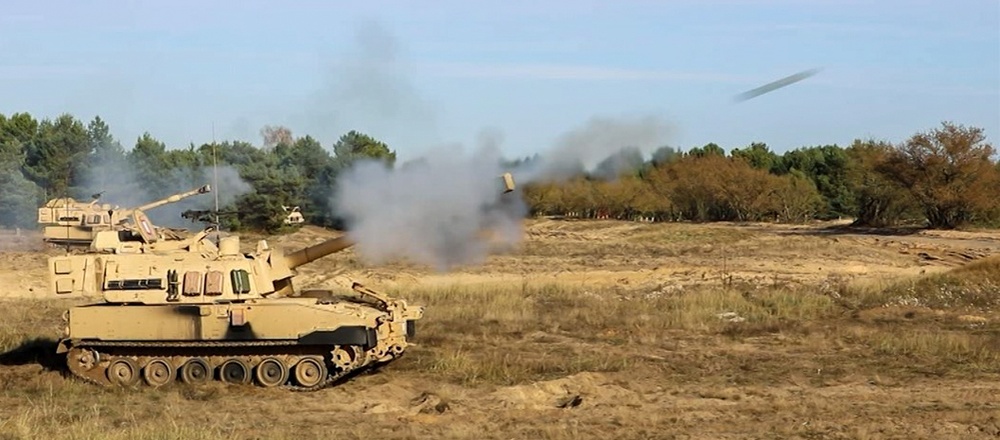
The M1156 Precision Guidance Kit is not a new shell — it's a fuze that screws onto the nose of a standard 155mm artillery projectile. GovConWire, which covered the award, described the kit as "a GPS-based guidance kit with fuzing functions designed for use with the Army's existing stockpile of M795 and M549A1 high-explosive 155mm projectiles." In practice, a gun crew loads what is otherwise an unguided artillery shell, and the kit's onboard guidance "corrects the ballistic trajectory of a projectile in flight to reduce delivery errors, improving accuracy and cutting down the number of rounds needed to complete a fire mission."
The kit is built to work from howitzers the Army already operates. GovConWire reported that it is compatible with the M109A7 Paladin Integrated Management and M109A6 Paladin self-propelled howitzers, as well as the M777A2 lightweight towed howitzer, and that it supports both point-detonation and height-of-burst fuze modes — meaning the same kit can be set to explode on impact or above the target depending on the mission. Because it retrofits a shell the Army already has in inventory rather than requiring a purpose-built guided round, a kit like the PGK is generally a less expensive way to add GPS accuracy to a battery's fires than fielding an entirely new precision projectile from scratch would be.
Because the kit lets a battery upgrade rounds it already has on hand, the PGK has become the Army's higher-volume precision option rather than a niche add-on: a unit can screw on a guidance kit and get a meaningfully tighter circular error probable without waiting for a fully guided projectile to be manufactured, shipped and issued. The five-year ordering period covered by this IDIQ gives the Army room to keep buying at that volume as existing stocks are drawn down and replenished, rather than negotiating a new production contract each time inventory runs low.
What It Means for Contractors
For Northrop Grumman, the award provides five years of guaranteed access to Army M1156 orders without a competing bidder to undercut price on any individual delivery order. For everyone else in the artillery-ammunition supply chain, the single-bid result is the more instructive data point. A contract this large drawing exactly one bid suggests either that the qualification bar for producing a fielded GPS fuze to the Army's specifications is high enough to deter new entrants, or that potential competitors judged Northrop Grumman's cost and schedule position too entrenched to challenge profitably. Either reading points to the same practical outcome: subcontractors and component suppliers looking for a way into the PGK program are more likely to find an opening as a second-tier supplier to Northrop Grumman than as a prime competing for the next recompete. And because the vehicle is firm-fixed-price rather than cost-reimbursable, Northrop Grumman — not the Army — carries the risk if its production costs rise over the life of the five-year ordering period, which sharpens the incentive to lock in efficient manufacturing now rather than counting on price adjustments later.
The order-by-order structure also matters for planning purposes. Because funding and work locations are set at the delivery-order level rather than fixed at contract award, companies tracking this program should watch for individual task-order announcements over the life of the five-year period rather than treating the $862.8 million ceiling as money already committed. For program offices and other services eyeing similar precision-guidance retrofit kits for their own unguided munitions stocks, the M1156 award is a working example of how the Army has chosen to structure a high-volume, single-source production vehicle: firm-fixed-price, IDIQ, five-year ordering period, with competition concentrated at the original solicitation rather than reopened at each order. Companies that sat out this solicitation now have a five-year wait before the vehicle recompetes, unless the Army opens a separate, parallel buy for additional PGK capacity in the meantime.
