
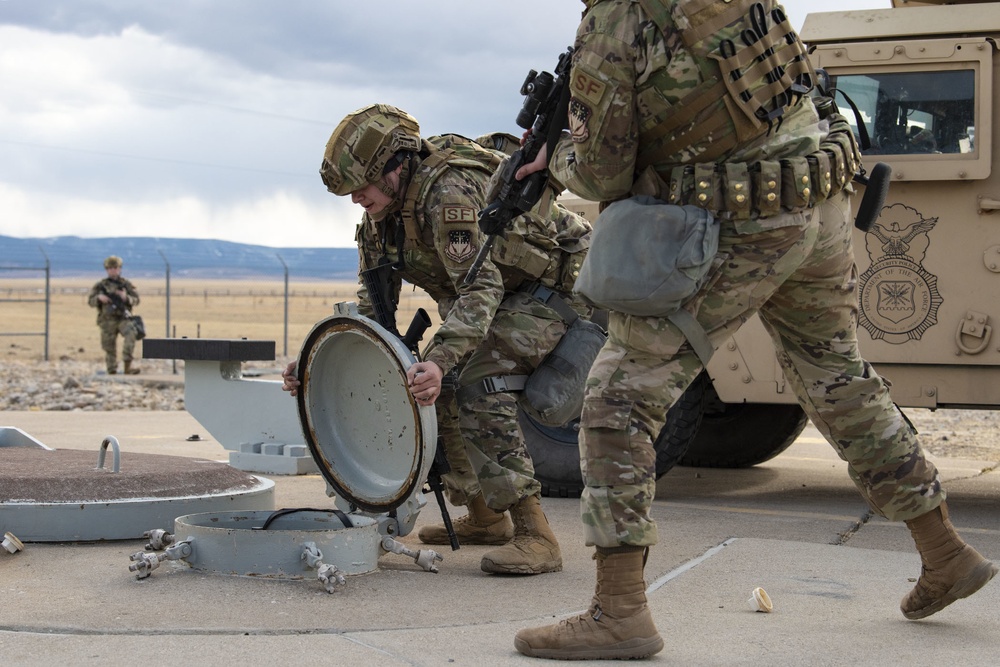
Security forces guarding four Minuteman III missile wings will keep watching over their fields through cameras and sensors instead of driving out to every alarm, after the Air Force awarded Northrop Grumman Systems Corp. an $86,069,000 task order to keep that camera network running through 2031.
The task order, FA8214-26-F-B017, was issued Aug. 31, 2026, under Northrop Grumman's existing ground subsystem support contract 2.0 (FA8214-21-D-0002) for Remote Visual Assessment program support. The Air Force Nuclear Weapons Center at Hill Air Force Base, Utah, made the award sole-source, obligating $15,240,085 in fiscal 2026 procurement funds up front against a period of performance running to September 2031.
The gap between the $86,069,000 task order value and the $15,240,085 obligated at signing is standard for a services task order of this length: the larger figure is the ceiling the Air Force can spend under this specific order, while the smaller figure funds only the work ordered so far. Additional funds will follow as the Nuclear Weapons Center exercises more of the order over its five-year run. The Aug. 31 order is the latest task order issued against the broader ground subsystem support contract 2.0 vehicle, an indefinite-delivery/indefinite-quantity contract the Air Force uses to buy sustainment work over time rather than negotiate a new contract every time RVA needs more support.
Why the Air Force Needs Eyes at Four Minuteman III Wings
RVA is a ground-based network of cameras and sensors installed across missile-field security perimeters, giving security forces a way to visually confirm what tripped an alarm without dispatching a response team. Work under the new task order covers all four active Minuteman III wings: Hill AFB itself, F.E. Warren AFB in Wyoming, Malmstrom AFB in Montana, and Minot AFB in North Dakota, the four bases that together operate the nation's deployed Minuteman III intercontinental ballistic missiles.
Before systems like RVA existed, that verification job fell to security forces driving out to the site in person. Lt. Col. Eric Green, an Air Force Global Strike Command Sentinel program integration officer, described the old process to Air & Space Forces Magazine: "if the alarm goes off, you virtually have to go out and inspect it, even if it's a rabbit or a tumbleweed." Cameras that can confirm a false alarm from a control center save the miles of driving, often on gravel roads spread across missile-field real estate, that a human response would otherwise require.
Inside the $86 Million Remote Visual Assessment Task Order
The Department of War's contract notice describes the scope in a single sentence: "This task order provides for program management, maintenance, sustaining engineering, and support services for the RVA program." That language covers the unglamorous but essential work of keeping an already-fielded security system running, replacing failed cameras and sensors, patching software, and engineering fixes as parts age out, rather than building something new.
The Air Force again went sole-source, meaning it did not open the work to competing bids. Sole-source awards on an established program typically reflect the practical reality that only the incumbent contractor holds the technical data, spare-parts pipeline, and system knowledge to sustain equipment already installed across a live nuclear security network. Northrop Grumman, based in Riverdale, Utah, has performed the underlying ground subsystem support contract for years, and Hill AFB, the same base hosting one of the four missile wings covered by this order, is also home to the Nuclear Weapons Center that manages the contract.
How RVA Fits the Sentinel-Era Security Overhaul
The RVA award lands alongside a broader rebuild of missile-field physical security as the Air Force prepares the fields for the incoming Sentinel ICBM, whose initial operational capability is expected between April and June 2030. The service has been replacing the copper Hardened Intersite Cable System that links launch facilities to launch control centers with fiber optic cable, and consolidating F.E. Warren's launch control centers from 15 down to eight. None of that construction eliminates the need for RVA in the meantime: Minuteman III remains on alert at all four wings until Sentinel arrives, which means the cameras watching those fields have to keep working for years of overlap between the old missile and the new one.
Air Force officials have framed the fiber and camera investments as pieces of the same push toward a more networked missile field. Lt. Col. Raymundo Vann told Air & Space Forces Magazine the upgrades are meant to deliver "more interconnectivity and more operational oversight" across the fields. A camera network that already lets responders rule out false alarms remotely becomes more valuable, not less, as the Air Force adds bandwidth and centralizes control over a larger stretch of missile-field infrastructure heading into the Sentinel transition.
What It Means for Contractors
The award is a reminder that nuclear-security sustainment work, once a system is fielded, tends to stay with the contractor that built or has long maintained it. Northrop Grumman's position on RVA, like its position on the broader ground subsystem support contract, gives it a five-year revenue stream through 2031 with limited competitive exposure, the kind of durable, non-competed workload that defense primes prize for its predictability over any single new-start program. Sole-source awards like this one rarely draw a protest, because the technical case for keeping the incumbent is straightforward: only Northrop Grumman has the design data, spare-parts pipeline, and field history to touch a camera and sensor network already wired into an active nuclear security posture.
For smaller firms, the opportunity sits one layer down. Northrop Grumman will need subcontractors for maintenance, engineering, and support labor spread across four geographically separate bases in Utah, Wyoming, Montana, and North Dakota. Companies with a presence near any of those wings, or with camera, sensor, and physical-security-system integration experience, are a more realistic entry point than trying to unseat the prime on a sole-source, already-fielded program. And as the Air Force layers fiber-optic replacement and launch-control consolidation on top of RVA ahead of Sentinel, contractors who can show they understand how the camera network ties into the rest of the missile-field security architecture will have an edge when the Nuclear Weapons Center issues its next round of task orders.
