
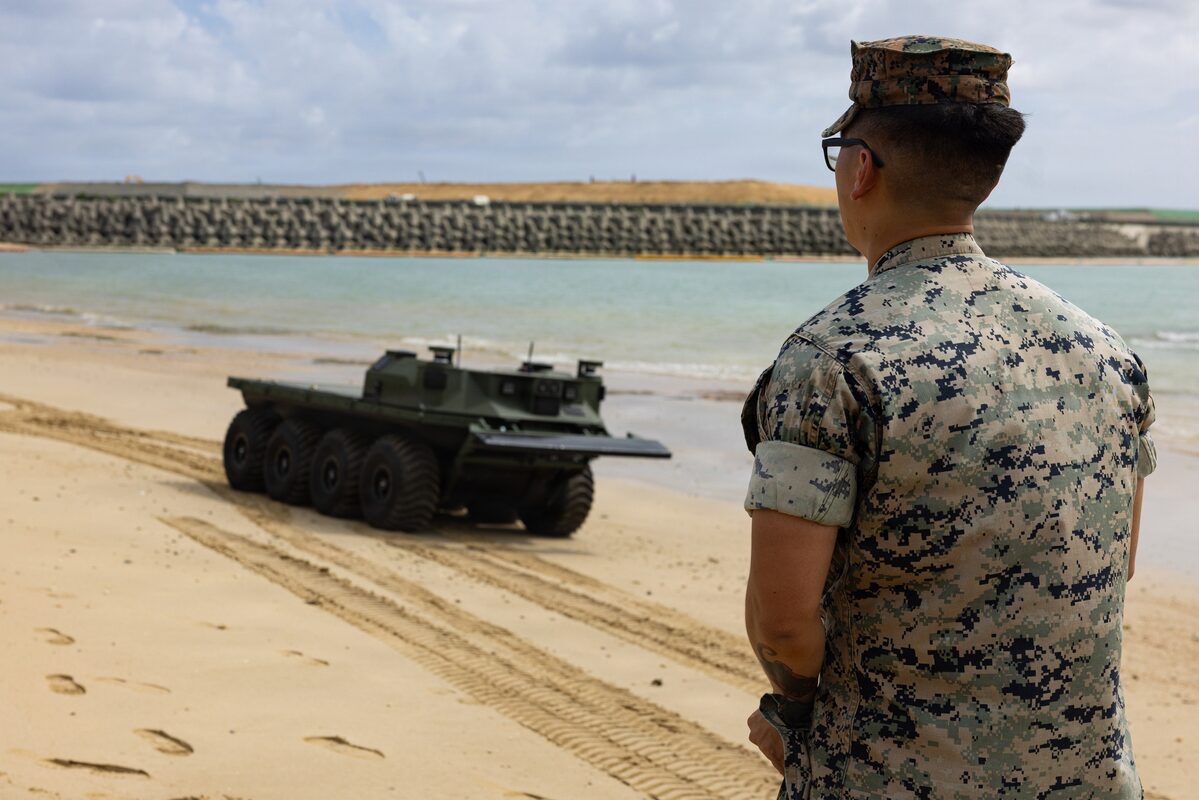
Marines testing how to haul gear across a beach without a driver behind the wheel are getting a dozen more robots to do it with. American Rheinmetall has been awarded a $7.28 million contract to deliver 12 Mission Master SP autonomous unmanned ground vehicles and five amphibious "Marine Kits" to the U.S. Marine Corps. The Defense Logistics Agency executed the deal on September 10 through reseller ADS Inc., with the vehicles headed to the Marine Corps Warfighting Laboratory in Quantico, Virginia, for continued autonomous-logistics and expeditionary-mobility experimentation.
The work splits between American Rheinmetall, which will build and deliver the vehicles in the United States, and Rheinmetall Canada, which supplies engineering support and the autonomy software that lets the platforms drive themselves. It is the latest in a string of Marine Corps buys of the Mission Master line, following an earlier order for six vehicles delivered to III Marine Expeditionary Force in December 2023 and field trials that have already run through major Marine Corps exercises.
What the $7.28 Million Buys
Army Recognition, which covered the award, put the core of the deal plainly: "American Rheinmetall has secured a $7.28 million contract from the Defense Logistics Agency to supply the United States Marine Corps with twelve Mission Master SP autonomous unmanned ground vehicles and five amphibious Marine Kits." Those five kits — not the base vehicles — are what makes this order different from prior Mission Master buys, since they adapt the platform for littoral operations that few competing robotic mules can handle out of the box. Each Mission Master SP weighs 1,134 kilograms empty and can carry up to 1,000 kilograms of cargo on land or 300 kilograms in the water, moving at up to 40 kilometers per hour on roads and roughly 54 kilometers on a single charge before it needs to recharge or refuel.
Beyond hardware, the contract folds in engineering support, technical documentation, operator training and acceptance testing — the unglamorous scaffolding that turns a delivered vehicle into one Marines can actually operate and sustain in the field. The Defense Post reported that "the platforms will support ongoing testing, autonomous logistics, and expeditionary mobility programs under the service's Warfighting Laboratory in Quantico, Virginia," language that tracks with how the Marine Corps has used the vehicles since it first brought them into the fleet.
Autonomy on the Mission Master SP runs on Rheinmetall Canada's PATH software stack, which fuses lidar, radar and camera data to let the vehicle follow a lead element, hold a formation with other robots, or navigate a route on its own. That software — not the chassis — is the part of the deal the Marine Corps is really buying more of with each successive order, since it is what separates a remote-controlled cart from an unmanned ground vehicle that can operate with reduced supervision in a contested logistics environment.
Why Quantico Keeps Buying the Same Robot
This is not the Marine Corps' first purchase of Mission Master vehicles, and that repetition is the story. Army Recognition detailed a testing history that runs from experimentation at Exercise Talisman Sabre 2023 in Australia, through Apollo Shield trials at Twentynine Palms, California, to the December 2023 order of six additional units fielded to III Marine Expeditionary Force. Each iteration has added a new operational wrinkle — coalition exercises, desert terrain, forward-deployed unit use — rather than starting a new evaluation from scratch.
The amphibious kit is the newest wrinkle, and it points at what the Marine Corps actually wants out of the platform. A robot that can carry a load across a beach and then back into the surf without a Marine walking alongside it addresses a specific problem the service has been vocal about since it reoriented around distributed, island-hopping operations in the Pacific: moving fuel, water and ammunition across contested shorelines with fewer people exposed to enemy fire. Small, repeatable buys like this one — a few million dollars, a dozen vehicles, a defined test unit — are how the Marine Corps builds toward a program of record without committing to one before the concept is proven.
That incremental approach also limits the Marine Corps' downside if the platform doesn't scale. Rather than betting a large acquisition on an unproven robot, the service hands a dozen vehicles to one lab, runs them through a defined set of exercises, and decides whether to expand the buy based on what actually happens in the field. Each order has come with a different mission profile — coalition interoperability at Talisman Sabre, desert mobility at Twentynine Palms, now littoral movement with the amphibious kits — building a broader evidentiary base than one large buy tested against a single scenario would.
DLA's use of ADS Inc. as the contracting vehicle is also notable. DLA routes a substantial share of tactical-equipment buys through catalog resellers like ADS rather than negotiating directly with manufacturers, which speeds up smaller awards even though American Rheinmetall and Rheinmetall Canada are the ones doing the engineering and delivery.
What It Means for Contractors
For Rheinmetall, the contract extends a foothold the company has spent several years building inside the Marine Corps' unmanned-systems testing pipeline, and it reinforces the value of a two-country production and support arrangement — U.S. delivery paired with Canadian engineering — that lets a foreign-owned defense supplier compete for Pentagon business while keeping final assembly domestic. Competitors chasing the same robotic-mule market, including smaller UGV startups, are watching a customer that keeps returning to one vendor for incremental buys rather than running a fresh full-and-open competition each time.
For subcontractors, the opportunity sits in the parts of the award that aren't the vehicles themselves: engineering support, documentation, operator training and acceptance testing are scope that primes often push down to smaller specialized firms, particularly ones with Quantico-area presence or existing lab relationships. And for companies building competing autonomy stacks, the deal is a reminder that the Marine Corps is buying proven software with a testing track record, not just a chassis — raising the bar for any newcomer hoping to displace an incumbent that already has years of exercise data behind it.
The dollar figure is modest by defense-contract standards, but the pattern is the signal: repeated, incremental UGV buys tied to one testing command are usually the on-ramp to a larger program of record, and vendors positioned inside that pipeline now are better placed to compete for it later than those trying to break in once a formal program launches.
