
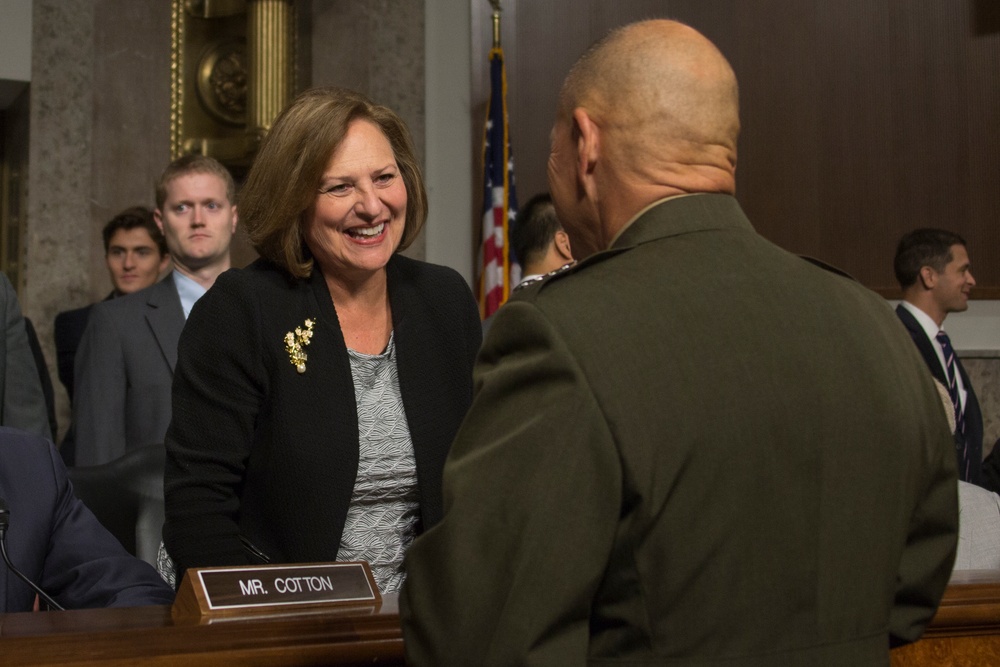
The Senate has filed cloture on the motion to proceed to S.4784, the fiscal year 2027 National Defense Authorization Act, teeing up the chamber's first real floor action on the roughly $1.14 trillion defense policy bill after weeks stuck between committee and the floor.
Background
The Senate Armed Services Committee reported S.4784 out of committee on an 18-9 vote on June 11, according to the committee's own markup announcement. Chairman Roger Wicker (R-Miss.) and Ranking Member Jack Reed (D-R.I.) oversaw the markup, with Wicker calling the bill "a seminal breakthrough for the American military" built on a "historic level of investment, and bold innovations in organization and procurement." The measure authorizes roughly $1.14 trillion in defense spending, matching the amount requested by the administration, according to a Congressional Research Service summary of the bill as reported by committee. That figure lands close to the House's own NDAA framework, itself pegged at roughly $1.14 trillion to $1.15 trillion in base budget funding, meaning the two chambers' toplines are not far apart — the bigger gap between the two bills right now is procedural, not financial.
The bill's path to the floor has been slow. S.4784 sat in the gap between committee markup and floor scheduling for weeks after the Armed Services Committee vote, with no procedural movement until the Daily Press schedule listed cloture on the motion to proceed for the week of July 13. That filing is a routine but necessary Senate mechanism to limit debate and force a path toward passage, and it marks the bill's first concrete step toward a floor vote rather than continued delay.
The Senate's push to the floor follows a separate stumble in the House in late June. Fourteen Republican defectors joined Democrats to sink a procedural rule, 198-224, that would have tied consideration of H.R. 8800 to the SAVE America Act, legislation that would require documentary proof of citizenship for federal election registration. That vote, on June 30, stalled the House's NDAA process indefinitely, along with whatever acquisition-related provisions are embedded in that chamber's bill. The Senate's cloture filing this week is unrelated to the House rule fight, but it means the two chambers are now moving on different tracks and at different speeds toward a bill that will eventually need to be reconciled. Until the House finds a path back to the floor for its own text, the Senate bill is effectively the only chamber-passed NDAA vehicle in play.
Key Details
Senate leaders plan to take the first procedural vote on S.4784 this week, opening the floor to consideration of amendments touching topics from energy policy to defense modernization. Among them is Sen. Alan Armstrong's (R-Okla.) "American Energy and Mineral Infrastructure Act" rider, an amendment unrelated to core defense authorization that illustrates how the NDAA continues to serve as a legislative vehicle for policy priorities well outside the Pentagon's budget. Additional energy- and environment-related amendments were expected to be introduced as floor debate opens, though a full, finalized amendment slate was not available at publication time.
The bill that emerged from committee touches several modernization priorities the Senate Armed Services Committee itself highlighted in describing the markup, including artificial intelligence approaches, autonomous weapons development, low-cost munitions procurement, and cyber operations initiatives. The committee described those priorities only in general terms in its public materials; the specific legislative language implementing them, and how much funding follows each one, will only become clear as the bill moves through floor debate and, eventually, conference with the House.
The rough parity between the Senate's roughly $1.14 trillion topline and the House's own framework is a departure from the kind of multi-hundred-billion-dollar gaps that have complicated past NDAA conferences. Because the House rule vote failed in June, though, the chamber has not yet passed its own NDAA text, meaning any comparison between the two toplines is still a comparison between a passed Senate committee bill and a House framework that itself remains unresolved. Any conference negotiation will have to wait until the House clears its own floor process.
What It Means for Contractors
For prime contractors and subcontractors tracking the FY2027 authorization cycle, the Senate's cloture filing is the clearest signal yet that the committee-reported bill is finally moving toward a floor vote rather than continuing to sit in limbo between markup and scheduling. Companies working on AI, autonomous systems, and cyber programs should watch how the modernization priorities the committee flagged in its markup materials hold up through this week's amendment process, since floor amendments can add, narrow, or strip funding tied to those priorities before the bill reaches final passage. Specific program-level detail on any of those priorities is not yet public and should not be assumed until bill text or committee report language confirms it.
Because the Senate and House toplines both track close to the administration's roughly $1.14 trillion budget request, contractors should not expect the kind of large, conference-driven topline cuts that a wide dollar gap between the chambers would otherwise force. That does not mean program-level funding is settled — individual line items can still shift significantly through floor amendments and conference negotiation even when the overall topline holds steady between chambers. With the House's own bill stalled since the failed rule vote in June, there is no House-passed text yet to reconcile against, which extends the window before program-level funding certainty arrives, regardless of how close the two chambers' toplines currently sit.
Firms with proposals or planning tied to specific FY2027 program lines should track both the Senate floor amendments this week and the House's next attempt to move H.R. 8800 or a successor vehicle to the floor. Until the House clears that procedural hurdle, the Senate's committee-reported bill remains the only concrete evidence that Congress is moving toward a final FY2027 defense authorization, even as the underlying dollar figures suggest less separation between the chambers than the stalled legislative process might imply.
Sources
- U.S. Senate Daily Press — Monday, July 6/13, 2026 schedule
- SASC — Completes Markup of National Defense Authorization Act for Fiscal Year 2027
- S.4784 — 119th Congress: FY2027 NDAA
- NDAA, spending to dominate Congress' pre-recess agenda
- House GOP defectors tank procedural vote to bring NDAA to floor
- CRS — FY2027 NDAA: Summary of Funding Authorizations
