
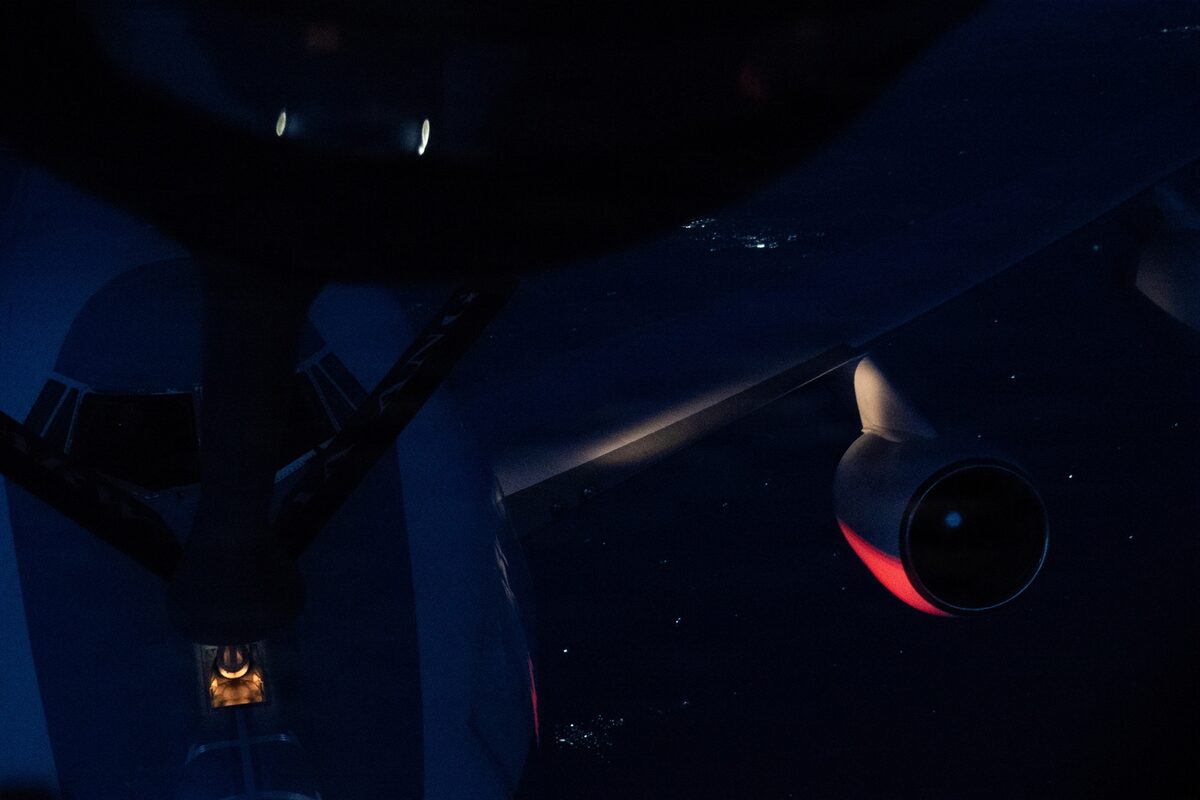
The Air Force's replacement for the nuclear-command "Doomsday Plane" just got $31 million more expensive, and the total price tag for a fleet still years from taking over the nuclear-watch mission has now edged past $13.1 billion. According to the Department of War's Sept. 3, 2026 contracts announcement, Sierra Nevada Co. LLC of Englewood, Colorado, received a $30,967,151 modification to its Survivable Airborne Operations Center (SAOC) contract, pushing the program's cumulative value from $13,082,081,647 to $13,113,048,798.
The modification, designated P00037, is a cost-plus-fixed-fee and cost-reimbursement change to contract FA2834-24-C-B002, the original SAOC award Sierra Nevada won in April 2024. Work under the modification will be performed in Englewood and is expected to wrap up by Dec. 31, 2027. The Air Force Life Cycle Management Center at Hanscom Air Force Base, Massachusetts, is the contracting activity, and the government obligated fiscal 2025 and fiscal 2026 research, development, test and evaluation funds at the time of award. Neither the location, the completion date, nor the funding type changed from the underlying contract — only the price attached to it moved.
Why the SAOC Contract Keeps Growing Past $13 Billion
The dollar figure is the headline here because it is precise and traceable: the Department of War's own contract announcement states the exact before-and-after totals, crediting Sierra Nevada Co. LLC of Englewood, Colorado with a $30,967,151 cost-plus-fixed-fee and cost-reimbursement modification, numbered P00037, to the previously awarded contract FA2834-24-C-B002 for the Survivable Airborne Operations Center. The release states that the modification brings the contract's total cumulative face value from $13,082,081,647 to $13,113,048,798.
That kind of incremental modification is standard practice on large, multiyear defense development contracts: rather than rebid or renegotiate the whole program every time requirements shift, the government adds funding through numbered modifications to the same base contract. P00037 marks at least the 37th such change since the original 2024 award, though the Pentagon's daily release does not itemize what specific engineering, testing or design work the latest $30.9 million covers. What it does confirm is the trajectory: a program that started at roughly $13 billion two years ago has now grown past $13.1 billion, more than $30 million heavier after a single week's announcement alone.
That pattern of steady, unremarked growth is by design as much as by necessity. Large cost-plus development contracts are structured precisely so the government can fund engineering changes, requirements refinements and testing discoveries as they occur rather than waiting to renegotiate the entire agreement. The tradeoff is that the public record — a single line in a daily contracts release — rarely conveys whether $30.9 million represents routine engineering support, a newly discovered technical problem, or a requirements change driven by the customer.
Why the E-4C's 2032 Target Date Still Matters
The six-year gap between now and SAOC's planned 2032 fielding is itself a cost driver worth watching. Every year the E-4B fleet remains in service past its planned retirement adds sustainment costs for an airframe design that first flew commercially in the 1970s, even as the government simultaneously funds SAOC's development. That overlap — paying to keep old aircraft flying while paying to build their replacement — is a familiar pattern across major Pentagon recapitalization programs, and it is one reason cost growth on this program draws close congressional attention even when a modification's technical justification isn't spelled out publicly.
Inside the Program Meant to Replace the E-4B Nightwatch
SAOC exists to replace the Air Force's aging E-4B "Nightwatch" fleet, the militarized Boeing 747-200 aircraft that serves as the National Airborne Operations Center — the flying command post intended to keep the president, the defense secretary and military leadership connected to nuclear forces if ground-based command centers are destroyed or compromised. The E-4B fleet dates to the 1970s, and the Air Force has spent years warning that the airframes and their support infrastructure are increasingly difficult and expensive to sustain.
Sierra Nevada beat out Boeing for the SAOC award in April 2024, a contract reported at the time to be worth close to $13 billion, a figure the current cumulative total of $13,113,048,798 confirms almost exactly. Boeing had been the only other company in contention before it was eliminated from the competition in late 2023 after declining to accept a fixed-price agreement, leaving Sierra Nevada unopposed in the final selection. The new aircraft, designated E-4C, is being built on a Boeing 747-8I airframe, the newer and larger variant of the jumbo jet. Sierra Nevada's role centers on converting used 747-8I airframes into a hardened, survivable command platform with the communications and electromagnetic-pulse protection needed to function during and after a nuclear exchange. Explaining why the program's requirements effectively ruled out any smaller jet, Air Force Col. Brian Golden told Aviation Week in 2022: "You need a very large, four-engine aircraft to execute our mission set. There was a lot of discussion on: Could it be done on two engines? Partly. A lot of risk would have to be taken, and it wasn't the Air Force's risk to take." The program is planned to field its first aircraft around 2032, giving the Air Force roughly six more years of reliance on the existing E-4B fleet before a replacement is ready.
What the Modification Doesn't Tell the Public
What the Sept. 3 announcement does not disclose is arguably as notable as what it does. The contract line for this modification does not break out labor categories, subcontractor shares or the specific milestone the $30.9 million covers — typical for major weapons-program announcements, where classification concerns limit how much technical detail the Pentagon releases. The announcement also does not specify how much of the $13.1 billion cumulative total has actually been obligated versus merely authorized as a ceiling, a distinction that matters for tracking real government spending against contract capacity.
What It Means for Contractors
For companies working the SAOC program or eyeing similar large aircraft-modification contracts, this modification is a reminder that base awards on major weapons systems are rarely the final word on program value. Subcontractors tied to Sierra Nevada's SAOC work should expect continued incremental modifications through the 2027 completion date tied to this particular change order. Companies bidding on future national security aircraft work should also note the Air Force Life Cycle Management Center at Hanscom as the contracting authority to watch for related solicitations. The steady drumbeat of SAOC modifications, each reported individually in the Pentagon's daily contracts log, underscores how much of the real cost story on a program this size only becomes visible by tracking every incremental award.
