
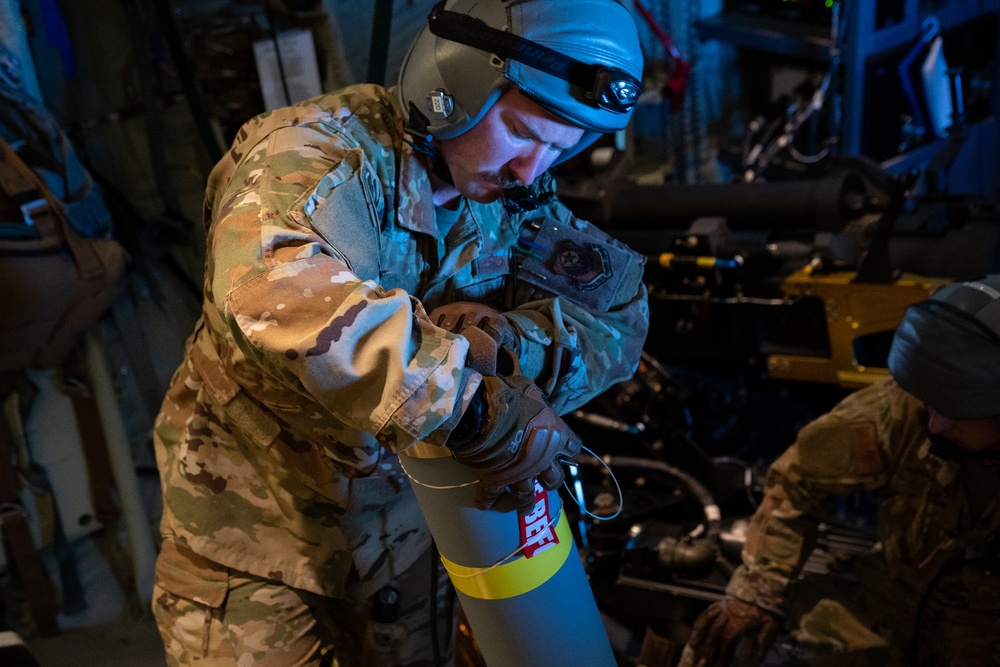
U.S. Special Operations Command has put its first real production money behind Leidos' new small cruise missile, awarding the company a $27,202,497 fixed-price-incentive contract modification to begin building All Up Rounds of the AGM-190A, according to the Department of War's July 8, 2026 contracts announcement.
Background
The AGM-190A traces back to a 2022 Cooperative Research and Development Agreement between USSOCOM, Air Force Special Operations Command, and Leidos' Dynetics segment in Huntsville, Alabama. CRADAs let a government organization and a private company pool resources on research without the company first winning a formal, competitively bid program of record, and SOCOM has leaned on that mechanism to move quickly on niche weapons that a big-service acquisition office might take years to fund. The effort, known internally as the Small Cruise Missile program and marketed publicly under the names "Black Arrow" and "Havoc Spear," set out to build a compact, low-observable weapon that special operations units could launch from light aircraft, drones, boats, or ground-based launchers rather than relying solely on fighter- or bomber-delivered munitions.
The missile achieved its first guided flight from an AC-130J gunship in November 2024 and demonstrated a standoff range beyond 400 nautical miles in an envelope-expansion test in July 2025. Those flight tests gave SOCOM the performance data it needed to move the weapon off the experimental books. On the strength of that record, the Air Force formally designated the weapon AGM-190A in February 2026, moving it out of an informal development label and into the standard joint munitions naming system used for fielded, sustainable inventory. Formal designation is itself a signal to industry: it means the services expect to support the weapon over a multi-year life cycle, with the logistics, spares, and sustainment contracts that follow. The modification awarded this week, funding actual All Up Rounds rather than test hardware, is the clearest sign yet that the program has cleared development and entered low-rate production.
Key Details
The contract modification carries a ceiling value of $27,202,497, with $24,202,497 obligated at time of award: $548,665 in fiscal 2025 procurement funds combined with $23,653,832 in fiscal 2026 procurement funds. USSOCOM, headquartered at MacDill Air Force Base, Florida, is the contracting activity. Work will be performed in Huntsville, where Leidos' Dynetics unit is based, with completion expected by Feb. 26, 2029 — a roughly two-and-a-half-year production window from the date of award.
The contract type itself is worth noting: a fixed-price-incentive, firm-target arrangement sets a target cost, target profit, and price ceiling up front, then shares any cost overrun or underrun between the government and Leidos according to a pre-negotiated formula. That structure gives Leidos an incentive to control manufacturing costs as it scales from hand-built test articles to a repeatable production line, while still capping the government's maximum exposure at the $27.2 million ceiling.
The AGM-190A itself is a roughly 200-pound-class weapon with a subsonic cruise profile, GPS-aided inertial navigation, and a terminal seeker for precision strikes. Its stated range of more than 400 nautical miles and low radar and infrared signature are designed to let small special operations platforms hold distant targets at risk without exposing the launching aircraft or vessel to enemy air defenses. Because it can fly from light aircraft, drones, boats, or ground launchers rather than a fighter or bomber, it gives special operations units a standoff-strike option that does not depend on tasking a larger, higher-demand aircraft. Moog supplies the missile's flight control actuation, and RTX's Pratt & Whitney business provides the turbojet engine that powers it — both established suppliers to the broader U.S. missile industrial base.
Because this award is a modification rather than a new contract, it builds on an existing vehicle rather than establishing new terms, and it specifically funds "All Up Rounds" — complete, ready-to-field missiles rather than test articles or engineering development units. That distinction matters: it signals SOCOM is now buying operational inventory, not just prototypes for further flight testing, and it puts real production volume, however modest at this stage, on Leidos' Huntsville manufacturing line.
What It Means for Contractors
The award marks a transition point that subcontractors and suppliers in the special operations weapons market should watch closely. Programs that move from CRADA-based development into designated, funded production lines typically see their subcontractor base expand as the prime scales manufacturing capacity to meet recurring orders instead of building a handful of prototypes. Moog and Pratt & Whitney already hold roles on the missile's flight controls and propulsion, and a production window running to February 2029 suggests SOCOM expects recurring annual buys rather than a single lot of rounds.
For companies with relevant precision-guidance, composite airframe, or small-turbojet manufacturing capacity, the Huntsville industrial base — already dense with missile and space contractors thanks to Redstone Arsenal and the surrounding cluster of defense primes — is the logical place to seek teaming opportunities as Leidos builds out production capacity. The mixed fiscal 2025 and fiscal 2026 funding on this modification also indicates the program has now cleared the annual appropriations cycle in back-to-back years, a signal of budget stability that smaller suppliers often look for before investing in dedicated tooling or facility space for a niche weapons program that has not yet reached full-rate production.
The award also illustrates how SOCOM is increasingly willing to fund a weapon system through informal cooperative agreements and rapid prototyping authorities before it enters a formal program-of-record acquisition process — a path that can move faster than a traditional major defense acquisition program but places more weight on a single prime's in-house engineering and manufacturing readiness rather than a broad, competitively selected industrial team. That model rewards primes like Leidos that can self-fund early development risk in exchange for a strong position once the government is ready to buy rounds in volume, and it narrows the door for competitors to break in once a design has been designated and funded like the AGM-190A has been.
Contractors positioning for follow-on work should track two things: whether the Air Force or other services adopt the AGM-190A for their own inventories, which would open additional procurement lines beyond USSOCOM's current buy, and whether future modifications on this same contract vehicle continue to grow in size, which would confirm the program is scaling toward full-rate production rather than staying at today's low-rate volume.
Sources
- Contracts for July 8, 2026 — U.S. Department of War
- Leidos moves forward with developing special forces small cruise missile — Military Aerospace
- Leidos Small Cruise Missile (SCM) Designated AGM-190A by US Air Force — MilitaryLeak
- Tiny Black Arrow Cruise Missile Demonstrates A Whopping 400-Mile Range — The War Zone
