
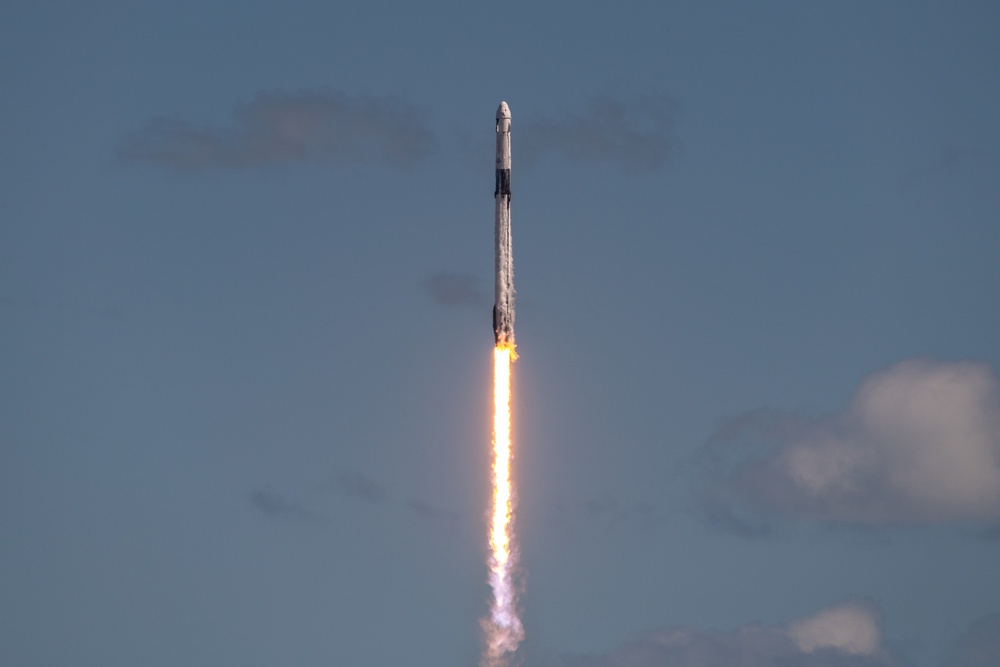
NASA just extended SpaceX's grip on American access to the International Space Station through the end of the decade, awarding the company three more crew rotation flights in a $946 million contract modification that keeps astronauts riding to orbit on Crew Dragon with no competing vehicle in the queue behind it.
The modification adds Crew-15, Crew-16 and Crew-17 to SpaceX's flight manifest under NASA's Commercial Crew Transportation Capability contract, known as CCtCap. It brings the total number of missions SpaceX has flown or booked under that contract to 17 and pushes the company's cumulative CCtCap contract value with NASA to $5.92 billion.
The award is firm-fixed-price and structured as indefinite-delivery/indefinite-quantity, the same mechanism NASA has used to layer new missions onto the contract incrementally since the Commercial Crew Program began. Rather than run a new competition, NASA issued the modification sole-source, following a notice of intent to do so that the agency published in May 2026. "To continue regular crew transportation to the International Space Station, NASA has awarded SpaceX three additional missions through a contract modification," the agency said in its announcement.
What the $946 Million Actually Covers
The price tag is not just launch services. It funds ground processing, launch, in-orbit operations, and return and recovery for each of the three flights, along with cargo transportation on every mission. It also pays for a capability NASA has leaned on since Crew Dragon began flying regularly: keeping the docked spacecraft available as a lifeboat for the station's crew for the full duration each capsule spends attached to the outpost, in case an emergency required an unplanned return to Earth.
That lifeboat function has become part of the routine math of station operations. With a Crew Dragon parked at the ISS almost continuously — SpaceX's twelfth CCtCap rotation mission, Crew-12, is in orbit and docked to the station right now — NASA is effectively paying to keep an emergency ride home on call at all times, not just to get astronauts up and back.
Mission Readiness Dates Land in 2027 and 2028
The modification's period of performance runs through 2030, with the three new missions carrying mission readiness dates in 2027 and 2028. That timeline slots Crew-15 through Crew-17 in behind the missions already on SpaceX's books, giving both SpaceX and NASA's station operations planners a multi-year runway: capsule builds, crew training and launch scheduling for three specific missions can now proceed against fixed target windows instead of being negotiated flight by flight, even as the current rotation, Crew-12, continues its stay docked to the station.
Why NASA Went Sole-Source Instead of Competing the Work
NASA's original Commercial Crew Program contract was awarded to two providers, Boeing and SpaceX, in 2014. SpaceX was certified for crew transportation in November 2020, and the CCtCap contract has since become the vehicle NASA uses to keep adding SpaceX rotation missions as the need for continued crew flights to the station persists — the basis cited for adding Crew-15 through Crew-17 to SpaceX's existing contract rather than opening a new competition.
NASA framed the award as one modification among possibly more, not a ceiling on future work. "The current sole source modification does not preclude NASA from seeking future contract modifications for additional transportation services, as needed," the agency said. That language leaves the door open for NASA to add further missions to either provider's contract as station operations continue, without committing now to how flights beyond Crew-17 will be sourced.
Trade coverage of the award framed the size of the commitment in similar terms. Govconwire reported that "SpaceX has secured a potential $946 million contract modification from NASA to conduct three additional crew rotation missions to the International Space Station under the agency's Commercial Crew Transportation Capability, or CCtCap, contract," underscoring that the modification's value rests on the full slate of three missions and their associated mission services, not a single flight.
What It Means for Contractors
The award is a reminder of how NASA's human spaceflight contracting has settled into a pattern: incremental, sole-source modifications layered onto a decade-old base contract rather than fresh competitions for each new batch of missions. For SpaceX, it means predictable, recurring revenue tied to station operations through 2030 and confirmation that NASA intends to keep routing crew rotation work to it under the existing contract rather than opening a new competition.
For other contractors watching the commercial spaceflight market, the modification underscores how difficult it is to break into an incumbent's position once NASA has built its operational tempo — trained astronaut corps, ground infrastructure and mission planning — around a single certified vehicle. Companies eyeing NASA's next-generation station transportation work, including any commercial successor to the ISS, should expect NASA to weigh operational continuity and certification status as heavily as price when it decides whether to compete future work or extend it sole-source to a proven provider.
The modification also reinforces the value of certification itself. SpaceX's November 2020 crew certification is the credential NASA is now relying on to justify skipping a competition for Crew-15 through Crew-17. Any company hoping to compete for NASA's next round of crew or cargo work should read the sole-source justification as a data point: once a provider clears NASA's certification bar and racks up a flight record, incumbency becomes a durable advantage that is hard for any other company, including the CCtCap contract's original second awardee, Boeing, to overcome without a certified vehicle of its own flying operational rotations.
The modification also signals where NASA's near-term crew transportation budget is committed. With $5.92 billion now obligated to SpaceX under CCtCap and readiness dates stretching into 2028, contractors bidding on adjacent station-support work — cargo, research payloads, ground systems — can plan around a crew transportation schedule that NASA has now locked in for the rest of the decade.
