
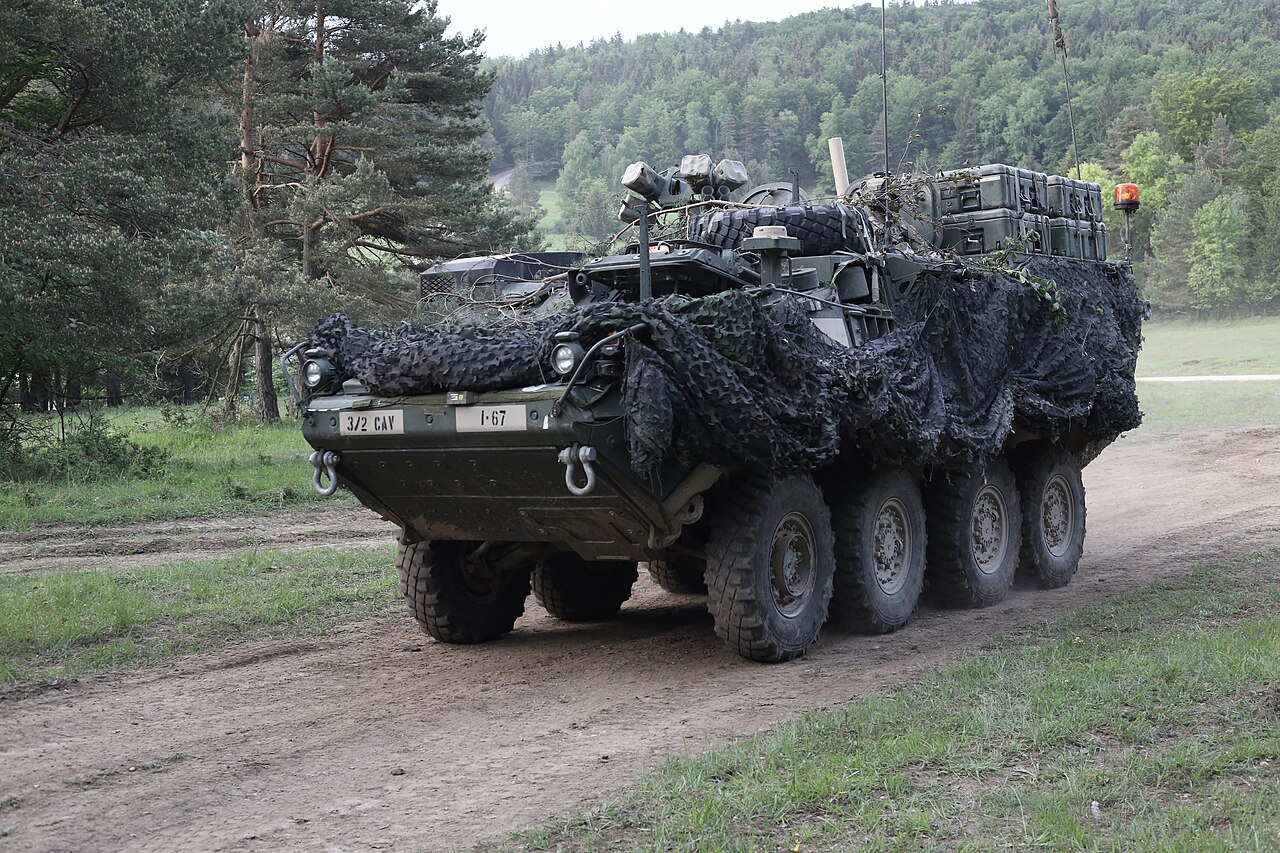
The Army has put a firm price on a retrofit kit that adds electrical capacity to its Stryker vehicles, and in doing so it has lifted a sole-bid General Dynamics contract from about $26.5 million to more than $162 million. The Oct. 26 Defense Department contract announcement, mirrored by GlobalSecurity, lists a $135,940,076 modification to General Dynamics Land Systems Inc. of Sterling Heights, Michigan, under contract W912CH-25-D-0050. The modification, numbered P00005, exists "to establish the pricing for procurement of the complete Stryker Enhanced Power Distribution Unit Version 2 Retrofit Kit," according to the notice.
The action brings the contract's total cumulative face value to $162,413,191. Army Contracting Command, Detroit Arsenal, Michigan, is the contracting activity, and the announcement sets an estimated completion date of Aug. 8, 2030.
What the EPDU-2 Retrofit Kit Adds to the Stryker Double-V-Hull A1
The Enhanced Power Distribution Unit Version 2, shortened to EPDU-2 in Army paperwork, is an electrical upgrade, not a new vehicle. A Justification and Approval notice for the same contract number, posted Sept. 11, 2025, and indexed by GovContractFinder, describes the purpose directly: "The Army Contracting Command - Detroit Arsenal awarded an Undefinitized Contract Action (UCA) to General Dynamics Land Systems., Inc. for the Stryker Enhanced Power Distribution Unit Retrofit Kits, which provides additional vehicle circuit breaker channels, in order to support the current power requirements on the Stryker Double-V-Hull A1 vehicles."
That sentence carries the program's logic. Each powered subsystem on a vehicle needs a protected circuit, and when a distribution unit runs out of breaker channels, the options are to stop adding equipment or to rework the distribution system. The EPDU-2 kit addresses the problem by adding breaker channels so the vehicle's electrical loads can be fed and protected. The notice does not say which specific loads prompted the requirement.
The notice lists the place of performance as Sumner, Washington, and classifies the work under NAICS code 335311, power, distribution and specialty transformer manufacturing, with product service code 6150. The Defense Department announcement, by contrast, says work locations and funding "will be determined with each order," which fits a contract under which the Army issues orders as kits are needed rather than buying the full quantity at once.
Why the $135.9M Modification Was a Pricing Action
The modification's stated job is to establish pricing. That language matters because the contract began as an undefinitized contract action. Under a UCA, the government authorizes a contractor to start work before the parties have agreed on final terms and price, usually because the need is urgent or the schedule cannot wait for a full negotiation. The government then has to definitize, or settle, those terms afterward.
The arithmetic in the announcement shows how much of the program was waiting on that step. Subtracting the $135,940,076 modification from the $162,413,191 cumulative total leaves about $26.5 million in face value on the contract before this action. The new pricing therefore accounts for roughly 84 percent of the contract's current cumulative face value. In practical terms, P00005 sets the price for procuring the complete kit going forward, which is the step that took the contract's value from its earlier level to its current one.
The announcement does not break out a unit price, a kit quantity or the number of Stryker vehicles the Army intends to retrofit, and it does not say how much money was obligated at the time of the modification. Those details will show up, if at all, in the individual orders.
One Bid, One Offer: How the Sole-Source Path Took Shape
The Defense Department's notice states plainly: "One bid was solicited with one received." The Justification and Approval is consistent with that outcome. A J&A is the document an agency prepares when it limits competition, and this one names General Dynamics Land Systems as the awardee of the original UCA for the retrofit kits. The posted notice text does not itself lay out the reasons for limiting competition.
One plausible explanation follows from the hardware. General Dynamics Land Systems builds the Stryker, and the power distribution unit sits inside the vehicle's electrical architecture. A retrofit kit that adds breaker channels would have to integrate with the original equipment manufacturer's wiring, mounting and software, which would narrow the field of firms able to deliver a drop-in kit without redesign work the Army would need to qualify. That is inference, not something either source states.
The GovContractFinder listing also tags the original notice with a "Full and open competition" set-aside field, a database label that sits alongside a document whose purpose is to justify limiting competition. The DoD announcement's single-bid language is the clearer record of how this modification was actually priced.
What It Means for Contractors
For companies outside General Dynamics, the prime contract looks closed. The single-bid record and the J&A suggest no opening to compete for the kit itself through the Aug. 8, 2030 estimated completion date. The opportunity likely sits lower in the supply chain. Power distribution kits draw on circuit breakers, harnesses, connectors, enclosures and cable assemblies, and the NAICS code attached to the J&A, 335311, is the same one that appears on a steady flow of small Defense Department electrical-parts solicitations; GovContractFinder's related-notices list shows several posted Oct. 25 and 26, 2026. Suppliers already qualified on Stryker electrical components should expect order-driven demand rather than a single production surge, because the Army will set locations and funding order by order.
For firms that follow undefinitized contract actions, the case is a clean example of how a UCA's initial face value can understate a program. A contract that stood at about $26.5 million gained more than five times that amount in a single pricing modification. Business development teams that screen opportunities by initial award value can miss these programs entirely; the more useful signals are the J&A filing and the follow-on definitization modification.
For integrators working on Stryker mission equipment, the purpose statement is the most useful line in the record. The Army bought extra breaker channels "in order to support the current power requirements" on the Double-V-Hull A1. Payload and subsystem vendors proposing new powered equipment for the vehicle should track how the EPDU-2 rollout changes the available electrical capacity, since that capacity shapes what the Army can add next.
Contracting officers and program offices will also watch the order flow against the Aug. 8, 2030 completion date. A pricing modification sets the terms. The orders that follow will show how fast the Army actually funds the retrofits across the fleet.
