
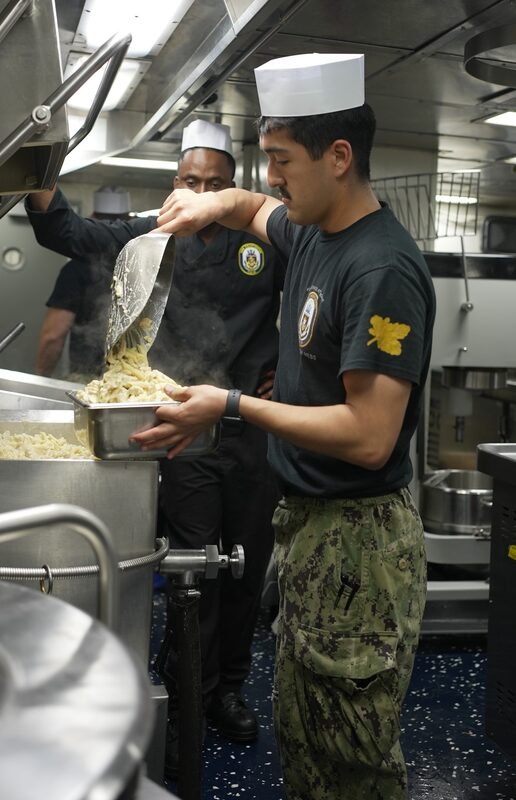
The Defense Logistics Agency has locked in its next major food-service pipeline for military dining facilities, awarding an indefinite-delivery/indefinite-quantity contract worth up to $281,019,046 to Sysco Seattle Inc., according to war.gov's June 30, 2026 contracts notice.
Background
DLA Troop Support runs the Pentagon's full-line food and beverage distribution program, the supply chain that keeps dining facilities, galleys, and mess halls stocked across every service branch. Rather than negotiating one-off purchases, DLA Troop Support relies on IDIQ vehicles that lock in a distributor for a defined region and let program offices place individual delivery orders against the ceiling as needs arise. That structure gives the agency a standing source of supply without committing to a fixed purchase volume up front, while giving the winning distributor predictable, multi-year revenue tied to actual demand.
Sysco Corp. is the largest foodservice distributor in the United States, controlling roughly 18% of the $377 billion domestic foodservice market and moving more than 500,000 products to about 730,000 customer locations nationwide. The Kent, Washington-based Sysco Seattle subsidiary that won this award operates as one of Sysco's regional distribution arms, the kind of operating company the corporation routes through when it bids on government contracts tied to a specific geographic footprint.
DLA Troop Support has for years split its full-line food distribution business among multiple regional prime vendors, a structure designed to guarantee redundancy so that a single supplier's disruption cannot take down dining support for an entire service branch. Sysco's operating companies, including its Seattle unit, have held prior DLA prime-vendor territories, giving the corporation an established track record with the agency's ordering, invoicing, and quality-assurance requirements before this award was made.
That track record matters because DLA Troop Support prime-vendor contracts carry heavy compliance obligations beyond simply moving product. Winning distributors must maintain traceability systems that can track a given shipment of protein or produce back to its supplier lot in the event of a recall, manage cold-chain integrity across long-haul deliveries to installations, and meet delivery-window requirements that dining facility managers build their meal planning around. An incumbent-adjacent distributor with existing DLA infrastructure, like a Sysco operating company, starts a new award cycle with much of that compliance apparatus already built and tested, which is one reason large, established distributors continue to win these regional territories over newer entrants.
Key Details
The contract, numbered SPE300-26-D-3018, is a firm-fixed-price vehicle with economic-price-adjustment provisions, a structure that lets the ceiling ordering rates flex with documented shifts in food commodity costs over the life of the agreement rather than locking Sysco into prices that could become unsustainable if inflation spikes. The award carries a five-year ordering period with no option periods, running through June 28, 2031, and is funded incrementally through fiscal years 2026 through 2031 via defense working capital funds. War.gov's notice describes the acquisition as competitive.
The $281,019,046 figure is a ceiling value, not a guaranteed payout. Under an IDIQ structure, DLA Troop Support and the military dining facilities it supports will place individual delivery orders against that maximum as actual food and beverage needs materialize; Sysco Seattle's actual revenue under the contract will depend on order volume over the five-year period rather than on the headline number alone.
The scope covers full-line food and beverage items, the standard DLA Troop Support category that spans shelf-stable groceries, proteins, dairy, produce, and beverages distributed to dining facilities. War.gov's notice identifies the Navy as the using military service for this award; it does not specify which installations Sysco Seattle will serve, information that typically becomes clearer as individual delivery orders and any related subcontracting-plan filings are made public.
What It Means for Contractors
For companies chasing DLA Troop Support business, this award is a reminder that the agency's food distribution vehicles remain concentrated among a small number of large, established prime vendors capable of meeting the logistics, cold-chain, and inventory-management demands the Pentagon requires. Sysco's scale, more than 500,000 SKUs and a national distribution network already serving roughly 730,000 commercial locations, is precisely the kind of infrastructure DLA Troop Support screens for when it structures these regional prime-vendor competitions. Smaller or regional distributors hoping to compete directly for a comparable full-line award will need to demonstrate similar depth of inventory and delivery reliability, or instead pursue a subcontracting relationship with a prime like Sysco.
The five-year ordering period and FY2026-2031 funding horizon also signal that DLA Troop Support is committing to a long runway with this vendor relationship, which narrows the near-term window for new entrants to break into this specific territory. Contractors watching the broader Troop Support food and beverage portfolio should treat this award as a data point on how DLA structures its regional coverage rather than a one-time procurement; the agency typically re-competes these territories only as existing IDIQs approach expiration, meaning the next realistic entry point for a competing distributor in this geographic lane is likely years away.
The economic-price-adjustment clause built into the contract is also worth noting for any company bidding on similar food-distribution work. As commodity costs for proteins, dairy, and produce have swung in recent years, DLA Troop Support has leaned more heavily on EPA provisions to keep long-duration IDIQs viable for both sides; contractors structuring proposals for comparable food-service vehicles should expect the agency to favor pricing structures that share commodity-cost risk rather than fixed pricing locked in for the full five-year term.
Contractors should also watch how DLA Troop Support staggers the FY2026-2031 funding across the ordering period. Because the agency incrementally funds IDIQs like this one fiscal year by fiscal year rather than obligating the full ceiling at award, delivery-order volume in the earlier years of the contract will be a better predictor of the vehicle's real value than the $281 million ceiling figure alone. Firms evaluating whether to pursue a subcontracting relationship with Sysco Seattle, or benchmarking their own bids on comparable regional territories elsewhere in the DLA Troop Support footprint, should track early delivery-order activity under SPE300-26-D-3018 rather than assuming the full ceiling will be reached.
Finally, the award underscores how much of DLA Troop Support's food and beverage spend flows through a handful of national distributors rather than smaller regional players. Companies without Sysco's scale of warehousing and delivery infrastructure are more likely to find opportunity as subcontractors, or by targeting smaller, more specialized categories within the Troop Support portfolio, such as niche dietary products or specific installation-level contracts, rather than by competing head-on for full-line regional prime-vendor territories of this size.
