
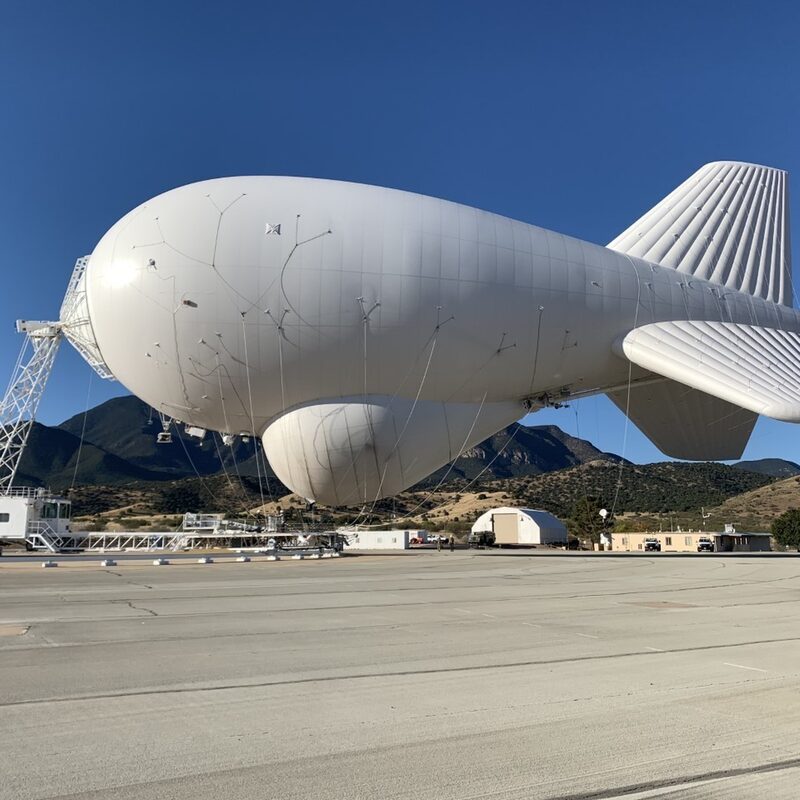
The U.S. Army has committed nearly half a billion dollars to keep its tethered surveillance balloons flying, awarding TCOM LP a $446,736,050 indefinite-delivery/indefinite-quantity contract for the production, fielding, sustainment and lifecycle support of its Persistent Surveillance Systems-Tethered family, according to the Defense Department contract announcement for July 21, 2026. The award routes through Army Contracting Command at Aberdeen Proving Ground, Maryland, under contract number W56KGY-26-F-A002, with an estimated completion date of July 20, 2031.
Background
Tethered aerostats are helium-filled envelopes anchored to the ground by a cable that carries power up and sensor data down. Because they hover at low altitude for days at a time without burning fuel, they give commanders a fixed high vantage point for intelligence, surveillance and reconnaissance work that would otherwise demand a rotation of aircraft or satellites. The Army's Persistent Surveillance Systems-Tethered program, known as PSS-T, packages that capability into medium and large variants sized for different mission footprints.
TCOM LP, based in Columbia, Maryland, has built aerostats for the U.S. government for decades and has served as the Army's principal engineering and sustainment partner on the PSS-T line. The company designs the platforms, integrates the sensor payloads, and supplies the logistics and program-management services that keep fielded systems operational. According to Army-Technology.com, PSS-T delivers a 360-degree detection, surveillance, monitoring and targeting capability for ISR and force-protection missions, drawing on TCOM's engineering, logistics, operations and program-management work.
This IDIQ follows a prior PSS-T support award to TCOM valued at roughly $979 million, underscoring how central the company has become to the Army's persistent-surveillance posture. Rather than a one-off buy, the new contract is structured to carry the program forward across a five-year horizon, funding both new production and the upkeep of systems already in the field.
Key Details
The contract is a hybrid arrangement combining cost-no-fee, cost-plus-fixed-fee and firm-fixed-price elements under a single IDIQ umbrella. That mix lets the Army buy hardware at fixed prices where the work is well defined while reimbursing cost on the engineering and sustainment tasks where scope is harder to pin down in advance. The $446,736,050 figure represents the ceiling value; because the vehicle is task-order based, individual work locations and funding are set as each order is issued rather than committed up front.
The competition drew a narrow field. Army Contracting Command solicited ten bids and received two, a response rate that reflects the small number of firms able to produce and sustain military-grade tethered aerostats at scale. The scope spans the full lifecycle: production of new systems, fielding them to operational units, sustaining them once deployed, and providing the ongoing lifecycle support that keeps the medium and large PSS-T variants mission-ready through the 2031 completion date.
The award covers the PSS-T family broadly rather than a single configuration, which gives the Army flexibility to order across variants as requirements shift. That structure matters for a program whose demand can move with force-protection needs at fixed sites and forward locations, where aerostats provide standing overwatch that persists far longer than a crewed or uncrewed aircraft can loiter.
What It Means for Contractors
The two-bid response to a ten-bid solicitation is the headline signal for the broader contracting community. Tethered-aerostat production sits inside a small supplier base, and the gap between how many firms the Army invited and how many actually competed shows how concentrated this niche remains. For companies weighing entry into military ISR balloon work, the barrier is not just the envelope and tether hardware but the accumulated engineering, sustainment infrastructure and program-management depth that an incumbent like TCOM has built over years of PSS-T work.
The hybrid contract structure is also worth studying. By blending firm-fixed-price production with cost-reimbursement engineering and sustainment lines, the Army spreads risk in a way that rewards a contractor able to price hardware confidently while staying flexible on the less predictable support tasks. Subcontractors and payload integrators should note that a five-year IDIQ ceiling of this size creates a stable stream of task orders, and that positioning as a supplier to the prime can be a more realistic path into the program than challenging the incumbent head-on.
For firms tracking the persistent-surveillance market, the award signals continued Army investment in low-altitude, long-endurance collection platforms even as attention flows toward satellites and uncrewed aircraft. Aerostats occupy a cost-effective middle ground: they stay aloft for days, carry substantial sensor payloads, and demand no aircrew. The decision to fund production and sustainment through 2031 tells the market that tethered ISR remains a durable line in the Army's force-protection toolkit, not a legacy capability being wound down. Companies with adjacent expertise in sensor payloads, data links, ground-station electronics or helium-management systems have a multi-year window in which to align their offerings with a program that now has funded runway well into the decade.
Finally, the continuity from TCOM's earlier roughly $979 million PSS-T support award to this $446.7 million follow-on illustrates a pattern common in specialized defense niches: once a contractor establishes itself as the sustaining engineer for a fielded system, recompetes tend to reinforce rather than displace the incumbent. That dynamic rewards early investment in a program's technical baseline and cautions new entrants that the most valuable position is often established years before a given solicitation reaches the street.
