
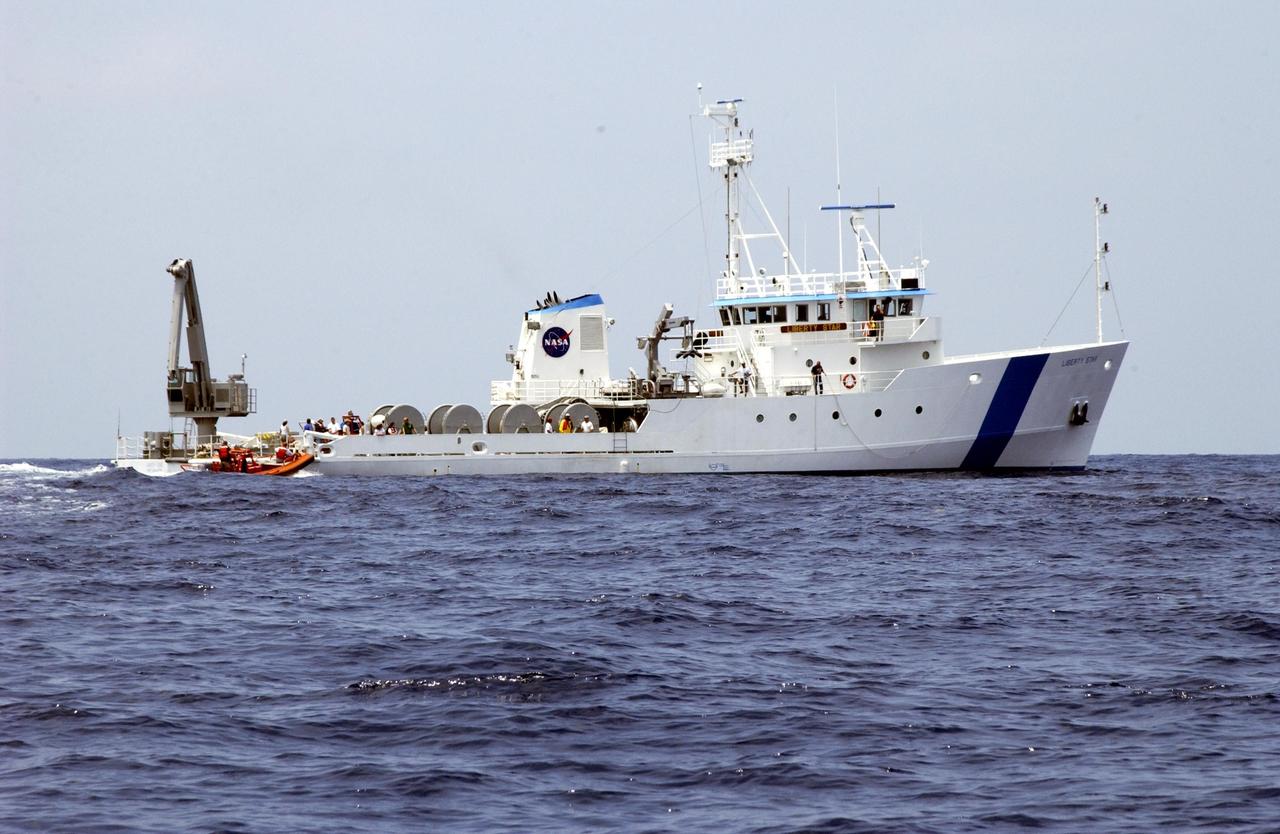
The Navy has added $26,625,622 to Thoma-Sea Marine Constructors' NOAA shipbuilding contract to definitize an engineering change that will give two nearly finished oceanographic research vessels the ability to run on shore power while in port.
Background
Thoma-Sea Marine Constructors LLC, based in Houma, Louisiana, is building two new Auxiliary General Oceanographic Research (AGOR) vessels for the National Oceanic and Atmospheric Administration under a contract NOAA has valued at $624.6 million. The ships, named Oceanographer and Discoverer, are being built to modernize NOAA's aging survey and research fleet and will support fisheries surveys, ocean mapping, and climate research once delivered. NOAA has publicly confirmed the original $624.6 million award on its own website, describing the effort as another milestone in the agency's push to recapitalize its aging fleet of ships.
The Navy's Naval Sea Systems Command manages ship construction contracts on NOAA's behalf, which is why the modification announced in the Department of War's July 2, 2026 daily contract release runs through NAVSEA in Washington, D.C., rather than through NOAA directly. That arrangement is standard for NOAA's larger research and survey vessels, which the Navy's shipbuilding program offices have historically overseen for technical expertise in hull design, systems integration, and contract administration that NOAA's own procurement office does not maintain in-house.
Thoma-Sea itself is a Gulf Coast shipbuilder with a long history in the region's marine construction industry, and the NOAA award represents a significant piece of federal research-vessel work moving through a shipyard best known for commercial and offshore support vessels rather than large scientific platforms. Winning and executing a contract of this scale marked an expansion of the yard's federal footprint well beyond its traditional commercial customer base.
Key Details
The $26,625,622 firm-fixed-price action definitizes an engineering change order that adds shore-power configuration and capability to both AGOR Ship 1 and AGOR Ship 2. Shore power lets a docked vessel draw electricity from a pier connection instead of running its own diesel generators, cutting fuel use, emissions, and engine wear during extended port calls. Adding that capability after a ship's basic design is set typically requires new electrical distribution runs, shore-tie receptacles, transformers, and control systems to safely convert incoming shoreside power to the vessel's onboard standard, work that has to be integrated into a hull that is already largely built rather than designed in from a clean sheet.
NAVSEA lists an expected completion date of November 2028 for the modification, a timeline that runs well past the vessels' anticipated delivery dates and reflects the multi-year nature of outfitting, testing, and closing out engineering changes on a shipbuilding contract even after a vessel is in the water and has begun its early operational life.
Construction on both hulls is well advanced. Oceanographer was floated in the fall of 2024 and is roughly 76 percent complete. Discoverer was launched in March 2025 and is roughly 68 percent complete. Both ships are due for completion in 2026, according to figures cited alongside the contract announcement, putting the shore-power retrofit work on a parallel track with final outfitting and commissioning activity rather than requiring a wholesale redesign of either hull.
The modification is one of many actions NAVSEA has taken against the base Thoma-Sea contract since it was awarded, a common pattern on large shipbuilding programs where the government adds engineering changes, government-furnished equipment, and configuration updates as a vessel design matures through construction and as operational requirements are refined between contract award and delivery. Each such action has to be negotiated, priced, and definitized separately, even when, as here, the underlying scope is conceptually straightforward.
What It Means for Contractors
The award is a reminder that shipbuilding contracts rarely stay static once signed. Firms holding fixed-price construction contracts for research, survey, or auxiliary vessels should expect the government to definitize engineering changes throughout the build, and should structure their own change-management and subcontractor pricing processes to absorb modifications like the shore-power addition without disrupting the master build schedule or cost basis of the underlying contract. Thoma-Sea's ability to price and accept a $26.6 million change order late in construction, with hulls already 68 to 76 percent complete, shows how shipyards build margin and flexibility into fixed-price vessel contracts to accommodate exactly this kind of add without renegotiating the entire agreement.
For companies that supply electrical distribution systems, shore-tie connectors, transformers, and power-conversion equipment, the modification is a concrete data point on where NOAA and Navy-managed research-vessel programs are investing as environmental and efficiency requirements for government vessels tighten. Contractors bidding on future NOAA or other Navy-managed research-vessel work should anticipate that shore-power capability is increasingly treated as a standard requirement rather than an optional upgrade, and should price it into initial proposals rather than waiting for a post-award engineering change to capture that scope.
The contracting structure itself is also instructive for firms newer to federal shipbuilding: even though NOAA owns the ships and defines the underlying mission requirement, NAVSEA holds the contract and administers modifications on NOAA's behalf. Companies pursuing NOAA vessel work should track solicitations and awards through the Navy's contracting channels and the Department of War's daily contract announcements, not solely through NOAA's own procurement postings, since that is where actions like this one are formally announced and where the contracting officer of record actually sits.
Finally, the timing offers a lesson in how far post-delivery obligations can stretch. A modification tied to two ships expected to reach completion in 2026 carries an expected completion date of November 2028, underscoring that contractors on multi-year vessel builds need financial and staffing plans that extend well beyond a ship's launch or commissioning date to cover the engineering changes, warranty work, and outfitting tasks that continue to flow through a contract long after a vessel first enters the water. Subcontractors and suppliers tied to these programs should plan their own staffing and inventory around that same long tail rather than assuming their obligations end at delivery.
