
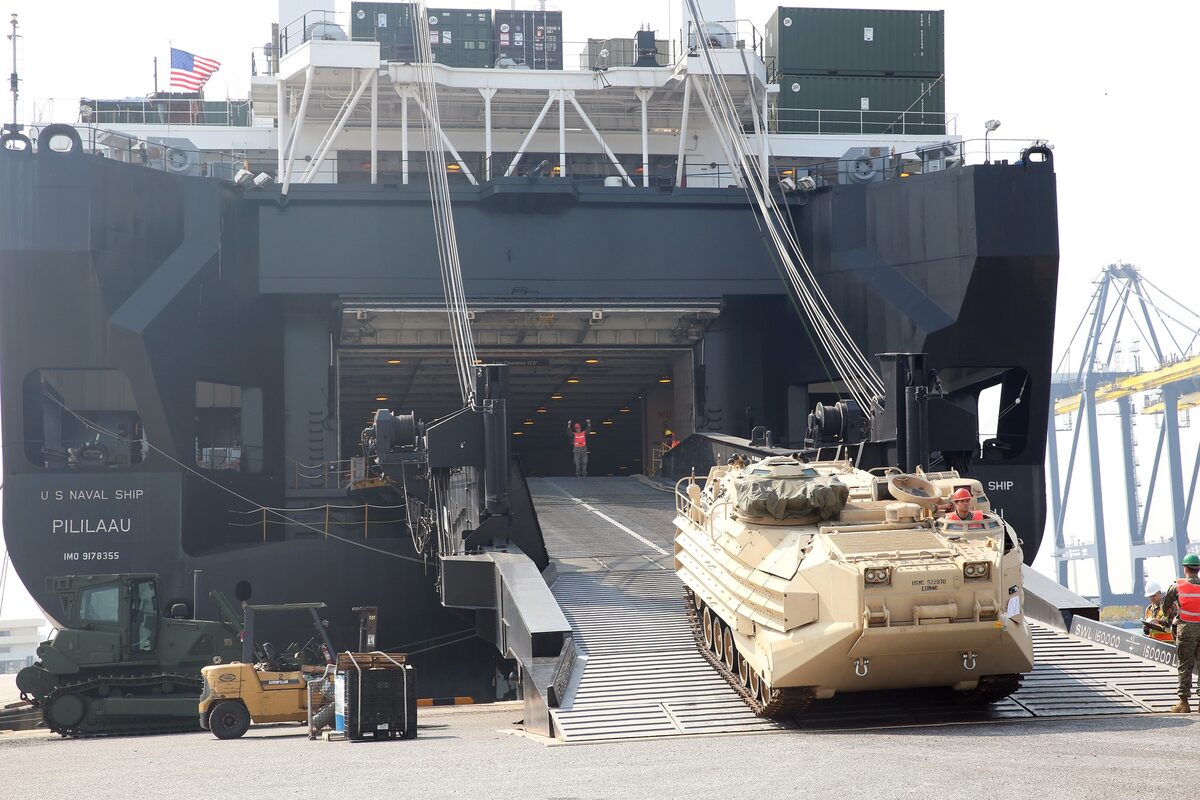
The Pentagon has put seven U.S.-flag shipping companies on call to move tanks, trucks and heavy equipment anywhere in the world on short notice, trading months-long contract solicitations for task orders it can issue as missions demand. U.S. Transportation Command announced the award Aug. 21: an indefinite-delivery/indefinite-quantity, fixed-price, multiple-award contract with an estimated program face value of $1.2 billion and a cumulative maximum ceiling of $2.7 billion. The vehicle covers global, short-term dry cargo time and voyage charter services using roll-on/roll-off, multi-purpose, or vehicle carrier vessels in support of USTRANSCOM's strategic sealift missions.
The base period of performance runs from Sept. 1, 2026, to Aug. 31, 2031, funded with fiscal 2026 through fiscal 2030 transportation working capital funds. USTRANSCOM's Directorate of Acquisition at Scott Air Force Base, Illinois, is the contracting activity.
The Seven Carriers Sharing the $1.2B Charter Pool
The awardees span the U.S.-flag commercial sealift industry from Long Island to the Gulf Coast. Per the DoD announcement, the seven are American Roll-On Roll-Off Carrier LLC of Ponte Vedra Beach, Florida; Farrell Lines Inc. of Norfolk, Virginia; Federated Maritime LLC of Boca Raton, Florida; Liberty Global Logistics LLC of Jericho, New York; Patriot Shipping LLC of New Orleans; Schuyler Line Navigation Co. LLC of West Palm Beach, Florida; and Waterman Transport Inc. of Mobile, Alabama. Their contract numbers run consecutively from HTC71126DE138 through HTC71126DE144.
USTRANSCOM said the new charter expedites the way it awards commercial shipping contracts, Baird Maritime reported, giving military logisticians more agility and industry partners more predictability through shorter dwell times. Because the IDIQ is a multiple-award vehicle, all seven will compete against one another at the task-order level for each charter requirement USTRANSCOM issues, keeping price pressure inside the pool while the government skips the overhead of a fresh full-and-open competition every time it needs a ship.
Task Orders Replace Full Solicitations for Surge Shipping
The structural change is the story. Under the new arrangement, Baird Maritime reported, USTRANSCOM can hire participating companies and their vessels as needed under short-term charter contracts awarded through individual task orders rather than full contract solicitations. When a brigade's vehicles need to cross an ocean, the command can turn to its pre-qualified bench instead of standing up a new procurement — a difference measured in weeks or months of acquisition lead time. The vehicle covers both charter types the commercial market uses: a time charter puts a vessel and its crew at the government's disposal for a set period, while a voyage charter buys a specific point-to-point movement.
“The joint global sealift charter significantly increases our speed of response,” said Gen. Randall Reed, USTRANSCOM's commander, in remarks reported by Baird Maritime. “It is one of the many ways we’re working with industry to strengthen relationships and improve processes across the joint deployment and distribution enterprise.”
The stakes behind that speed are considerable. Sealift represents approximately 90 percent of USTRANSCOM's total capacity to move military vehicles and equipment, according to the command. Airlift grabs headlines during crises, but the mass of any large deployment — armor, artillery, engineering equipment, sustainment stocks — moves by sea. A charter vehicle that compresses the time between requirement and ship-under-contract directly shortens the timeline for delivering combat power to a theater.
Commercial charters also hand the command a complementary lever alongside its government-owned shipping: capacity it does not have to own, crew, or maintain, but can put under contract quickly when a surge requirement lands — and release when the mission ends.
VISA Enrollment Sets the Bar for Entry
The qualification gate reveals what USTRANSCOM values in this pool. To qualify, Baird Maritime reported, companies must have at least one roll-on/roll-off, multi-purpose, or vehicle carrier vessel enrolled in the government's Voluntary Intermodal Sealift Agreement that has transported defense cargo within the past two years. VISA is the standing program under which commercial carriers commit capacity to the military in exchange for peacetime cargo preference — and the two-year recency requirement screens for operators who are actively hauling military cargo today, not merely listed on a roster.
That filter effectively limits the field to the small community of U.S.-flag operators already doing defense sealift work, which explains the composition of the winners' circle. It also reinforces the government's long-running bargain with the U.S. Merchant Marine: peacetime revenue in exchange for assured wartime capacity, executed here through a fixed-price structure that puts cost risk on the carriers for each charter they win.
The five-year base period gives the seven carriers planning certainty through August 2031 — a horizon long enough to influence fleet investment decisions, since a vessel positioned to win recurring task orders under this vehicle has a predictable revenue stream that a spot-market tramp operator does not.
What It Means for Contractors
For the seven awardees, the vehicle is a hunting license, not a guarantee: revenue arrives task order by task order, and the spread between the $1.2 billion face value and the $2.7 billion ceiling signals meaningful upside if operational demand runs high. Carriers that keep ships positioned, crewed, and responsive to short-notice requirements will capture a disproportionate share of the pool.
For maritime operators outside the pool, the VISA-enrollment-plus-recent-cargo requirement is the roadmap. Enrolling qualifying tonnage in VISA and building a record of carrying defense cargo — even through subcontracted or liner-service moves — is the path to eligibility when USTRANSCOM refreshes or expands the vehicle. Operators weighing U.S.-flag registry for roll-on/roll-off or multi-purpose tonnage now have a concrete demand signal to price into that decision.
More broadly, the award continues a pattern contractors should note across the transportation command's portfolio: consolidating recurring requirements into multiple-award IDIQs where speed of response, not lowest one-off price, is the design objective. Teams that invest in fast, compliant task-order response — pre-priced rate structures, ready vessel data, quick turnaround on proposals — are structurally advantaged under these vehicles. With sealift carrying roughly 90 percent of the military's equipment-moving capacity, the companies inside this charter pool have positioned themselves at the center of how America projects force for the next five years.
