
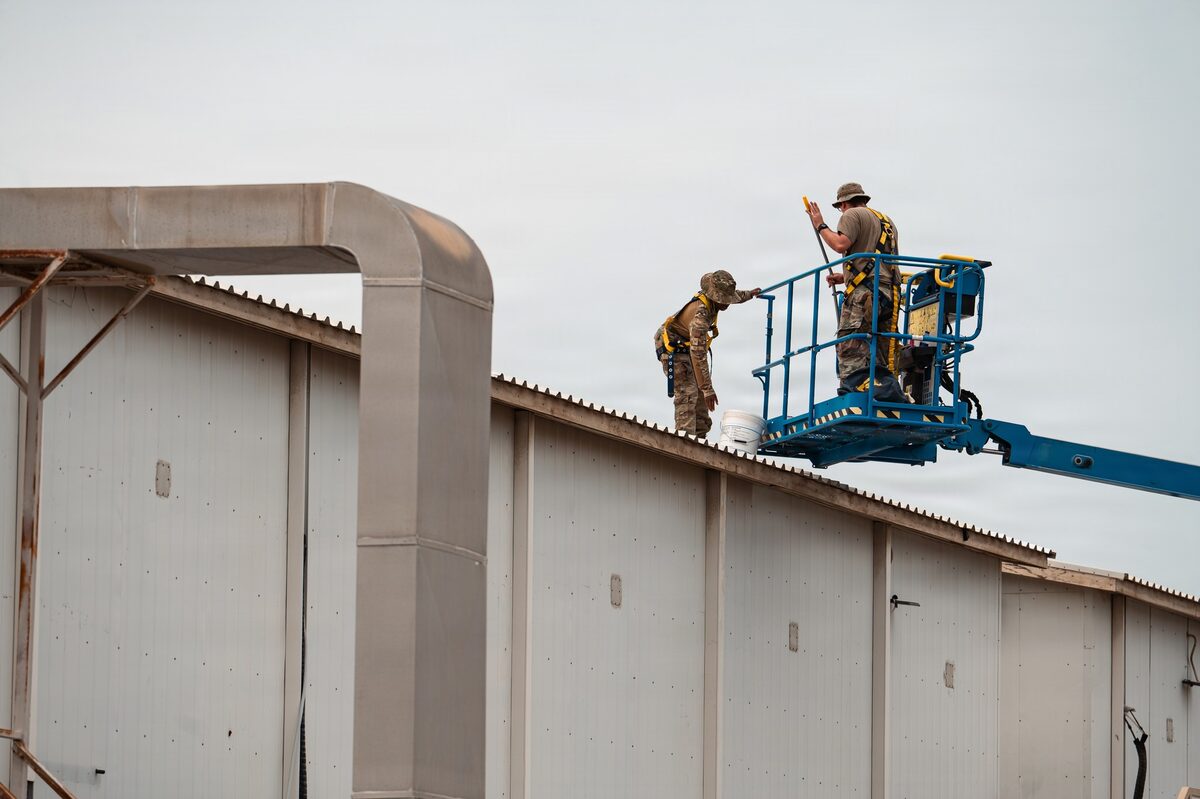
The Department of the Air Force has reserved up to $450 million to keep water out of its buildings, dividing a new roofing contract among 23 small businesses that will compete for repair and replacement work stretching from the Southeast to Alaska. According to the Department of War contract announcement for June 29, 2026, the firm-fixed-price, indefinite-delivery/indefinite-quantity, multiple-award task order contract carries a $450,000,000 ceiling and runs through June 29, 2031. The 772nd Enterprise Sourcing Squadron at Joint Base San Antonio–Lackland, Texas, is the contracting activity.
Background
Roofing is one of the least glamorous and most persistent line items in the military's facility budget. Air Force installations own tens of thousands of buildings — hangars, dormitories, maintenance shops, warehouses — and every one of them needs a roof that holds up under snow load in Alaska, hurricane-driven rain in the Southeast, and the daily thermal cycling of the desert Southwest. When a roof fails, the damage rarely stops at the ceiling tiles: water intrusion ruins insulation, corrodes structural steel, shorts out electrical systems, and grounds the mission housed underneath.
Rather than compete a separate contract every time a roof reaches the end of its service life, the Air Force uses a multiple-award task order contract, or MATOC, to pre-qualify a bench of contractors and then order specific jobs against it as needs arise. The vehicle announced on June 29 covers the full range of commercial and industrial roofing: low-slope systems typical of large flat-roofed hangars and warehouses, steep-slope systems on pitched-roof buildings, and metal roofing. Because the work is bundled into a single ceiling that spans hundreds of buildings and five years, the Air Force can move quickly when a roof needs attention instead of restarting the acquisition clock each time.
The contract was structured as a competitive small-business set-aside, meaning only firms that qualify as small under the applicable size standard were eligible to bid. That framing matters: roofing is a trade dominated by regional and specialty contractors rather than the large prime integrators that win aircraft or IT awards, and the set-aside channels the entire $450 million ceiling toward that base.
Key Details
The competition drew 40 offers, and the Air Force selected 23 firms to share the vehicle. The named awardees include Miwok Construction, Good-Men Roofing & Construction, C. Ortiz Corp., D.A. Nolt, Blue Frog Roofing, A-Vet Roofing, and Defense Roofing Solutions 2, among others. Work will be performed at Department of the Air Force installations within the continental United States, including Alaska, with performance completion set for June 29, 2031.
One figure stands out and is easy to misread: only $23,000 was obligated at the time of award — $1,000 for each of the 23 awardees. That is not the value of the work. On a multiple-award IDIQ, the award itself establishes eligibility and the shared ceiling; the government obligates a nominal minimum guarantee to make each contract binding, then funds the actual roofing jobs later through individual task orders. The $450,000,000 figure is the maximum the Air Force can spend across all 23 firms over the life of the vehicle, not a guaranteed payout to any single company. How much each awardee ultimately earns depends entirely on how many task order competitions it wins.
The contract is firm-fixed-price, which places the risk of cost overruns on the contractor rather than the government — a standard and appropriate structure for construction and repair work where scope can be defined up front. The 772nd Enterprise Sourcing Squadron, part of the Air Force's installation and mission support enterprise, will administer the vehicle and issue task orders from Joint Base San Antonio–Lackland.
What It Means for Contractors
For the 23 firms on the award, the real work is just beginning. Winning a seat on a MATOC is a gate, not a finish line: each future roofing project is competed among the pool, so a company that landed one of the 23 slots still has to bid — and win — task orders to convert the award into revenue. Contractors that build fast, accurate estimating and mobilization capabilities tend to capture a disproportionate share of task orders on vehicles like this one, while those that treat the award as a guaranteed backlog can go years without meaningful work.
For small businesses that did not make the cut, the structure of this award is a roadmap. Forty offers for 23 slots tells prospective bidders that the Air Force is willing to build a wide bench, and it signals steady demand for roofing trades across the enterprise for the next five years. Firms shut out of this vehicle should watch for follow-on and regional roofing set-asides, and should note which past-performance and bonding thresholds separated the winners from the field. Geographic reach is also a factor worth studying: a vehicle that spans the continental U.S. and Alaska rewards contractors who can either self-perform across regions or line up reliable local labor and subcontractors near the installations they intend to service.
More broadly, the award is a reminder that facilities sustainment remains one of the most accessible corners of the defense market for small construction firms. It requires no security clearances, no exotic technology, and no massive capital base — just proven trade capability, a clean safety record, and the administrative discipline to compete task orders on a tight cadence. As the Air Force works through a long backlog of deferred infrastructure maintenance, vehicles like this $450 million roofing MATOC will keep routing dependable, recurring work to the small-business base that keeps its buildings dry.
