
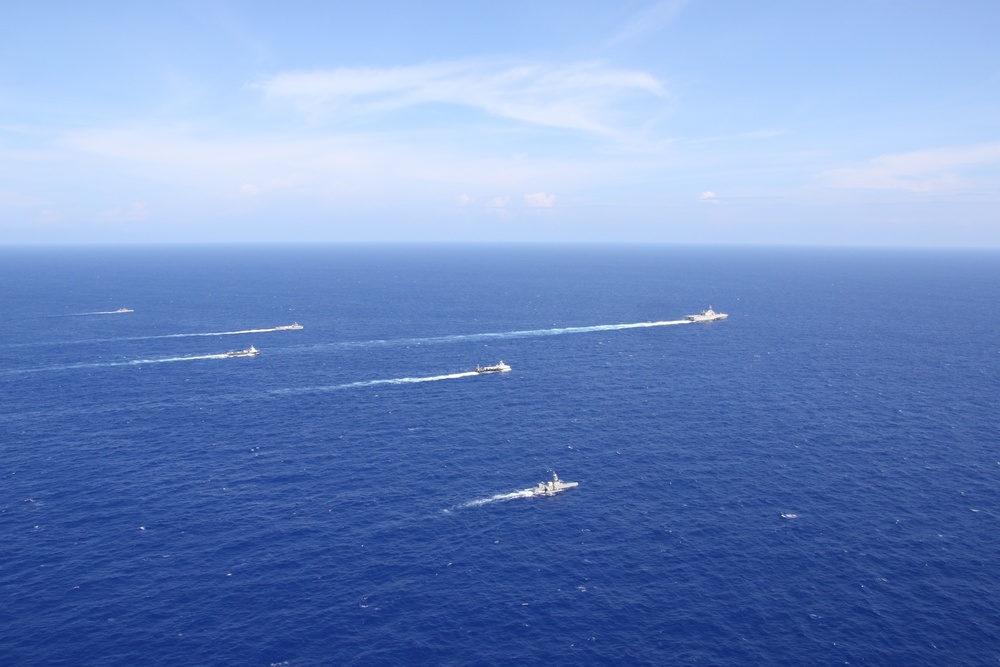
The Navy has moved its medium unmanned surface vessel program out of the test range and into production, committing to 30 robotic ships from three builders at an average of about $40 million per vessel. DefenseScoop reported that Galliano Marine Services, HII and Saronic Technologies were each awarded other transaction agreements to produce 10 MUSVs after "successful at sea testing," according to a press release from the Navy's direct reporting program manager for robotic and autonomous systems (DRPM RAS). Initial deliveries are slated before the end of fiscal 2027.
At that price, the 30-vessel buy totals more than $1 billion, per DefenseScoop. The buy follows the Navy's selection in May of seven companies for at-sea testing, according to Breaking Defense, and it comes out of the marketplace model the Navy launched in March to buy production-ready platforms that already exist.
What the Navy Bought From Galliano, HII and Saronic
Each of the three production agreements covers 10 vessels, for 30 in total. DefenseScoop put the average cost at $40 million per platform; Breaking Defense, citing the Navy, said each system costs roughly $40 million.
Because the figure is an average, individual unit prices may differ. The awards are Other Transaction agreements, the flexible contracting vehicle the Department of Defense uses for prototype and follow-on production work outside standard Federal Acquisition Regulation rules. DefenseScoop described them as production OTA awards that followed "Phase I" at-sea testing. Breaking Defense added that the vessels will also be made available for purchase through the Navy's marketplace for unmanned surface vessels.
The testing focused on three things, according to the Navy release quoted by DefenseScoop: "their ability to see and understand the surrounding maritime environment, how well the vessels navigate autonomously according to International Regulations for Preventing Collisions at Sea, and the vessel's ability to conduct a long-duration mission."
Adm. Daryl Caudle, the Chief of Naval Operations, tied the buy to his Hedge Strategy, which gives uncrewed systems a major role. "MUSVs are an important part of the hedge strategy laid out in our U.S. Navy Fighting Instructions," Caudle said in a statement. "This is about moving beyond experimentation and putting reliable, combat-relevant capability into the hands of our Sailors at the speed the Fleet requires."
Which Vendors Finished Phase I and Which Did Not
Six companies completed the Phase I demonstration. Three won production orders. Leidos, PacMar Technologies and Sea Machines will each receive $15 million under the previously established terms of their prototype agreements, DefenseScoop reported. The Navy release, as relayed by DefenseScoop, says they will be included in the maritime marketplace hosted on the Drones.mil website, where sea drone makers are eligible to receive follow-on production agreements "from authorized acquisition authorities" across the Defense Department.
One selected vendor did not make it through. Breaking Defense reported that Birdon was among the seven companies selected for at-sea testing, which was expected to run from July through October, but did not successfully complete the demonstration, according to the Navy. The Navy's public materials, as reported, do not say why.
HII's entry is the ROMULUS 151 unmanned surface vessel, shown in DefenseScoop's photo in production at Breaux Brothers in New Iberia, Louisiana.
What Phase II Asks for After Phase I
The production awards landed less than a week after the Navy opened the next round. DefenseScoop reported that the service released a call for solutions for a Phase II effort and, in the same window, established a Robotic and Autonomous Systems Warfighting Development Center (RASWDC) at Joint Expeditionary Base Little Creek in Virginia, which is expected to play a major role in shaping how the Navy fights with uncrewed systems.
According to Breaking Defense, the Phase II solicitation, published Sept. 23, asks for vessels no longer than 90 meters that can complete at least 10 days of unmanned operations. The notice calls for a payload capacity of at least two standard 20-foot shipping containers, down from the Phase I requirement of two 40-foot containers. Christopher Miller, the DRPM for robotic and autonomous systems, said all companies that completed Phase I will transfer into the marketplace for Phase II and will be eligible for follow-on production agreements. He also said one lesson from Phase I is that increasing requirements for capabilities like speed can create production challenges for industry and affect vessel designs.
"What I'm trying to do is also give more industry opportunities for companies that have something ready to go," Miller told reporters. "Obviously with Phase I, there were some more challenging requirements that they had to meet, and so I'm trying to back off of those."
Miller has framed the marketplace as a market-shaping tool. He said he is trying to find the "sweet spot in the market where there is healthy competition and there's opportunities, and we can have more things that potentially are dual use, both military and civilian." The Navy is also working with the DRPM for autonomy to expand the Drones.mil marketplace beyond MUSVs to include other surface vessels as well as air, undersea and counter-UxS systems, Miller said.
What It Means for Contractors
The marketplace has now produced a 30-vessel production buy, and the path it used looks reproducible. Vendors that complete an at-sea demonstration under a prototype OT get a $15 million payment under their prototype terms, a place in the Drones.mil marketplace and eligibility for follow-on agreements from authorized acquisition authorities across the department. A Navy production order is one route to revenue, not the only one. Six vendors are now on that track, and Phase II is meant to draw more.
For vessel builders, the lesson is that demonstration performance decided the outcome. Birdon was selected in the first round and did not finish. Three of the six finishers won production orders, and three received the prototype payment with follow-on eligibility only. Builders considering Phase II should plan against the new envelope: hulls no longer than 90 meters, at least 10 days of unmanned operation, and a payload capacity of at least two 20-foot containers. Miller's comments suggest the Navy is deliberately trading some performance demands for buildability and a broader industrial base, though that reading is our inference from his remarks.
For the supply chain, 30 vessels delivered starting before the end of fiscal 2027 implies demand for engines, sensors, autonomy software, power systems and integration work across the three builders' yards. HII's ROMULUS 151 production in Louisiana, as shown in DefenseScoop's photo caption, is one visible node.
For payload and mission-system vendors, Caudle's description of MUSVs as "a platform for rapidly integrating new sensors, weapons, and other mission payloads" points to potential demand for modular payloads, though the coverage does not identify specific payload solicitations. Watch the marketplace and the new RASWDC for requirements.
Finally, the average-price framing matters for competitors: roughly $40 million per vessel is now a public benchmark for a production MUSV, and Phase II offerors will likely be measured against it.
