
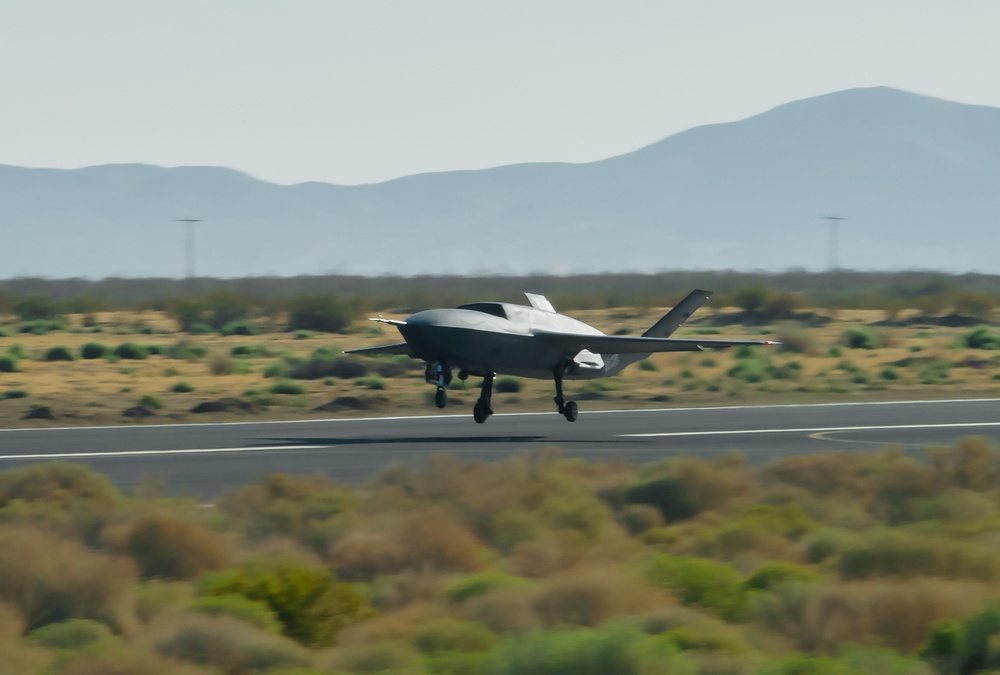
The Air Force announced June 17, 2026, that it has selected Anduril Industries and General Atomics Aeronautical Systems for engineering-and-manufacturing development and initial production contracts covering the first Collaborative Combat Aircraft (CCA) program of record. The selection ends the prototype competition phase and moves two unmanned combat platforms — Anduril's FQ-44A Fury and General Atomics' FQ-42A Dark Merlin — into full production, dropping the experimental "Y" prefix. The decision positions both companies as prime producers for a program the Air Force has described as the backbone of future crewed-uncrewed teaming operations, and signals a willingness to look past the traditional prime contractors when speed and cost discipline are the deciding criteria.
What Was Awarded and Why
The contracts cover the first three production lots of CCA Increment 1, the initial operational variant of the unmanned wingman program. The Air Force requested approximately $996.5 million for procurement in FY2027 and roughly $1.4 billion for continued development in the same budget cycle, framing CCA as one of its highest-priority modernization investments. Both figures appear in the FY2027 President's Budget request disclosed alongside the June 17 announcement.
Both awardees beat out prominent incumbents. Lockheed Martin, Northrop Grumman, and Boeing all competed for the production airframe contracts and were not selected. The outcome underscores a deliberate Air Force strategy to expand its industrial base beyond the traditional primes for certain advanced programs.
The contracts were awarded four months ahead of the original schedule, a timeline achievement Air Force acquisition officials attributed to lessons absorbed from the YFQ-42A and YFQ-44A prototype fly-offs. Both companies emphasized that the accelerated schedule reflected a deliberate engineering-for-manufacture approach from the earliest design reviews.
Platform Specifications and the Autonomy Software Split
Both aircraft share a core set of requirements. Each CCA must achieve a minimum combat radius of 700 nautical miles and carry a modular payload bay that can be reconfigured for strike, intelligence-surveillance-reconnaissance, or electronic warfare missions without major airframe modifications. The target unit cost sits below $30 million per aircraft — roughly one-third the flyaway cost of an F-35A — a price point the Air Force set deliberately to enable procurement at scale without the budgetary pressure that limits fighter buys.
The long-term fleet objective is approximately 1,000 aircraft across multiple CCA increments. The nearer-term production goal calls for at least 150 operational CCAs fielded by the end of the decade. The aircraft are designed to fly in coordinated formations alongside crewed fighters, performing tasks ranging from suppression of enemy air defenses to attritable penetration of contested airspace where sending crewed aircraft carries unacceptable risk.
One of the more consequential structural decisions embedded in the program is what the Air Force is calling the "software sold separately" strategy. The production airframe contracts do not include mission autonomy software. That work is proceeding under a parallel competition: Anduril, Shield AI, and Collins Aerospace each received six-month contracts to develop and demonstrate autonomy solutions. The Air Force plans a downselect to one or two vendors by summer 2027. Decoupling the airframe and the autonomy software allows the service to update the aircraft's mission logic independently of the physical platform — the same logic that underpins cloud-native software acquisition models, now applied to a flying weapons system.
Col. Timothy Helfrich, the portfolio acquisition executive for Fighters and Advanced Aircraft, characterized CCA as representing the next evolution of airpower and the service's first operational instance of human-machine teaming in aviation. The statement marks a deliberate shift in language from prior unmanned programs. Earlier Air Force drones operated largely as remote-controlled platforms flown by ground-based pilots. CCA aircraft are designed to operate with on-board AI decision support, responding to tactical inputs from a crewed flight lead without constant datalink supervision.
What It Means for Contractors
- Anduril and General Atomics hold the production runway. Both companies now hold multi-lot production positions on a program targeting a 1,000-aircraft fleet. Subcontractor and supply-chain opportunities across structures, propulsion, sensors, and ground systems will materialize as production ramps through the late 2020s.
- The autonomy software competition remains open. Shield AI and Collins Aerospace remain in the autonomy downselect alongside Anduril. A contract award is expected by summer 2027, and the winning autonomy vendor or vendors will hold an ongoing software license position for the life of the program — potentially more durable revenue than a single hardware production contract.
- Payload and mission-system integrators have a defined insertion point. The modular payload architecture means companies developing EW systems, ISR sensors, and strike packages can compete for role-specific configurations without needing to touch the airframe itself. This creates a structural opportunity for mid-tier defense electronics firms that would not otherwise have access to a major air vehicle program.
- The losing primes face a positioning question for Increment 2. Boeing, Lockheed Martin, and Northrop Grumman invested heavily in their CCA prototype bids. None are shut out of the broader uncrewed aviation market, but each will need to assess how aggressively to pursue CCA Increment 2 or other emerging uncrewed programs to offset the miss on Increment 1 production.
- FY2027 budget requests signal sustained commitment. The combined approximately $2.4 billion in FY2027 Air Force requests for CCA development and procurement establishes a baseline contractors can use to size proposals and teaming strategies for subsequent lots and sustainment vehicles.
- Primes outside the production award face a narrowing window. Companies that did not receive a CCA production position will find it increasingly difficult to enter the program as lot sizes grow and production lines mature. The practical path to participation runs through the open autonomy software competition or through established subcontract relationships with Anduril and General Atomics, both of which will need to scale supplier networks substantially to meet the 1,000-aircraft target.
Sources
- DefenseScoop — Air Force picks Anduril, General Atomics to build first operational CCA drones (June 17, 2026)
- Breaking Defense — Air Force picks General Atomics, Anduril to build first CCA drone wingmen (June 17, 2026)
- Air and Space Forces Magazine — Air Force Selects General Atomics and Anduril for CCA Production (June 17, 2026)
