
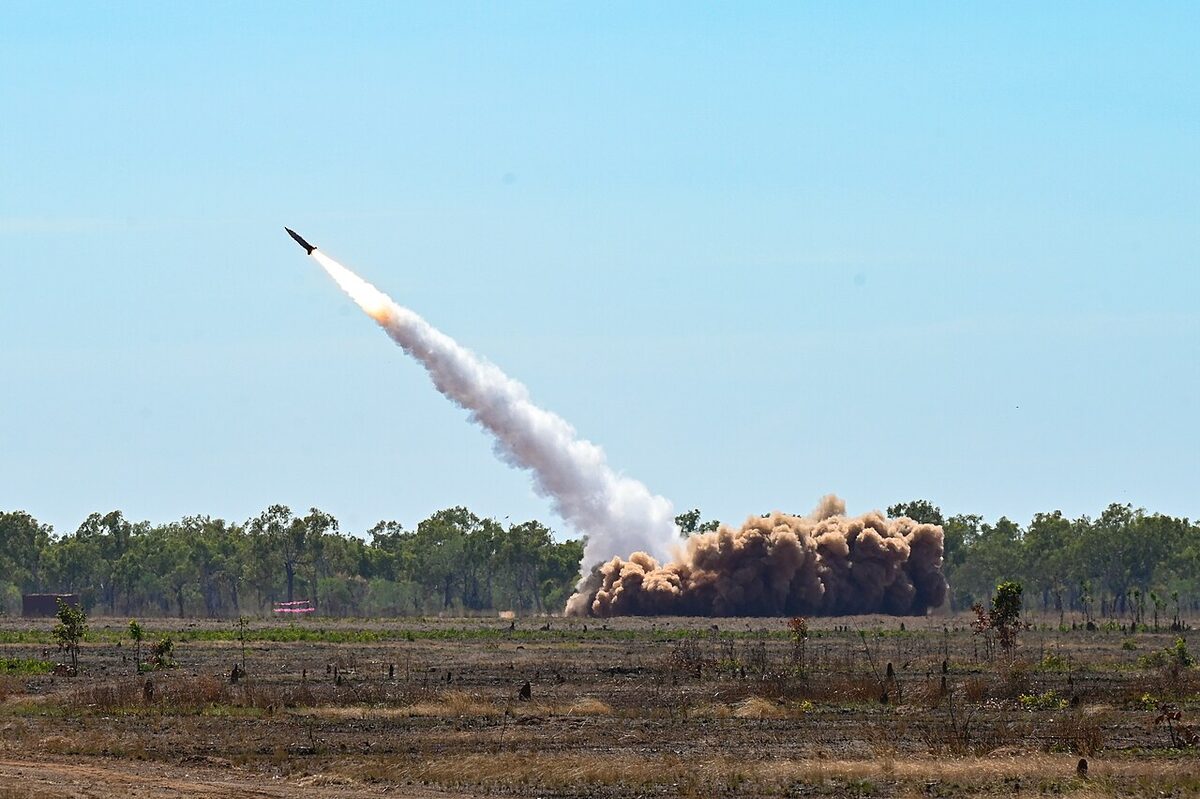
Launcher builders chasing the Army's next family of autonomous missile carriers are about to learn who holds the lead position. The service has finished source selection for the Common Autonomous Multi-Domain Launcher (CAML) Medium platform and could make an award within the next 30 days, Defense Daily reported on Oct. 14, 2026. The update came from Lt. Gen. Frank Lozano, the Army's program acquisition executive for fires, during a panel at the Association of the U.S. Army's annual conference in Washington, D.C.
“We just finished our source selection effort,” Lozano said, according to Defense Daily. He also laid out a three-variant roadmap: a CAML Light effort run with Australia starting in 2027, followed by a CAML Heavy initiative around the 2028/2029 timeframe.
What Happens Next for CAML Medium?
The Army has already picked Georgia Tech Research Institute (GTRI) as weapon systems integrator for CAML Medium, a deal Defense Daily put at $33.4 million and Breaking Defense described as worth up to $33.4 million. Defense Daily reported that the Army called that deal “the first key step in the development” of CAML and said subsequent awards covering the autonomous mobility platform and additional components were scheduled in the coming months.
Lozano filled in that schedule at AUSA. Breaking Defense reported that he said a munitions palette provider and the autonomous platform provider for the medium program should be awarded in the next 30 days. Neither source names bidders or a contract value for either piece.
The Army has described CAML as an “autonomous, optionally crewed, highly mobile, air-transportable, multi-domain (offensive and defensive) fires launcher with the potential to augment or replace existing Army launchers,” Defense Daily reported. Each CAML system is expected to include a launcher platform, a leader vehicle with an autonomy kit, and either an automated resupply vehicle or an “inherent autonomous resupply capability.” Breaking Defense reported that CAML is set to replace Typhon, the Army's Mid-Range Capability launcher, after the service found that system too large to operate on the battlefield.
Why the Army Capped CAML Medium at 36,000 Pounds
CAML Medium did not start as the Army's only near-term target. Lozano said in an earlier media roundtable, as reported by Defense Daily, that the service had planned to pursue a heavy version concurrently, but the platforms industry demonstrated and proposed came in heavier than the Army wanted.
Once his office matched interceptor loadouts against how combatant commands planned to employ the system, a 60,000-pound gross vehicle weight platform “was just going to be too heavy,” Lozano said. The Army settled on a CAML Medium variant “that would have a top-end gross vehicle weight rating of 36,000 pounds,” he said, according to Defense Daily.
Within that weight limit, Lozano has said CAML Medium should be able to carry Tomahawk missiles, PAC-3 MSE interceptors, “probably” the future low-cost interceptor, the Lockheed Martin-built MLRS family of munitions, and Indirect Fire Protection Capability interceptors, Defense Daily reported.
One Launcher Per Missile Gives Way to Three
The broader goal is fewer launcher types across the Army's fires portfolio. Today, Lozano said, each missile tends to come with its own launcher.
“We’re looking at a strategy here…where we have every missile [currently] having its own unique launcher and trying to collapse down to a maximum of three. But that generically is the timeline, and we massage and adjust that timeline as we learn more about industry’s capabilities to deliver what we need,” Lozano said, as quoted by Defense Daily.
CAML Heavy would carry the largest weapons. Lozano said the Army envisions that platform handling “some of our larger missile systems, potentially a Leviathan and [Long-Range Hypersonic Weapon], maybe a stack of Tomahawk missiles,” according to Defense Daily. Breaking Defense reported that his office is “starting to look” at the 2028-2029 timeframe for that launcher.
How the CAML Light Sprint With Australia Will Work
The Light variant is the newest addition. Breaking Defense noted that the Army had previously said it was pursuing only medium and heavy variants, and that Lozano did not explain why a light version was added or detail the Australian military's role.
Lozano said Acting Army Chief Gen. Christopher LaNeve directed PAE Fires to run the program with Australia “to help the Australians meet some of their capability requirements,” Defense Daily reported. “We have a solicitation, an RFI, ready to issue that will be followed up by an industry day,” Lozano said.
The timeline is short. Defense Daily reported that the Army could make CAML Light prototyping selections in spring 2027, and Breaking Defense put the “early selections” in the March to April window. Those picks could support a live-fire demonstration at the Talisman Sabre exercise in June or July, Lozano said, which “would then allow us to make a downselected award on that effort.”
Lozano also said the Army will keep more than one vendor on CAML Light, as with the medium variant. “We have to break the old tradition of doing a competition and going down to one vendor, and then going all in on one single vendor, because then you just created a sole source environment, a choke point, and a manufacturing constraint,” he said, according to Breaking Defense.
What It Means for Contractors
Companies that bid on CAML Medium's autonomous platform and munitions palette pieces should expect decisions soon. Lozano's 30-day window, counted from his Oct. 14 remarks, points to awards in mid-November, though the Army has not released a firm date. Losing offerors should watch for debriefing notices and the protest clock that starts with them.
For firms that missed Medium, CAML Light is the next entry point. The RFI is described as ready to issue, with an industry day to follow and selections targeted for spring 2027. Vendors with lighter autonomous vehicles or launcher designs that fit Australian requirements should prepare now, since the gap between the RFI and a live-fire demonstration at Talisman Sabre is only a few months. Teams should also plan for coordination with Australian stakeholders, though the Army has not described how that partnership will work.
Lozano's multi-vendor approach matters for business planning. If the Army holds to its stated intent of keeping multiple suppliers, a Light award may be one of several rather than a winner-take-all contract. That lowers the stakes of any single competition, though it could also mean smaller shares per vendor.
Missile and interceptor makers have a stake too. With the Army working toward no more than three launcher types, integration with CAML Medium's 36,000-pound platform, and later CAML Heavy, will shape which munitions reach the field on Army autonomous launchers. GTRI's role as weapon systems integrator makes it a likely point of contact for companies that need their weapons to fit the CAML architecture.
