
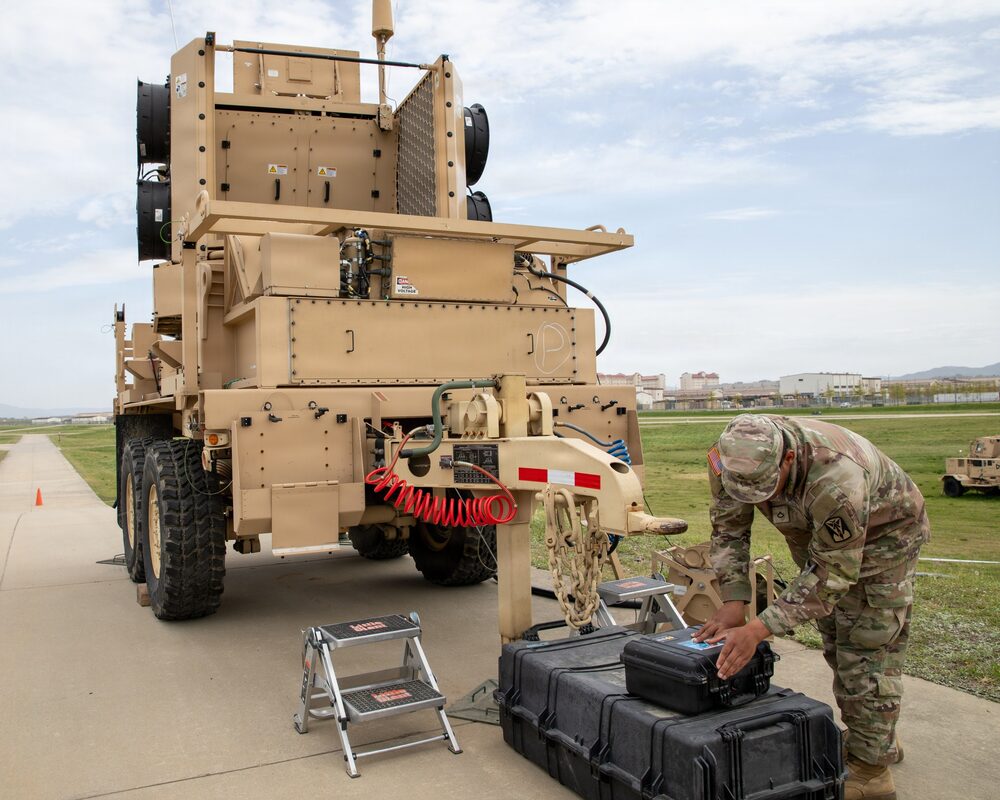
The Army has committed to as much as $2,998,742,163 for continued production of Lockheed Martin's Sentinel A4 radar, according to the Department of War's daily contract announcement for June 30, 2026. Army Contracting Command at Redstone Arsenal, Alabama, structured the deal as a framework vehicle combining fixed-price-incentive work with cost-plus-fixed-fee and cost-no-fee lines, covering radar production and associated engineering services. The period of performance runs through June 29, 2031, giving Lockheed a five-year runway to build out one of the Army's most closely watched sensor programs.
Background
Sentinel A4 is the Army's next-generation air-and-missile-defense radar, built to replace the legacy Sentinel A3 that has anchored Short-Range Air Defense units for years. The older radar was designed in a threat environment that predates the current explosion of small unmanned aircraft, one-way attack drones, and low-flying cruise missiles. Sentinel A4 answers that gap by adding 360-degree detection across a wider set of threat classes: cruise missiles, unmanned aircraft systems, rotary- and fixed-wing aircraft, electronic-warfare emitters, and the rockets, artillery, and mortars that dominate contested ground.
The radar does not operate in isolation. Its open-architecture design lets it connect across multiple command-and-control networks rather than being tied to a single weapon, including integration with the Army's Forward Area Air Defense Command and Control (FAAD-C2) system. In that role, Sentinel A4 serves as a forward sensor that can pass tracks to shooters across the broader air-and-missile-defense network. The Army recently took delivery of its first Low-Rate Initial Production Lot 2 radar in February 2026, a marker that the program has moved past early engineering builds and into a manufacturing cadence that the new framework contract is meant to sustain and scale.
Key Details
The award carries a maximum value just under $3 billion, making it one of the larger single-day actions in the June 30 announcement. The hybrid pricing structure is notable: fixed-price-incentive terms put production risk on the contractor while preserving an incentive to control cost, and the cost-plus-fixed-fee and cost-no-fee lines cover the engineering and support work that is harder to price to a firm number. That blend is common on programs that are simultaneously in production and still maturing, where the government wants delivery discipline on hardware but flexibility on the surrounding technical services.
Army Contracting Command at Redstone Arsenal is the contracting activity, consistent with the program's home at the service's aviation and missile enterprise in Huntsville. As a framework contract, the vehicle establishes a ceiling and terms against which the Army can place production orders over the five-year window rather than committing the full amount up front. That means the $2.99 billion figure represents capacity, not a lump obligation, and actual spending will track the number of radars the Army orders and the pace of the associated engineering effort through June 2031.
The recent LRIP 2 delivery is the operational context for the award. With a first low-rate radar in hand, the Army needs a production instrument in place to keep units flowing as the system moves toward full-rate decisions. The framework contract supplies that instrument, and the engineering services included alongside production give the government a mechanism to fund fixes, upgrades, and integration work that inevitably surface as the radar reaches more field units.
What It Means for Contractors
A framework contract of this size is a magnet for the supplier base beneath the prime. Sentinel A4 is built around an active electronically scanned array, and that translates into sustained demand for transmit-receive modules, power and cooling subsystems, precision machining, cabling, and the specialized RF components that go into a modern AESA. Firms that already hold positions on Lockheed's radar supply chain gain a multi-year demand signal; those that do not now have a concrete program to target with capability pitches and qualification efforts.
The networking role widens the opportunity beyond hardware. Because Sentinel A4 is built on an open architecture that connects across multiple command-and-control networks rather than operating as a standalone radar, there is recurring work in software integration, interface management, cybersecurity, and test and evaluation as the sensor is folded into the broader air-and-missile-defense architecture. Systems-engineering and digital-engineering vendors that can support open-architecture integration have a durable lane here, particularly given the cost-reimbursable engineering lines that fund exactly that kind of effort.
The award also reinforces where Army modernization money is flowing. Counter-drone and counter-cruise-missile detection has become a top-tier requirement, and a nearly $3 billion commitment to a 360-degree radar signals that the service intends to keep buying sensors that address those threats at scale. Contractors weighing where to place business-development bets can read the five-year period of performance as a stable demand horizon rather than a one-off buy. Sustainment, training-system, and depot-support providers should watch the same window, because a growing fielded radar fleet generates a maintenance and spares tail that typically outlasts the production run itself. For small businesses, the depth of the RF and electronics supply chain leaves room to compete for lower-tier subcontracts and specialized component work even without a direct prime relationship.
Finally, the contract type is instructive for anyone bidding adjacent programs. The government's decision to blend firm production pricing with cost-reimbursable engineering reflects a program that is delivering and evolving at the same time. Vendors that can operate comfortably in both worlds, holding to fixed-price delivery while flexing on engineering scope, are best positioned to win and keep this kind of work.
