
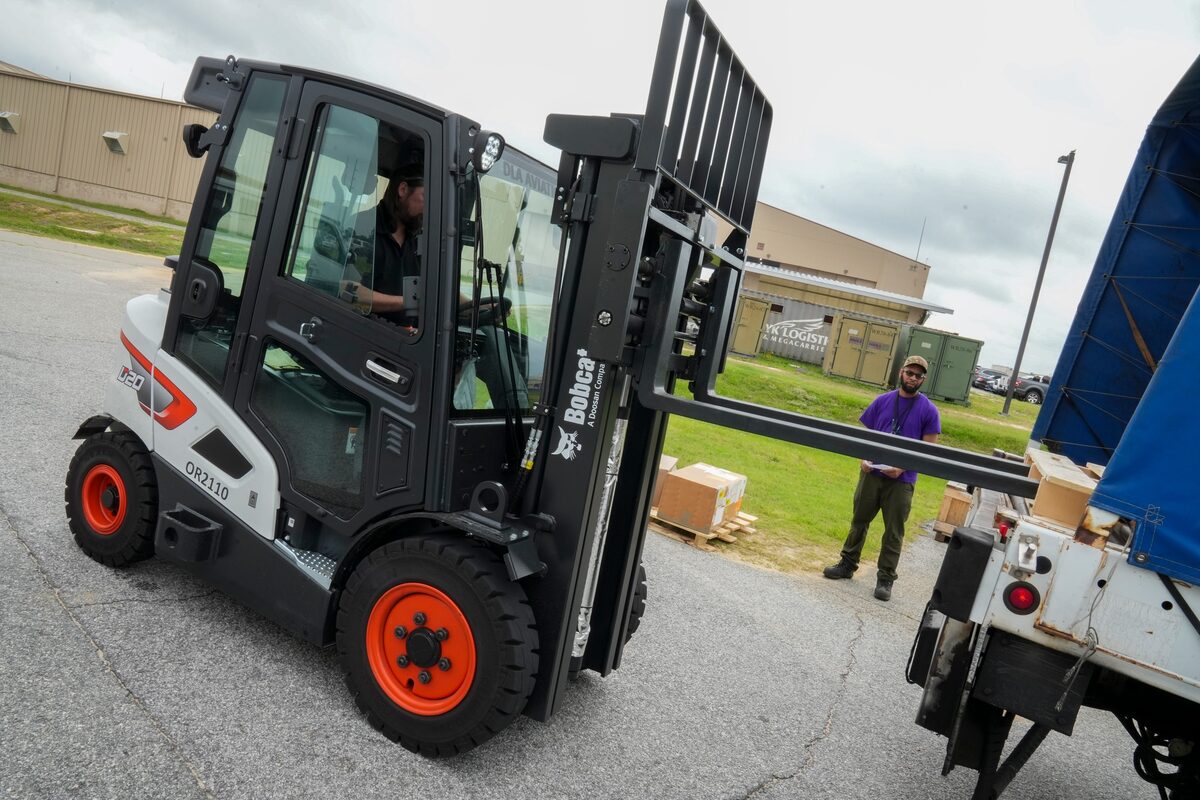
The Defense Logistics Agency has awarded ASRC Federal Facilities Logistics an indefinite-delivery/indefinite-quantity contract with a maximum value of $1,525,000,000 for industrial product supply chain support, according to the Department of War's contract announcement for June 25, 2026. The fixed-price-with-economic-price-adjustment vehicle covers work in Georgia, Oklahoma and Utah, carries a five-year base period plus options, and runs through December 31, 2031. DLA competitively procured the requirement and received three responses.
Background
The Defense Logistics Agency is the Pentagon's combat-support agency for materiel, and its industrial product lines keep military maintenance depots stocked with the consumables and hardware those depots burn through repairing aircraft, ground vehicles, ships and weapon systems. Supply chain management for maintenance, repair and operations (MRO) materials and broader industrial products is a recurring DLA need, and the agency increasingly bundles it under large IDIQ vehicles that let depots place delivery orders against a pre-negotiated ceiling rather than running individual procurements for each line item.
ASRC Federal Facilities Logistics is a subsidiary of ASRC Federal, itself owned by Arctic Slope Regional Corporation, an Alaska Native Corporation. The company has built a deep DLA supply-chain portfolio. It holds the ChemPOL III program for chemicals and packaged petroleum, oil and lubricants, an award the company has described as worth up to $2.3 billion and one that serves more than 5,000 U.S. installations worldwide while processing roughly 17,000 delivery orders a month. The new $1.53 billion industrial product award extends that line of business into the consumables and materials that flow through major depot operations.
The three named performance states map closely to the military's organic industrial base. Georgia, Oklahoma and Utah each host large depots and logistics complexes that sustain Defense Department platforms, and co-locating supply-chain management with those sites lets a prime push material directly into the maintenance pipeline.
Key Details
The contract's structure carries practical weight. A fixed-price-with-economic-price-adjustment arrangement sets prices up front but allows defined adjustments tied to economic indices, a hedge against commodity and labor cost swings over a contract that could run more than five years. That mechanism is common on long-duration supply contracts where the underlying material costs are volatile and neither party wants to absorb open-ended inflation risk.
The ceiling is a maximum, not a guaranteed payout. As an IDIQ, the $1,525,000,000 figure represents the most DLA can order over the life of the vehicle; actual obligations depend on the volume of delivery orders the agency and its depot customers issue. The five-year base period plus options is the contractual runway, with completion set for December 31, 2031.
Competition was limited. DLA received three responses to the solicitation, a modest field for a contract of this size and a signal that few firms carry the depot-facing logistics infrastructure and past performance to bid credibly on industrial product supply chain management at this scale. The award is distinct from the larger awards on the same June 25 contract list, including a combined $8 billion NAVFAC Washington construction vehicle, and reflects DLA's separate sustainment mission rather than vertical construction.
Industrial product support under DLA typically spans the routine but essential categories that keep maintenance lines moving: tooling, fasteners, abrasives, lubricants, shop supplies and similar MRO materials. The supply-chain management role places responsibility on the prime for sourcing, stocking and delivering those items against depot demand signals, a function that rewards established vendor relationships and warehouse and distribution reach near the work.
What It Means for Contractors
For the government contracting market, the award reinforces several patterns worth tracking. First, DLA continues to consolidate recurring materiel needs into large multiyear IDIQs, which concentrates revenue in incumbents with proven depot-support records and raises the barrier for new entrants. A three-response field on a $1.53 billion requirement shows how thin the qualified bidder pool can be once a contract demands national distribution capacity and a track record of moving industrial materials into active maintenance operations.
Second, the economic-price-adjustment clause is a reminder that pricing strategy on long supply contracts is as much about risk allocation as it is about unit cost. Firms bidding multiyear materiel vehicles should weigh how index-based adjustments are defined, since the structure shapes margin durability across a period that can see meaningful commodity and labor inflation.
Third, the award underscores the standing of Alaska Native Corporation subsidiaries as primes on major federal logistics programs. ASRC Federal's accumulation of DLA work, from the ChemPOL III chemicals and POL program to the new industrial product support vehicle, illustrates how a logistics-focused prime can build adjacent supply-chain franchises across a single agency. Subcontractors and suppliers in tooling, MRO materials and distribution should view the new vehicle as a multiyear demand channel and position early, because delivery-order work under an IDIQ flows to the supplier network the prime assembles at the outset.
Finally, the geographic concentration in Georgia, Oklahoma and Utah signals where the depot-driven demand sits. Contractors with warehousing, transportation or staging capacity near those logistics hubs hold a structural advantage on the delivery orders that will define how much of the $1.525 billion ceiling actually converts to revenue through 2031.
