
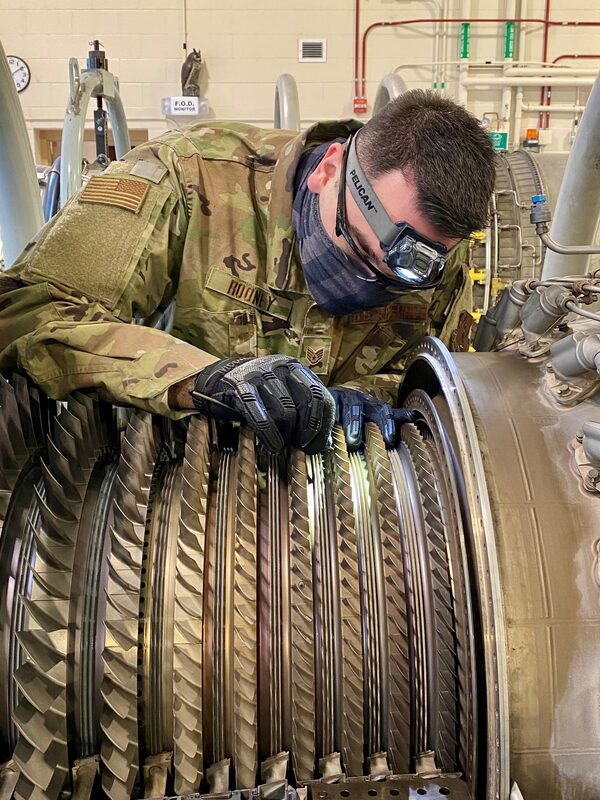
The Air Force is betting $85 million that the way it designs aircraft is broken. Under a new 10-year contract, Booz Allen Hamilton will build digital tools meant to link the engineering of a jet's airframe, propulsion, power and thermal systems together from the start of a program, instead of optimizing each piece separately and hoping they fit when assembled, according to Washington Technology.
The award went to Booz Allen's McLean, Virginia headquarters for work titled "Digital System-Level Mission-Driven Integrated Design Methods for Aerospace Systems," contract number FA2391-26-D-B012. The Air Force Research Laboratory at Wright-Patterson Air Force Base, Ohio, is the contracting activity, and the work itself will happen in Dayton, Ohio. The period of performance runs a full decade, with an estimated completion date of Sept. 22, 2036.
The Pentagon's daily contracts announcement, mirrored by GlobalSecurity after the Department of War's Sept. 22, 2026 release, lays out the award in its own language: "Booz Allen Hamilton Inc., McLean, Virginia, has been awarded a not-to-exceed $85,000,000 ceiling indefinite delivery/indefinite quantity contract for Digital System-Level Mission-Driven Integrated Design Methods for Aerospace Systems," reads the Department of War contract announcement for Sept. 22, 2026, mirrored by GlobalSecurity.
What an $85 Million Ceiling Actually Buys
The headline number is a ceiling, not a check. It caps how much the government can spend across the contract's full 10-year life if every option and task order gets exercised — it is not money in hand. The announcement is explicit that "no funds are obligated on the basic indefinite delivery/indefinite quantity contract at the time of award." The first real dollars flow through a separate vehicle: task order FA2391-26-F-B019, which the contract announcement says "is incrementally funded with Fiscal 2026 research and development funds in the amount of $75,000."
That gap between an $85 million ceiling and a $75,000 initial task order is standard for research IDIQs, which exist to let a lab tap a vetted contractor repeatedly over a decade without re-competing every individual project. But it also means the contract's real value to Booz Allen will be determined almost entirely by how many additional task orders AFRL issues against it in the coming years, not by the number in this week's announcement.
Winning the vehicle at all required beating a crowded field. Washington Technology reported: "The company beat out seven other competitors for the 10-year contract with the Air Force Research Lab at Wright-Patterson Air Force Base in Ohio, according to the Defense Department's Tuesday awards roundup." The contract announcement itself confirms eight total offers were received for what it calls a competitive acquisition — a notably deep bench for a niche digital-engineering research contract, and a sign of how much interest the underlying design problem has attracted across the aerospace-engineering contractor base.
Why the Air Force Wants One Team Instead of Many
The contract did not appear out of nowhere. It traces back to a 2024 Air Force request for information that asked industry for an integrated approach to system design — one that considers airframes, propulsion, power and thermal management together, rather than treating each as its own optimization problem handed to a separate team, according to Washington Technology's reporting on the award's origins.
That distinction matters more than it might sound. In a conventional aircraft-design process, propulsion engineers optimize an engine, structures engineers optimize an airframe, and thermal engineers figure out how to keep everything cool, often on separate schedules with limited visibility into how a change in one discipline ripples into the others. A structural change made late to save weight can blow a thermal budget; an engine swap can force airframe changes nobody modeled early enough to catch cheaply. AFRL's 2024 RFI framed that hand-off-heavy process as the problem to solve, and this week's award is the lab putting a contractor on the hook to build a fix: a vehicle-system design product and thermal-management design methodologies meant to model those interactions before metal gets cut.
The RFI did not stop at design tools. It also flagged a cluster of adjacent capabilities the Air Force wants folded into the same digital-engineering push: military utility analysis, model-based systems engineering, data science, research computing and DevSecOps software practices. None of those show up as separately funded line items in this week's award, but they outline where AFRL is likely to steer future task orders issued against the same 10-year vehicle — and where competitors who lost this round may get another shot at work under the ceiling.
What It Means for Contractors
For Booz Allen, the award adds a decade-long foothold in Air Force digital-engineering research at a moment when the Pentagon is pushing "digital engineering" and model-based design from buzzword into acquisition policy across multiple services. An IDIQ ceiling of $85 million gives the firm room to grow with the program if AFRL keeps funding follow-on task orders, but it carries no revenue guarantee — the company will have to keep winning individual task orders, the same as any contractor on a research IDIQ, starting with the $75,000 first order already on the books.
For the seven firms that lost the competition, the door is not fully closed. Because the vehicle is structured as an IDIQ rather than a single fixed-scope contract, AFRL can in principle bring in additional awardees on future increments, and the adjacent capability areas flagged in the original RFI — model-based systems engineering, data science, research computing, DevSecOps — give losing bidders specific, named territory to compete for on the next request rather than a vague promise of "future opportunities."
More broadly, the award is a data point for any aerospace-engineering contractor watching where AFRL research dollars are headed: toward tools that model a jet's subsystems as one interconnected system rather than a stack of components designed in isolation, and toward the ten-year vehicles that let a single research lab fund that work incrementally without a fresh competition every year. Contractors chasing similar AFRL digital-engineering work now have a concrete benchmark for what a competitive award in this space actually looks like — an $85 million ceiling, an eight-offer field, and a first task order funded in the tens of thousands of dollars rather than millions.
