
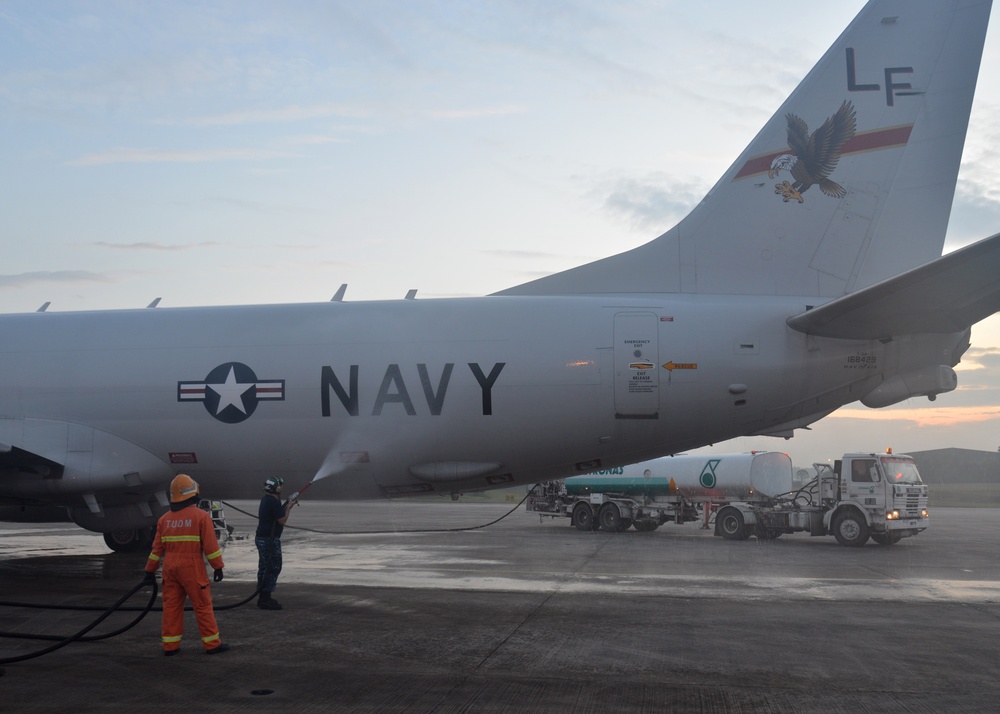
The U.S. Navy awarded Boeing an $880 million indefinite-delivery/indefinite-quantity contract on June 18, 2026, for procurement, modernization, and sustainment of P-8A Poseidon aircrew and maintenance training systems. The five-year performance period runs through June 2031, with work spread across 12 locations in nine countries. Contract number N6134026D1006 was administered by the Naval Air Warfare Center Training Systems Division in Orlando, Florida. The deal covers not only U.S. Navy flight crews but operators across every allied nation that has taken delivery of the maritime patrol aircraft — reflecting the P-8A's role as the dominant Western maritime patrol platform of its generation.
Background
The Boeing P-8A Poseidon is the Navy's primary long-range maritime patrol and anti-submarine warfare aircraft, replacing the aging P-3C Orion. Built on the 737-800 commercial airframe, the aircraft carries advanced sensors, sonobuoys, torpedoes, and Harpoon missiles. Its reach extends well beyond U.S. shores: Australia, the United Kingdom, Germany, South Korea, Norway, New Zealand, Canada, and Singapore have all acquired the platform, making allied crew training a standing multinational requirement rather than an occasional add-on.
Training systems for a complex patrol aircraft encompass full-mission simulators, weapons systems trainers, tactical coordination trainers, and computer-based instruction modules. These devices require constant hardware refreshes, software updates keyed to aircraft block upgrades, and on-site support at each operator's home station. The scope of this contract directly reflects the scale of the P-8A's international footprint: 12 discrete work locations spanning three continents and nine sovereign nations, all managed under a single Boeing umbrella contract. Work locations include St. Louis, Missouri; Jacksonville, Florida; Oak Harbor, Washington; Edinburgh, South Australia; Ohakea, New Zealand; Gyeonsangnam-Do, South Korea; Wurster Nordseeküste, Germany; Greenwood and Comox, Canada; Singapore; Trondheim, Norway; and Edinburgh, United Kingdom.
This award builds on a pattern of sustained Navy investment in P-8A training infrastructure. In February 2026, the Navy issued Boeing a separate $167 million IDIQ for P-8A software sustainment. In April 2025, the Navy awarded Boeing $133.5 million for South Korean air force training systems. The new $880 million vehicle consolidates much of that fragmented award history into a single overarching training systems contract, providing the Navy and its partners a more unified acquisition pathway for simulator upgrades and long-term lifecycle support across the full operator community.
Contract Details
The contract structure mixes firm-fixed-price line items for hardware procurement and deliverables with cost-plus-fixed-fee line items covering integration, testing, and support services — a common hybrid approach for training system programs where hardware costs are predictable but engineering labor is less so. As an IDIQ vehicle, the $880 million figure represents the ceiling; actual task orders obligated against it may total less depending on allied partner uptake and budget cycles. No funds were obligated at time of award; funds are obligated per individual task orders.
Primary work is performed at Boeing's facility in St. Louis, Missouri, which accounts for approximately 80 percent of total contract work. Additional U.S. work locations include Jacksonville, Florida and Oak Harbor, Washington. International work spans eight allied countries: Australia, the United Kingdom, Germany, South Korea, Norway, New Zealand, Canada, and Singapore. Each location hosts its own mix of simulator hardware and instructor support, meaning Boeing must manage a geographically distributed sustainment enterprise with varying host-nation requirements, logistics pipelines, and security arrangements particular to each partner nation's base infrastructure.
The Naval Air Warfare Center Training Systems Division in Orlando serves as the administering activity. NAWCTSD is the Navy's center of excellence for training device development, acquisition, and lifecycle support, and it manages similar training systems contracts across multiple aircraft platforms.
Allied Training as a Strategic Imperative
The multinational dimension of this contract reflects a broader Pentagon posture. As the Navy expands combined operations with allied partners in the Indo-Pacific and North Atlantic, interoperable training has become an operational priority. A Norwegian P-8A crew and a U.S. Navy crew prosecuting the same submarine contact need compatible tactics and identical sensor familiarity. When Boeing refreshes the U.S. Navy's full-mission simulators, those upgrades must cascade to partner stations in Norway and Australia on a coordinated schedule to maintain alliance-wide proficiency.
The contract's coverage of nine countries in a single vehicle streamlines that coordination. Rather than negotiating bilateral foreign military sales training annexes one country at a time, the Navy can direct task orders from a central vehicle and push consistent curriculum and software updates across the entire operator community. Germany, which is still building out its training infrastructure, stands to benefit from access to the mature simulation ecosystem that Boeing has been sustaining for the U.S. Navy. The contract was not competed, reflecting Boeing's entrenched incumbency as the P-8A's original equipment manufacturer and primary training systems integrator.
What It Means for Contractors
- Boeing subcontractors: Boeing will issue subcontracts for simulator components, display systems, motion platforms, and computer-based training courseware under this vehicle. Firms already supporting P-8A training hardware should anticipate task order flow-down solicitations through Boeing's St. Louis and Florida operations. Watch Boeing's supplier portal and SAM.gov subcontracting plan filings once individual task orders are awarded and posted.
- Small business opportunities: IDIQ task orders issued under this vehicle are subject to the subcontracting plan Boeing files with NAWCTSD Orlando. Companies holding relevant NAICS codes in simulation (336411, 611512) or IT services (541512) should reach out to Boeing's supplier diversity office to position for flow-down work, particularly for the international location support packages where local-market small businesses may hold logistical or cost advantages.
- Allied-nation industrial participation: Several P-8A partner nations, including Australia and the United Kingdom, maintain industrial participation requirements tied to major defense procurement. Boeing's management of international work locations may include teaming arrangements with in-country firms. Defense-industrial companies in those nations should track task order solicitations through their respective national procurement channels as the contract activates.
- Competing platforms: The P-8A has no direct U.S. competitor for the maritime patrol mission at this scale, but the training systems market is competitive. CAE and L3Harris both operate in the Navy aircrew training space. Boeing's entrenched incumbency here — underscored by the contract being awarded without competition — signals that firms seeking future training systems work should engage with NAWCTSD Orlando early on next-generation maritime patrol requirements rather than waiting for a re-solicitation.
Sources
- GlobalSecurity.org — DoD Contracts for June 18, 2026 (June 18, 2026)
- GovConWire — Boeing Lands $880M Navy IDIQ for P-8A Training Systems (June 18, 2026)
