
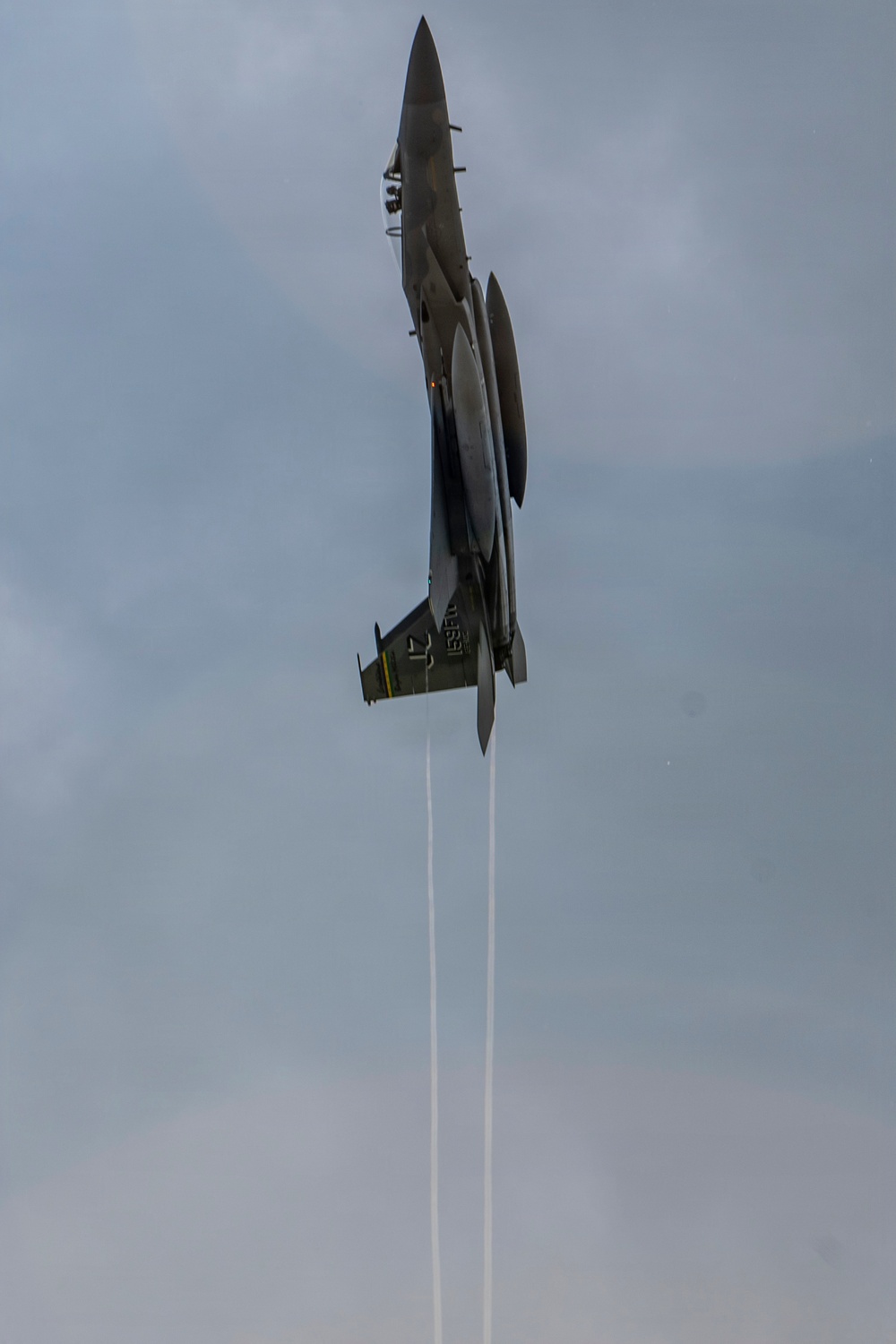
Boeing's F-15 fighter jet line in St. Louis now has federal work locked in through the next decade and beyond. The Air Force awarded the company a sole-source contract with a ceiling of $131.23 billion covering production, upgrades and sustainment of the F-15 Eagle Weapon System, according to the Department of War's Aug. 24, 2026 contracts announcement. The deal, named F-15 Eagle Crest, runs through August 2037 and gives Boeing a single vehicle for nearly every dollar the Pentagon and its allies spend on the fighter for the next eleven years.
The award is structured as an indefinite-delivery/indefinite-quantity contract, meaning the $131.23 billion figure is a maximum spending cap, not money that has actually changed hands. At the time of the award, the Air Force had obligated just $343,740 in fiscal 2026 research, development, test and evaluation funds — a placeholder that starts the clock on individual task orders rather than a down payment on the full ceiling. Every dollar above that will be committed piecemeal as specific task orders are issued over the life of the contract.
What the $131.23 Billion Ceiling Actually Covers
Eagle Crest is not a single weapons buy. It bundles together aircraft production, systems integration, modernization and upgrades, retrofits, sustainment, and a new organic depot maintenance capability for the F-15 fleet, all performed at Boeing's St. Louis, Missouri facility. A SAM.gov presolicitation notice describing the scope, quoted by GovConWire, lists the work as "hardware and software design, development, and integration; subsystem and component production; studies and analyses; program management; modification kit installation; future enhancements; and product support for the F-15 fleet." That presolicitation notice was posted to SAM.gov in November 2025, months ahead of the sole-source award finalized in August 2026, giving industry an early look at the scope before the vehicle was locked in.
That breadth is deliberate. Rather than negotiating separate contracts each time the Air Force needs new F-15 airframes, a software update, a depot repair, or a hardware retrofit, Eagle Crest folds all of it into one IDIQ vehicle managed by the Air Force Life Cycle Management Center at Wright-Patterson Air Force Base, Ohio. The Department of War's own award notice, titled "Contracts for Aug. 24, 2026," confirms Boeing was awarded a $131,230,000,000 ceiling indefinite-delivery/indefinite-quantity contract for the F-15 Eagle Crest program — the same sole-source vehicle now folding in production, upgrades, and depot-level maintenance as the Air Force works to establish "organic depot maintenance capabilities."
Why the Contract Extends to 2037 and Beyond
The Eagle Crest timeline is built in two stages. Task orders can be issued under the base contract through Aug. 24, 2031 — five years from the award date. The Air Force also holds an option to extend that ordering window an additional five years, through Aug. 24, 2036, with the overall contract completion date set at August 2037 to allow the final task orders time to run their course. That structure gives the service flexibility to keep buying under Eagle Crest for a full decade without having to recompete or renegotiate the underlying vehicle, while still capping the government's total exposure at the $131.23 billion ceiling regardless of how long the ordering period stretches.
A decade-long ordering window on a fighter aircraft contract signals that the Air Force expects sustained demand for the F-15 for years to come. Eagle Crest's structure — production, upgrades, and depot sustainment all under one roof — suggests the service is planning for the F-15 fleet, in its various configurations, to remain in service through at least the mid-2030s.
Foreign Military Sales Ride Along With Eagle Crest
Eagle Crest is not limited to U.S. Air Force needs. The contract explicitly covers Foreign Military Sales customers that fly or are acquiring the F-15: Indonesia, Israel, Japan, Poland, Saudi Arabia, Singapore and South Korea. Folding FMS customers into the same IDIQ vehicle lets those governments draw on the same production line, upgrade packages and sustainment infrastructure the Air Force uses, rather than negotiating standalone contracts each time an ally needs new jets or support. For Boeing, that consolidation effectively guarantees order flow from a broad allied customer base for as long as the vehicle remains open, insulating the St. Louis production line from any single customer's budget swings.
The sole-source nature of the award reflects the reality that Boeing is the only manufacturer of the F-15 airframe and holds the intellectual property and production infrastructure needed to build, modernize and sustain it. No other contractor was in a position to compete for the work, which is why the Air Force structured Eagle Crest as a sole-source IDIQ rather than running a competitive solicitation.
What It Means for Contractors
Eagle Crest is a case study in how the Pentagon is consolidating decades of fragmented sustainment and production contracts into single large-ceiling vehicles. For prime contractors, the message is that owning an aging-but-still-flying platform end to end — production, upgrades, and now organic depot support — is where the durable revenue sits, not in one-off buys. Subcontractors and suppliers feeding Boeing's F-15 line should expect task orders to flow under Eagle Crest for years, but should also note that the $131.23 billion figure is a ceiling, not a funded backlog; actual work will arrive in discrete task orders tied to specific appropriations, starting from the modest $343,740 RDT&E obligation recorded at award.
Companies chasing depot maintenance and sustainment work in particular should watch how the Air Force stands up the "organic depot maintenance capabilities" referenced in the award — that language suggests the service intends to bring some F-15 repair and overhaul work in-house rather than routing all of it through Boeing or third-party MRO contractors, which could open competitive opportunities even within a sole-source prime vehicle. Firms supporting the FMS customer list should also track how allied procurement schedules for Indonesia, Israel, Japan, Poland, Saudi Arabia, Singapore and South Korea shape task-order timing, since those orders will compete for the same production capacity as U.S. Air Force requirements under the single Eagle Crest ceiling.
