
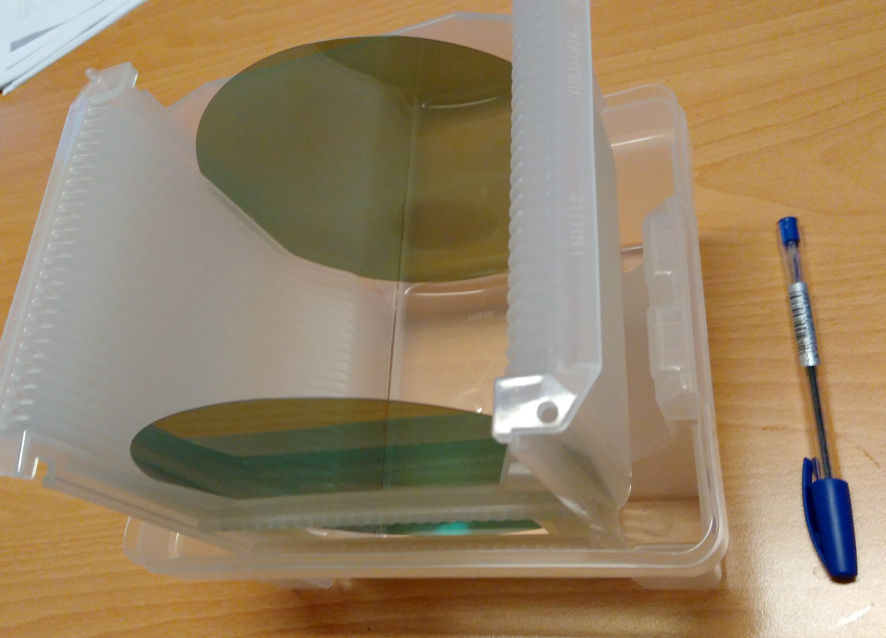
The Pentagon is offering to put up to $1.5 billion of long-term debt behind U.S. production of silicon carbide and gallium nitride chips, the wide bandgap semiconductors used in defense power electronics and radio-frequency systems. Wolfspeed, the Durham, N.C., chipmaker, disclosed on Oct. 7 that it received a conditional loan commitment letter from the Department of War's Office of Strategic Capital (OSC). The money is not yet committed in a binding sense: the deal still needs due diligence, definitive agreements and government approvals before any funds move.
The financing would support "the domestic development and production of silicon carbide (SiC) materials and wide bandgap power devices, with an additional focus on U.S. national security applications," according to the company's press release, filed with the Securities and Exchange Commission as an exhibit to a Form 8-K.
What the $1.5 Billion OSC Loan Would Pay For
Wolfspeed said it plans to use the financing to upgrade its gallium nitride (GaN) epitaxy capabilities for next-generation communications infrastructure and electronic warfare systems, and to develop radiation-hardening capabilities for its current SiC products and future GaN products. Radiation hardening is the engineering that lets chips survive in space and other high-radiation environments.
The company framed the money as backing a multi-year program built on its existing manufacturing footprint in North Carolina, New York and Arkansas. The press release lists four goals for that program:
- Strengthen Wolfspeed's domestic silicon carbide materials and power-device leadership.
- Establish, expand and/or onshore domestic low-voltage and/or high-voltage GaN power device production capabilities.
- Advance GaN-on-SiC radio-frequency epitaxial wafer technology.
- Develop domestic radiation-hardening capabilities.
"SiC and GaN have critical national security applications," said Robert Feurle, Wolfspeed's chief executive officer. "With this financing, the company would be well positioned to not only continue to serve the DoW but also expand its capabilities for the benefit of U.S. national security as a whole."
Wolfspeed said it considers SiC and related semiconductor technologies critical to next-generation power and radio-frequency applications across defense, aerospace, AI, critical infrastructure and other strategic commercial markets. As Reuters noted in its report, silicon carbide chips are more energy-efficient and are used in applications that require large amounts of power conversion, such as electric vehicles, solar inverters and industrial power systems.
How the 30-Year Delayed-Draw Structure and Warrants Work
The commitment letter contemplates a senior secured delayed-draw term loan facility of up to $1.5 billion with a 30-year tenor. A delayed-draw structure means the borrower takes the money in tranches over time rather than as a single lump sum, and "senior secured" places the lender at the front of the line, backed by collateral, if the borrower runs into trouble.
The government would also take a potential equity stake. Subject to definitive agreements, Wolfspeed would be required to issue the department VWAP-based warrants to purchase, in the aggregate, up to 7.5% of the company's fully diluted equity. Those warrants would be issued pro rata as each financing tranche is funded, so the government's upside grows only as it actually lends.
"We believe the scale and 30-year tenor of this conditional commitment reflects the long-term importance of the technology and manufacturing capabilities Wolfspeed has built in the United States," Feurle said.
Chief Financial Officer Gregor van Issum tied the deal to the company's balance sheet, describing it as part of "our ongoing efforts to optimize Wolfspeed’s capital structure and improve our financial foundation." He said the commitment is expected to "provide additional long-dated capital to support our strategic priorities, improve financial flexibility, and further position Wolfspeed for long-term value creation," subject to diligence and the negotiation of definitive agreements.
Investors reacted quickly. Reuters reported that Wolfspeed shares surged 27% in extended trading after the announcement.
Why the Commitment Could Still Fall Through
The letter is a starting point, not a closed deal. Wolfspeed's release states that executing definitive agreements and completing the financing are subject to "substantial due diligence and numerous conditions," including significant closing conditions, governmental authorizations and approvals, appropriations and required third-party consents.
The company put the caveat plainly: "There can be no assurance that definitive agreements will be executed or that any financing will be provided."
The forward-looking statements in the release add more detail on what could derail it. Among the listed risks: due diligence by OSC; Wolfspeed's ability to negotiate and execute definitive agreements on the terms in the commitment letter, or at all; its ability to satisfy conditions for each tranche, including obtaining satisfactory amendments or waivers to agreements governing some of its existing debt; compliance with covenants expected in the final agreements; and the continuing authorization or approval of relevant U.S. government authorities.
Power Semiconductors Weekly summarized the status the same way, reporting that the commitment "remains conditional and does not guarantee that Wolfspeed will receive the financing."
What It Means for Contractors
For the defense industrial base, the commitment suggests OSC is prepared to consider very large, very long-dated financing for component-level supply chains. The stated uses map directly onto defense electronics: GaN epitaxy for electronic warfare and communications, GaN-on-SiC RF wafers, and radiation-hardened parts. Primes and subsystem suppliers that design radars, EW payloads, power conversion hardware or space electronics around wide bandgap devices have a direct interest in whether a domestic source for those materials expands.
Several practical points stand out:
- Watch the definitive agreements. Until Wolfspeed signs final loan documents, the $1.5 billion is a ceiling, not funding. Suppliers planning around new domestic GaN or rad-hard capacity should treat timelines as uncertain.
- Tranche timing drives capacity. The delayed-draw structure means money arrives in pieces tied to conditions, so new production lines would likely come online in phases rather than all at once.
- Equity strings are part of this deal. The warrant package, up to 7.5% of fully diluted equity issued as tranches fund, shows the government seeking upside alongside its lender protections. Companies weighing their own OSC financing may want to ask whether similar terms could apply, though this deal does not establish that.
- Onshoring GaN power devices is an explicit goal. The program language calls for establishing or onshoring domestic low- and high-voltage GaN power device production, which could matter for buyers facing domestic-sourcing requirements.
Wolfspeed said further details are available in its Form 8-K filed with the SEC on Oct. 7.
Sources
- Wolfspeed Announces Conditional 30-Year, $1.5 Billion Loan Commitment from U.S. Department of War (SEC 8-K Exhibit 99.1, company press release)
- Wolfspeed secures $1.5 billion conditional loan commitment from US defense department (Reuters, via The Star)
- Wolfspeed Receives Conditional $1.5 Billion U.S. Government Loan Commitment for SiC and GaN Expansion (Power Semiconductors Weekly)
