
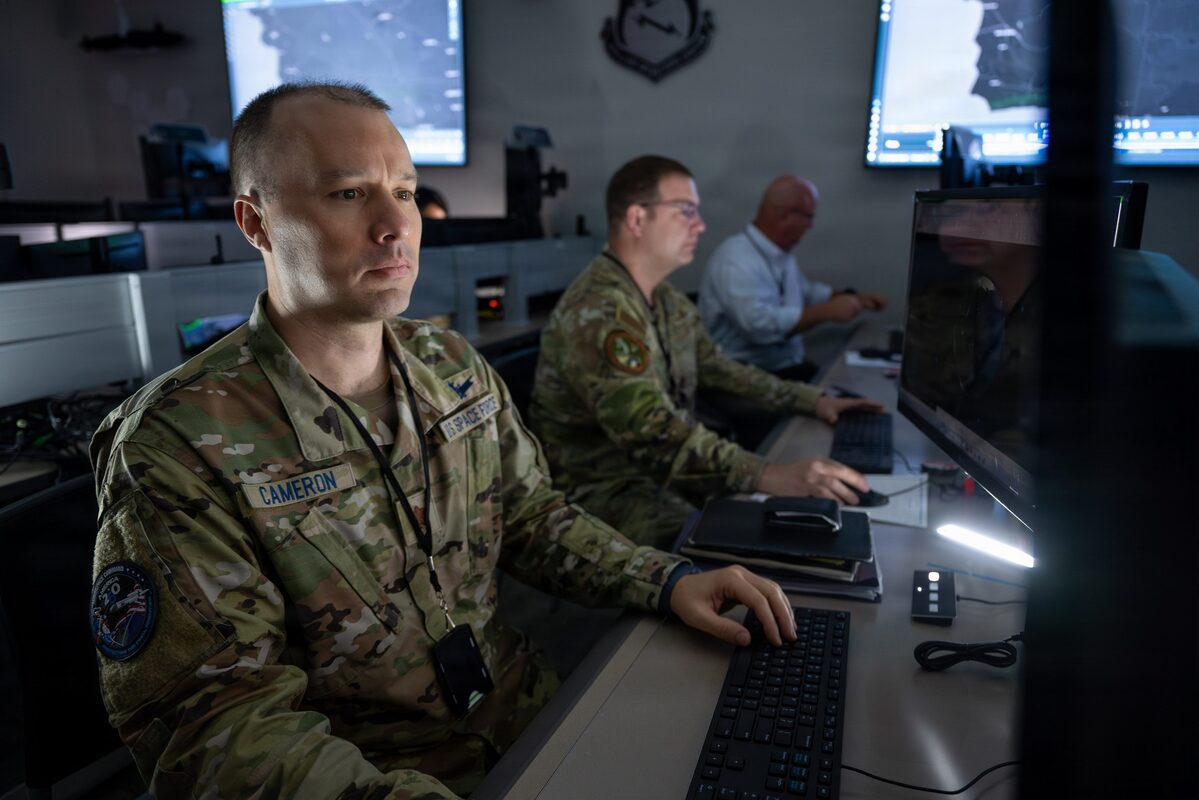
The Air Force is putting a single AI company in charge of warning the entire U.S. military about breaking events worldwide, and it's paying enough to make the arrangement last through 2031. Dataminr, of Reston, Virginia, has been awarded a $317,806,746 firm-fixed-price contract for what the Department of War calls "A2 Publicly Available Information Alerting," according to the department's official contracts announcement for Aug. 26, 2026. The Air Force District of Washington made the award after a competitive process that drew eight offers, with roughly $46.5 million obligated up front from fiscal 2026 operations and maintenance funds. Performance runs through June 25, 2031, work will be performed in Washington, D.C., and the contract effectively locks in a five-year enterprise license for Dataminr's alerting platform, with the Air Force positioning it to scale department-wide.
The award turns Dataminr's commercial "First Alert Advanced" product into the backbone of how the Air Force — and potentially the rest of the Department of War — learns about crises, attacks, natural disasters and other fast-moving events before official channels catch up. The company built its reputation using AI to scan public data streams, including social media, news wires, sensor feeds and other open-source material, and surface early warnings faster than traditional monitoring desks. This contract scales that capability to a global military alerting function with a specific mandate for situational awareness and force protection.
What the $318 Million Buys: Autonomous AI Agents, Not Just Alerts
The A2 Publicly Available Information Alerting program is built around AI agents that work with minimal human direction. Rather than simply flagging keywords, the system autonomously scans open-source information, tracks how an event evolves over time, synthesizes contextual intelligence around it, and generates predictions about how an incident might develop next. That is a meaningfully different capability than the alert-and-forward tools many analysts associate with earlier generations of open-source monitoring software.
The platform also integrates with Palantir Foundry's Marketplace, letting the AI agents plug into agentic workflows and contextual analytics within that data-integration environment. Once an alert is generated, it can reach personnel through multiple channels — email, an application programming interface for downstream systems, a web application, and mobile delivery — so the same warning can move simultaneously to a watch officer's desktop, a commander's phone, and an automated system that feeds other defense platforms.
Dataminr founder and CEO Ted Bailey framed the award as a validation of the company's position inside the defense market. "Our landmark $318 million DOW contract award for First Alert solidifies Dataminr's position as the real-time alerting backbone of the U.S. military for the next half-decade," Bailey said, according to DefenseScoop.
Why the Air Force Is Positioning This for Department-Wide Scale-Up
Though the Air Force District of Washington issued the award, the contract's design points beyond one service branch. The alerting capability is structured to scale from Air Force use to the broader Department of War, meaning other services and defense agencies could eventually draw on the same First Alert Advanced backbone rather than each standing up separate open-source monitoring tools. That approach mirrors a pattern increasingly common in defense IT procurement: buy an enterprise license for a commercial capability once, then extend access department-wide instead of letting individual commands negotiate redundant contracts with the same vendor or its competitors.
The five-year performance window, running to June 2031, also signals the department expects the underlying need — global situational awareness fed by AI-processed open-source data — to persist rather than shrink. Force protection officers, watch centers and operational planners have long relied on some combination of news monitoring, social media scanning and classified feeds to build a picture of unfolding events; this contract consolidates a large share of the unclassified, publicly available piece of that picture under one vendor with a single, extended enterprise agreement.
The $46.5 million obligated at award, drawn from fiscal 2026 operations and maintenance funds, covers only the initial tranche of the roughly $318 million ceiling. That structure — a large total contract value with a smaller initial obligation — is standard for firm-fixed-price awards tied to multi-year service agreements, and it gives the Air Force room to fund subsequent option years as budgets are appropriated without having to recompete the underlying agreement each cycle.
What It Means for Contractors
The award reinforces that publicly available information analysis, once treated as a relatively low-cost adjunct to classified intelligence work, is now commanding hundreds of millions of dollars in dedicated defense spending — and that the government is willing to award it as a long-duration enterprise license rather than a series of shorter task orders. Companies competing in the open-source intelligence and situational awareness space should expect the bar to keep rising: this procurement drew eight offers, indicating a competitive field of vendors capable of delivering AI-driven alerting at scale, not just a single dominant incumbent.
The Palantir Foundry integration built into the contract also points to a broader trend worth watching. Vendors whose products interoperate cleanly with Palantir's data platform may hold a structural advantage when competing for large enterprise awards, since integration compatibility can function as a de facto requirement even when it is not explicitly mandated in a solicitation. Smaller alerting or open-source monitoring firms without that interoperability may find it harder to compete for the next wave of department-wide licensing deals, particularly as this contract's design for scaling beyond the Air Force suggests other commands and agencies could follow with similar sole-source extensions or parallel enterprise buys rather than fresh competitions.
For contractors watching the broader AI procurement landscape, this award is also a data point on pricing. A five-year, roughly $318 million enterprise license works out to an average of roughly $63.6 million annually for a platform that, at its core, licenses software and AI processing capacity rather than hardware or personnel-heavy services — a useful benchmark for firms pricing their own AI-enabled monitoring, alerting or predictive-analytics offerings to defense customers.
