
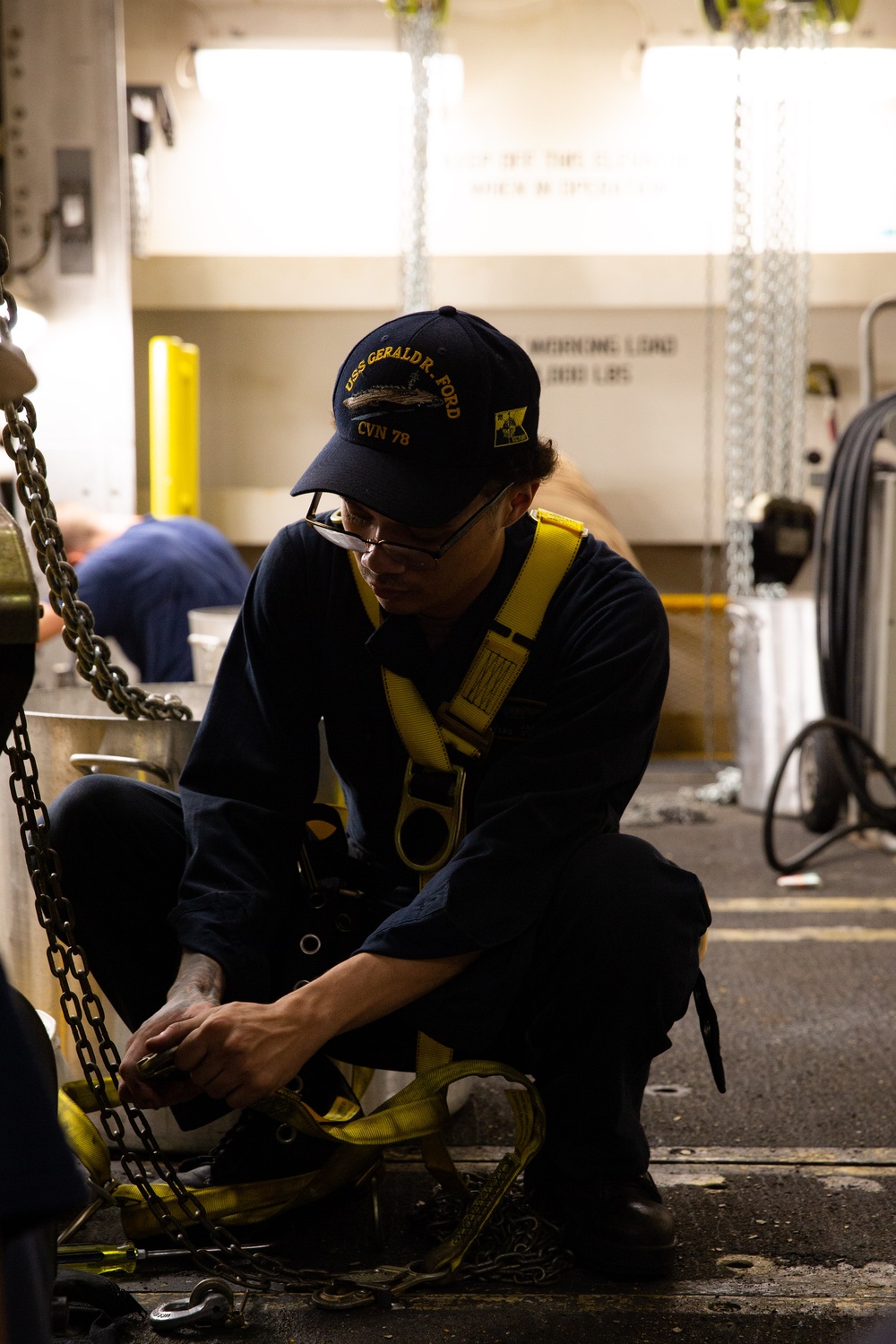
The Naval Sea Systems Command awarded Huntington Ingalls Industries Mission Technologies Corp. a $417,692,575 cost-plus-fixed-fee, indefinite-delivery/indefinite-quantity contract on June 15, 2026, for elevator support unit maintenance and repair across U.S. Navy aircraft carriers and amphibious assault ships. The five-year contract, identified under contract number N00024-26-D-4103, runs through June 2031 and covers work at locations both inside and outside the continental United States, including forward-deployed sites. No funds were obligated at award; amounts will be obligated upon issuance of individual task orders. HII Mission Technologies is the McLean, Virginia-based defense technology subsidiary of Huntington Ingalls Industries.
Background
Aircraft carrier and amphibious ship elevators are among the most mechanically demanding systems in the fleet. These are not standard freight lifts — they are weapons elevators, aircraft elevators, and stores elevators that must reliably move ordnance, aircraft, fuel, and supplies across multiple decks under combat-ready timelines. On a Nimitz-class or Gerald R. Ford-class carrier, the deck-edge aircraft elevators alone weigh hundreds of tons and must cycle continuously during flight operations. A failed elevator can halt flight operations, compromise sortie generation rates, and in a combat scenario, reduce a carrier strike group's lethality at exactly the wrong moment.
The elevator support unit encompasses the hydraulic systems, mechanical components, control systems, and structural assemblies that keep these platforms functional. Maintaining them requires specialized engineering knowledge, access to vessel-specific technical documentation, and the ability to deploy repair teams to forward locations — including overseas bases and vessels underway or in port abroad. NAVSEA has historically relied on a small number of specialized contractors for this work due to the technical niche and the classified nature of certain carrier systems.
HII has a documented track record on this program family. The company previously held a $174.9 million IDIQ awarded in January 2021 covering similar elevator support maintenance on U.S. Navy nuclear-powered aircraft carriers, with a five-year period of performance that ran through January 2026. The new $417.7 million vehicle consolidates and extends the scope of that ongoing relationship through fiscal year 2031.
Contract Details
The IDIQ ceiling of $417,692,575 is not an obligated commitment — it is the maximum the government may order over the five-year ordering period. Individual task orders issued under the vehicle will specify the scope, dollar value, and location of each work package. The contract structure uses cost-plus-fixed-fee pricing, which reimburses HII for allowable costs plus a negotiated fixed fee. This structure is typical for maintenance and repair work where the full scope of labor and parts cannot be precisely estimated at contract award — particularly when ships may present unanticipated damage or component wear that changes the work scope mid-execution.
The contracting activity is NAVSEA in Washington, D.C. Work is performed at locations inside and outside the continental United States, with forward-deployed locations explicitly listed in the performance terms. This geographic scope reflects the operational reality of the fleet: carriers and amphibious ships spend extended periods at overseas bases including Naval Station Rota in Spain, Fleet Activities Yokosuka in Japan, and various contingency locations. Maintenance support must follow the ships, not wait for them to return to a U.S. shipyard.
The contract was competitively procured with one offer received. The award was dated June 15, 2026, with the Department of Defense daily contracts listing published shortly after — a standard lag between award and public announcement typical for NAVSEA contracts, where the contracting office batches announcements per the notification window required under the Federal Acquisition Regulation.
Program Context
The award comes as the Navy continues expanding its carrier fleet sustainment capacity under pressure from both the shipbuilding backlog and deferred maintenance accumulated during the COVID-19 pandemic and subsequent workforce disruptions at major shipyards. The Ford-class carriers — USS Gerald R. Ford (CVN-78), USS John F. Kennedy (CVN-79), and USS Enterprise (CVN-80, currently under construction) — introduce new electromagnetic aircraft launch systems and advanced arresting gear alongside next-generation weapons elevators. The Ford class uses 11 Advanced Weapons Elevators, each capable of moving 24,000 pounds at high speed, in contrast to the legacy hydraulic elevators on Nimitz-class ships. Early AWE delivery challenges on USS Gerald R. Ford drew significant Congressional scrutiny; sustainment of this newer technology adds a layer of complexity to elevator support contracts going forward.
On the amphibious side, the Navy's America-class and Wasp-class amphibious assault ships rely on their own elevator networks to move Marine Corps aircraft, vehicles, and equipment between the flight deck, hangar bay, and vehicle storage areas. With the Marine Corps executing Force Design 2030 — a structural shift toward smaller, more distributed forces using Light Armored Vehicles and unmanned systems — the throughput demands on amphibious ship elevators are evolving, placing additional emphasis on reliability and rapid repair turnaround.
HII Mission Technologies, as distinct from HII's Newport News Shipbuilding and Ingalls Shipbuilding divisions, focuses on government IT, cybersecurity, analytics, and mission-critical technical services rather than new construction. Its involvement in elevator maintenance support underscores the breadth of the HII portfolio across the full vessel lifecycle — from keel laying and outfitting at the shipyard to in-service maintenance at forward locations decades later.
What It Means for Contractors
- The IDIQ is single-award; the ordering period runs through June 2031. Companies seeking to compete for this work should monitor SAM.gov for any recompete solicitation anticipated around fiscal year 2030 and begin relationship-building with NAVSEA's Program Executive Office for Ships.
- Task orders under the vehicle will be let on a cost-plus-fixed-fee basis — contractors pursuing teaming or subcontracting roles should review their indirect rate structures and ensure DCAA audit readiness, as cost-plus vehicles require detailed cost accounting system compliance.
- The explicit inclusion of forward-deployed locations in the performance requirements means subcontractors must have the clearances and logistics infrastructure to support work outside the continental United States on short notice. Domestic-only capabilities will limit subcontracting opportunities on this vehicle.
- The contract number N00024-26-D-4103 can be used to monitor task order activity on USASpending.gov and to identify future subcontracting opportunities as HII executes individual awards under the ceiling.
- Companies with specialized expertise in hydraulic systems, electromagnetic elevator technology, or structural maintenance of naval platforms should position with HII Mission Technologies for the Ford-class AWE sustainment work specifically, as those task orders will likely carry premium labor rates given the technical complexity.
