
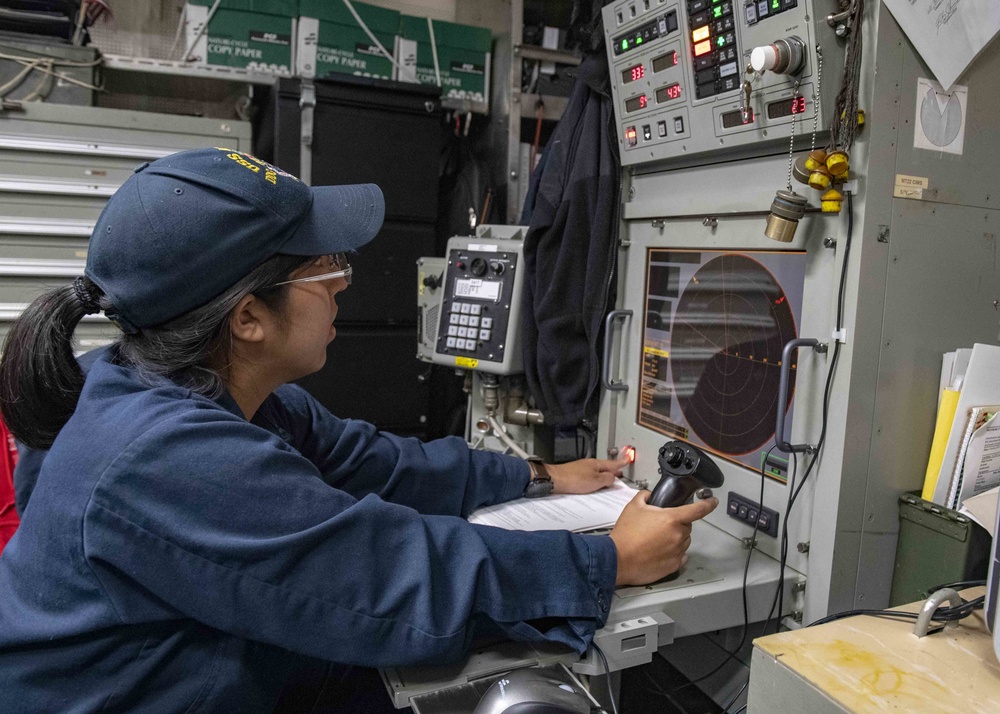
The Navy has awarded Raytheon Missiles and Defense a $271,493,519 contract to produce Aegis Weapon System Fire Control System MK 99 equipment, modernization hardware and engineering support, with options that could push the deal's cumulative value to $302,476,216. The Marlborough, Massachusetts, company will build equipment for the U.S. Navy and, through the Foreign Military Sales program, for Australia and Japan.
Background
The MK 99 Fire Control System is the piece of the Aegis Combat System that turns a radar track into a missile in the air. It sits between the Aegis radar and the Standard Missile family, managing missile loading, arming, launch and terminal illumination guidance for engagements. Every Aegis-equipped cruiser and destroyer in the Navy's fleet, plus Aegis ships operated by allied navies, depends on the MK 99 to close the loop between detection and intercept.
Naval Sea Systems Command has been working for several years on a broader below-decks re-architecture of the MK 99, aiming to establish a new "Mod X" baseline that would carry the system through the FY28-33 production runs of DDG 51 Flight III destroyers, according to Janes. That modernization push is distinct from this specific production contract but is a separate NAVSEA effort running alongside the continued MK 99 hardware buys reflected in this award.
The July 29, 2026, award was issued as a combination contract covering firm-fixed-price and cost-plus-fixed-fee line items, and it folds together separate national requirements into a single vehicle: 97 percent of the value belongs to the Navy, with Australia taking 2 percent and Japan 1 percent under Foreign Military Sales.
The Aegis Combat System has anchored U.S. surface-fleet air and missile defense since the first Ticonderoga-class cruisers entered service in the 1980s, and it now equips Arleigh Burke-class destroyers as well as allied warships built to the same combat-system architecture. This contract is itself an example of how Navy and allied requirements get combined on one vehicle: the Australian and Japanese shares ride the same unit pricing and delivery schedule the Navy negotiated, which keeps those countries' Aegis-equipped destroyers aligned with the U.S. fleet's production line and configuration baseline rather than on a separate track.
Key Details
NAVSEA issued the award as a sole-source procurement under 10 U.S. Code 3204(a)(1), citing Raytheon as the only responsible source capable of meeting the requirement. That statutory citation reflects Raytheon's position as the only qualified producer of MK 99 fire control hardware under this contract; the government did not solicit competing bids.
Work under the contract, numbered N00024-26-C-5340, is split across four Raytheon and Northeast defense-industrial sites: Andover, Massachusetts, will perform 56 percent of the work; Chesapeake, Virginia, 28 percent; Marlborough, Massachusetts, 15 percent; and Burlington, Massachusetts, the remaining 1 percent. The base contract is scheduled to run through July 29, 2032, and if the Navy exercises its options, performance extends to December 2032.
Naval Sea Systems Command in Washington is the contracting activity. The award was made July 29, 2026, and was publicly posted in the Department of War's daily contracts listing on August 3, 2026, five days after the award date.
The funding behind the award is spread across multiple fiscal years and appropriations, per the contract announcement. Fiscal 2025 shipbuilding and conversion (Navy) funds of $107,736,242 make up the largest single tranche, at 40 percent of the dollars obligated at time of award, followed by fiscal 2023 shipbuilding and conversion funds of $106,781,648 (39 percent) and fiscal 2024 shipbuilding and conversion funds of $41,117,291 (14 percent). The remaining balance is split among smaller tranches: FMS funds from Australia ($6,015,401, 2 percent) and Japan ($1,021,780, 1 percent), fiscal 2026 other procurement (Navy) funds (2 percent), fiscal 2025 defense-wide procurement funds (1 percent), and fiscal 2025 other procurement (Navy) funds (1 percent). None of the obligated funds expire at the end of the current fiscal year.
The contract does not itself fund the Mod X re-architecture effort NAVSEA has outlined separately; it is a production and modernization-equipment buy for the current MK 99 configuration, plus the engineering support needed to sustain fielded units. Because it combines Navy and FMS quantities on one vehicle, the Australian and Japanese portions ride the same unit pricing and delivery schedule the Navy negotiated, an approach that lets those partner navies avoid standing up parallel contracting actions for identical equipment.
What It Means for Contractors
The award confirms Raytheon's position as the sole qualified source for MK 99 production hardware for at least the next six years, leaving no near-term competitive opportunity for other primes to bid into this specific line. Subcontractors and component suppliers feeding Raytheon's Andover and Marlborough, Massachusetts, and Chesapeake, Virginia, sites are the more realistic entry points for companies without an existing MK 99 production role, since those three locations together account for 99 percent of the contract's work share.
The FMS structure is worth watching for firms that sell into allied Aegis programs. Because Australia and Japan are riding the same production contract as the Navy rather than negotiating separate FMS cases, suppliers hoping to sell ancillary equipment, spares or support services to those allied Aegis efforts should expect procurement timelines and configuration standards to track the U.S. Navy's schedule rather than a bespoke national one.
The contract's multi-year run, through 2032 with options into December of that year, gives Raytheon and its supply chain a long-duration revenue baseline independent of whatever configuration the Mod X re-architecture ultimately settles on. Companies pursuing a role in that separate modernization effort should treat this production award as confirmation that the legacy MK 99 configuration will remain in the fleet, and in production, well into the next decade, meaning any Mod X transition is additive to sustained legacy demand rather than a near-term replacement for it.
Firms working Aegis-adjacent combat-system contracts should also note the sole-source justification itself: NAVSEA's use of 10 U.S. Code 3204(a)(1) signals the Navy sees no viable alternate source for MK 99 hardware today. Companies that want to compete for future MK 99-related work would need to demonstrate a qualified alternate production capability well before the current contract's 2032 end date, since establishing that kind of qualification against an incumbent sole source is a multi-year undertaking in its own right.
