
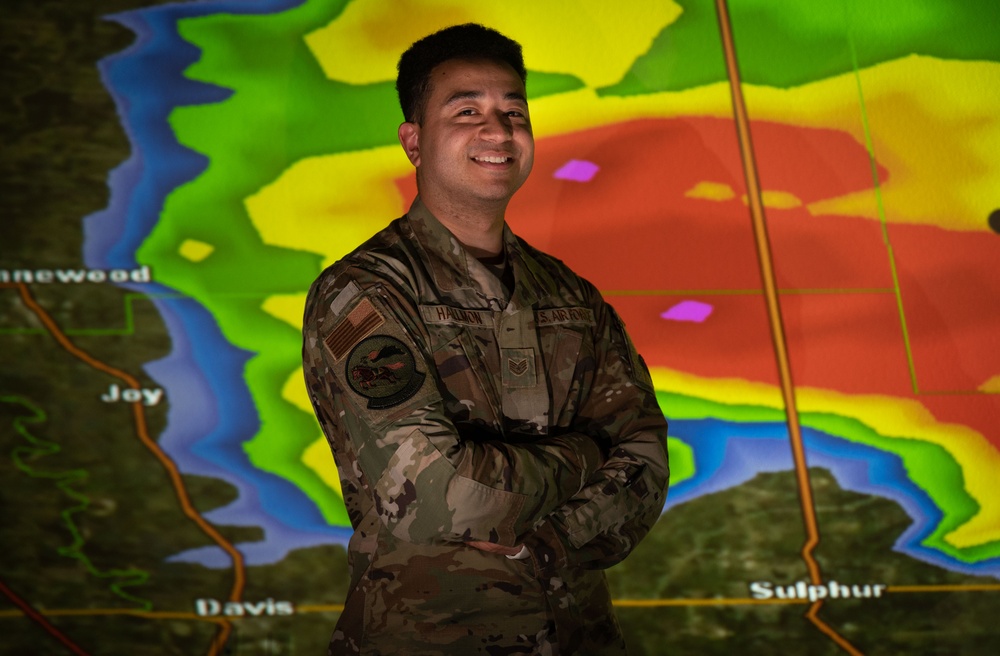
The U.S. Air Force has awarded Nextgen Federal Systems a sole-source cost-type contract worth up to $14,081,185 to integrate artificial intelligence and machine learning capabilities into the Battlefield Information for Forecasters and Remote Operations Support Technology (BIFROST) weather data command and control portal, according to the SAM.gov contract notice. BIFROST is the Air Force's primary weather data management and C2 platform, used by Air Force weather officers and specialists to access and integrate meteorological data from diverse sources, provide weather support to operational commanders, and manage weather tasking across Air Force operations globally. The sole-source award to Nextgen Federal reflects that company's role as the original developer of the BIFROST system.
Nextgen Federal Systems is a defense technology company that has developed significant expertise in weather systems and the integration of meteorological data with military command and control architectures. The company built BIFROST under prior contracts and has maintained the system through its operational life, accumulating deep institutional knowledge of the system architecture, the government's weather data infrastructure, and the operational requirements of Air Force weather personnel who use BIFROST to support flight operations, mission planning, and other weather-sensitive military activities. This prior development history justifies the sole-source determination — only the original developer has the system knowledge, source code, and architectural understanding needed to add AI/ML capabilities to the existing BIFROST platform without a lengthy and costly system re-engineering effort.
BIFROST and Air Force Weather Operations
Weather has always been a critical factor in military operations, and the Air Force has invested substantially in dedicated weather operations capabilities to support its mission. Air Force weather officers and specialists provide weather support across a wide range of operations, from tactical flight operations at Air Force bases to theater-level meteorological and oceanographic support for combatant commands. The data and tools available to Air Force weather personnel directly affect the quality of the weather support they can provide to operational commanders making time-sensitive decisions about mission execution, aircraft routing, and force protection.
BIFROST serves as the central data management and C2 layer of the Air Force's weather operations architecture, aggregating data from multiple sources including satellite imagery, radiosondes, surface observations, numerical weather prediction models, and specialized military weather sensors. Weather officers use BIFROST to query this integrated data environment, generate weather products, manage tasking for weather collection assets, and communicate weather information to supported units. As the volume and variety of weather data available to the Air Force has grown — particularly with the expansion of commercial weather satellite data and the proliferation of model output from multiple numerical weather prediction centers — managing and effectively using this data has become increasingly challenging using traditional tools and workflows.
The integration of AI and machine learning into BIFROST addresses this data management challenge directly. Machine learning algorithms can rapidly identify patterns in large volumes of meteorological data, flag anomalies, generate automated forecasts for routine conditions, and provide decision support tools that help weather officers focus their attention on the most complex and consequential forecast challenges rather than routine data management tasks. Natural language processing capabilities can enable weather officers to query BIFROST data using conversational language rather than technical query syntax, reducing training requirements and improving usability for personnel with varying levels of technical expertise.
Sole-Source Award Rationale
The decision to award this contract as a sole source to Nextgen Federal reflects the practical realities of adding capabilities to an operational government information system with a complex architecture and significant integration requirements. BIFROST's integration with classified government weather networks, military data links, and the broader Air Force command and control infrastructure means that a contractor without existing knowledge of the system's architecture and integration points would require a substantial ramp-up period just to understand the system before beginning to develop new capabilities. The cost and risk of that ramp-up, and the operational risk of introducing a new contractor team into an operational system, support the contracting officer's determination that only Nextgen Federal can provide the required capabilities at acceptable cost and risk.
The cost-type contract structure — which covers allowable costs plus fee — is appropriate for AI/ML development work where the specific technical approaches and implementation complexity cannot be fully determined in advance. Machine learning model development is inherently iterative, with technical approaches evolving based on the characteristics of the training data, the computational resources available, and the performance achieved through progressive experimentation. A fixed-price contract for this type of work would require either very conservative pricing that adds unnecessary cost or risk-taking by the contractor that could result in deficient performance if the technical challenges prove more difficult than anticipated.
What It Means for Contractors
The BIFROST AI/ML integration award illustrates the competitive dynamics of government information system development and modernization markets. Original system developers who maintain close technical relationships with government customers and continuously update their understanding of evolving requirements are well positioned to capture sole-source follow-on contracts for new capabilities added to operational systems they built. This is a deliberate market strategy — investing in strong system performance and customer relationships during the initial development phase creates future sole-source opportunity that can sustain a company's program revenue for years after initial delivery.
For firms without an existing position in Air Force weather programs, the competitive path runs through smaller AI/ML development contracts, SBIR awards focused on meteorological applications, and research partnerships with government weather program offices that can build technical credibility and operational understanding of the weather support domain. The Air Force weather enterprise procures a range of systems and tools beyond BIFROST, and firms that demonstrate relevant AI and ML capabilities in smaller programs can build the track record needed to compete for prime contract opportunities when BIFROST or similar systems reach re-competition or are replaced by successor systems.
The broader trend toward AI/ML integration in defense C2 systems represents a significant market opportunity for firms with demonstrated capability in defense-relevant machine learning applications. Weather is one of many domains — logistics, intelligence analysis, maintenance scheduling, cyber defense — where DoD is actively investing in AI and ML to augment human decision-making and manage increasingly complex data environments. Firms that develop deep expertise in a specific defense domain combined with strong AI/ML technical capability are positioned to capture multiple opportunities across this expanding market, whether through sole-source awards as system developers or through competitive procurements for new AI-enabled capabilities.
