
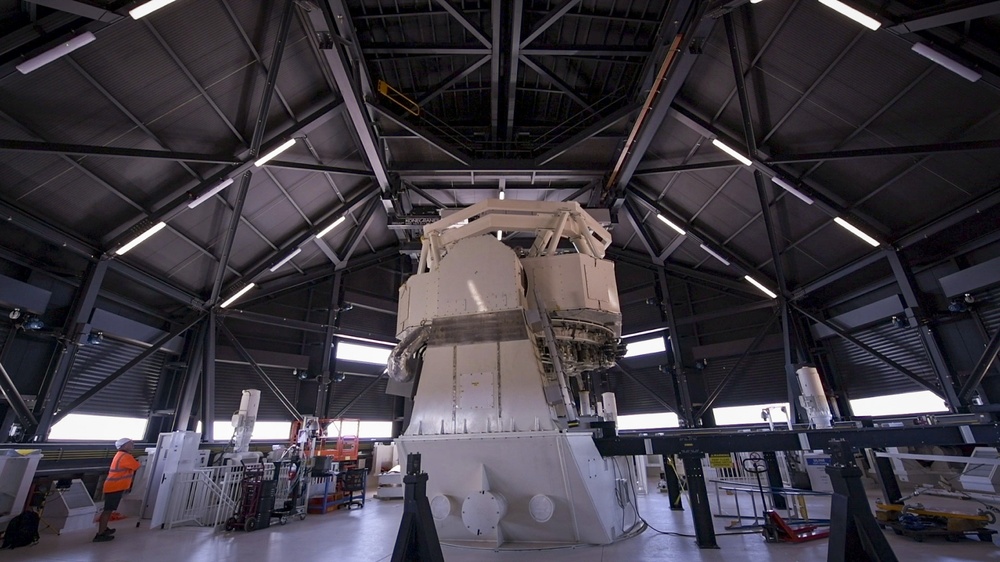
The U.S. Space Force is locking down a bigger, more permanent radar watchpost on the Welsh coast to track objects in deep space around the clock, after more than doubling the site's price tag in just two years. Northrop Grumman Systems Corp. of Colorado Springs, Colorado, was awarded a $215,934,576 contract modification for Deep Space Advanced Radar Capability (DARC) Site 2, according to the Department of War's Aug. 25, 2026 daily contracts release, raising the total value of the contract to approximately $495 million. Work under the modification is expected to be completed by March 30, 2030.
Why Cawdor Barracks Was Chosen for Deep-Space Tracking
DARC Site 2 sits at the UK Ministry of Defence's Cawdor Barracks, near St Davids in Pembrokeshire, Wales, according to a location profile from the Nautilus Institute. The site is the second node in a three-country radar network built under the AUKUS security partnership between the United States, United Kingdom and Australia. DARC Site 1 already operates in Western Australia, and the two locations are designed to give U.S. Space Systems Command overlapping coverage of geosynchronous orbit, roughly 22,000 miles above Earth, where communications, navigation and warning satellites from around the world operate.
Unlike the optical telescopes that dominated space-tracking for decades, DARC is a ground-based, all-weather radar system that does not need darkness or clear skies to find and follow objects in that distant orbital band. Northrop Grumman, in a statement posted to its newsroom, said the Wales expansion builds directly on that mission. "The DARC Site 2 award expands Northrop Grumman's support for the U.S. Space Force's Space Domain Awareness (SDA) capabilities in an increasingly contested domain," said Pablo Pezzimenti, vice president of Integrated National Systems at Northrop Grumman.
The choice of a UK Ministry of Defence installation, rather than a U.S. territory, reflects how AUKUS has moved beyond submarines and munitions cooperation into shared orbital surveillance infrastructure. Hosting a U.S.-funded radar on British soil is likely to give the UK more direct access to geosynchronous tracking data than it would get through allied channels alone, while giving U.S. Space Systems Command a sensor footprint in the Northern Hemisphere to complement the Southern Hemisphere vantage point at the Australian site. Together, the two locations are meant to close gaps in orbital coverage that a single site, no matter how capable, cannot see past the curve of the Earth.
Space Systems Command, the Space Force field command responsible for fielding space-based and ground-based systems, oversees the DARC program across all of its planned sites. The command has not detailed a public timeline for additional DARC locations beyond the two now under contract.
How the $200 Million Award Grew to Nearly $495 Million
The Cawdor Barracks site did not start out anywhere near half a billion dollars. Northrop Grumman's original DARC Site 2 award, announced in August 2024, was valued at $200.2 million, according to the Nautilus Institute's location profile. By the time this week's modification was issued, the contract's cumulative value had already grown to $279,441,415 through earlier modifications. The Department of War's Aug. 25 release shows the new $215,934,576 modification — which funds pre-construction long-lead items, antenna hardware, antenna manufacturing and other pre-construction tasks for the DARC Site 2 radar — pushes the total to $495,375,991, with work expected to be completed by March 30, 2030.
That growth pattern — repeated nine-figure additions piling onto an already substantial base award within two years of the original contract — is typical of how the Pentagon funds space-domain-awareness infrastructure as a design matures from prototype to fielded hardware. The contract listing does not itemize the scope behind the earlier increase to $279.4 million, though this week's modification specifies its funding as covering pre-construction and long-lead procurement work.
What DARC Is Built to Watch
DARC's mission is narrow but important: continuous custody of objects in geosynchronous orbit, the crowded shelf of space where weather, communications and early-warning satellites sit in fixed positions relative to the ground. Optical sensors, the traditional tool for that job, are blind during daylight hours and degraded by cloud cover. A radar system solves both problems by bouncing its own signal off targets rather than relying on reflected sunlight, letting operators track a satellite's position whether it is noon or midnight, clear or overcast. Northrop Grumman has framed the layered DARC network — one site now operating in Australia, a second under construction in Wales — as extending coverage in what the company calls "an increasingly contested domain," though the government has not publicly detailed plans for sites beyond these two.
What It Means for Contractors
The modification is a reminder that space-domain-awareness work, once a program clears its early testing hurdles, tends to generate large follow-on obligations rather than one-time awards. Northrop Grumman now holds a Site 2 contract worth nearly $495 million — more than double its original August 2024 award value at this one site alone. For competitors, the modification underscores how difficult it is to unseat an incumbent once a radar site reaches the construction and integration phase — the government is contractually and technically committed to the vendor that designed the system. For smaller firms and subcontractors, the March 2030 completion horizon signals years of additional subcontracting opportunity in site construction, radar-array integration and sustainment support tied to the Wales location specifically. Firms chasing space-domain-awareness work more broadly should also note the AUKUS dimension: DARC's binational site selection — U.S.-funded, UK-hosted — is a model the Pentagon may repeat as it looks for allied territory to extend its orbital sensor coverage, meaning companies with existing UK or Australian defense-industrial relationships may have an edge on the next site in the network.
The modification also illustrates a budgeting reality worth tracking across the broader Space Force portfolio: contract values published at award time are often floors, not ceilings. A program that starts as a $200 million line item can grow to more than double within two years without a new competitive solicitation, simply through modifications to the incumbent's existing contract vehicle. Contractors evaluating whether to bid on a space-domain-awareness program should weigh not just the headline award figure but the likelihood of follow-on modification funding as the government's confidence in the design grows — a pattern DARC Site 2 has now demonstrated more than once, growing from its $200.2 million base award in 2024 to nearly $495 million through this week's modification and the funding actions that preceded it.
