
The Pentagon's tab for repairs it keeps putting off has more than doubled in five years — from $137 billion in fiscal 2020 to $285 billion in fiscal 2025 — and the watchdog tracking it says the department has not fully determined what the decay is doing to its missions. That is the core finding of GAO report GAO-26-107255, "Installation Maintenance: Better Information on Risks and Challenges Needed to Improve Oversight of DOD Facility Conditions," released August 21, 2026. The Government Accountability Office calls the deferred-maintenance mountain "a significant and growing risk to the department's ability to support its missions." For the firms that fix roofs, HVAC plants, barracks and airfield pavement for a living, the report reads as a $285 billion demand signal that is compounding, not shrinking.
The scale of the portfolio explains why the numbers get large so fast. The Defense Department manages more than 736,000 facilities worldwide with a combined value of $2.6 trillion, and about a third of those buildings are more than 50 years old. Every year the services skimp on sustainment, more of that inventory slides from routine upkeep into expensive restoration — or into the demolition queue.
How the Backlog Doubled to $285 Billion in Five Years
GAO traces the doubling to a persistent, structural funding gap. The department's own policy sets a target for how much of its identified maintenance requirement the services should actually fund each year — and they routinely miss it. As the report puts it: "Due to competing budget priorities, DOD set a goal to fund 90 percent of its maintenance needs, but GAO found that the military services continue to fall short of this goal by funding about 80 percent of these needs." That unfunded remainder — roughly 20 percent of the requirement — does not disappear. It rolls forward, gathers interest in the form of accelerating deterioration, and lands in the backlog column.
The Air Force illustrates the math. In 2025 the service needed $5.6 billion for facility sustainment and received $4.3 billion — about 77 percent. The other services carry their own mountains: the Army reports roughly $140 billion in unfunded construction and repair needs, while the Navy faces about $70 billion in unfunded construction plus another $37 billion in repairs.
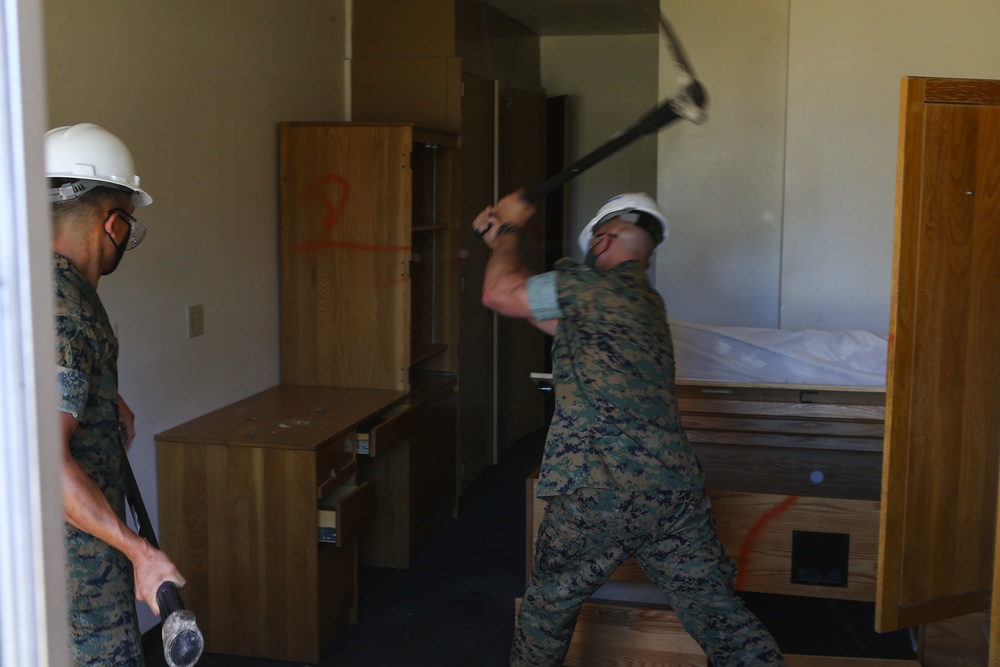
Money is not the only constraint. GAO found the department short of the people needed to spend maintenance dollars effectively, noting that DOD faces "challenges in hiring and retaining key maintenance workers, which are critical for maintaining facilities." Auditors also flagged maintenance work-order data as generally unreliable — each service runs a different work-order system — meaning the Pentagon's picture of its own facility conditions is blurry enough that the $285 billion figure itself rests on shaky records. Site visits documented deterioration — damage, corrosion, and suspected mold — including in barracks.
Andersen and Minot: 28 and 31 Cents on the Dollar
Two installations show what the averages hide. Andersen Air Force Base on Guam — a linchpin of Pacific posture — needed $122 million for facility maintenance in 2025 and received $34.7 million, about 28 percent. Its average across fiscal 2023 through 2025 was 37 percent. Minot Air Force Base in North Dakota, home to two legs of the nuclear triad, needed $75 million and received $23.5 million, about 31 percent; its average across fiscal 2021 through 2025 was 40 percent.
Those percentages matter for contractors because they describe installations where the maintenance requirement is thoroughly documented, validated, and simply waiting for appropriations. When money does arrive — through regular sustainment accounts, restoration and modernization lines, or emergency supplementals — installations with deficits this well documented are well placed to absorb it. Andersen sits at the center of Indo-Pacific Command's infrastructure buildup; Minot's strategic mission gives its facility shortfalls a natural congressional constituency. Both are places where deferred work stands a strong chance of becoming funded task orders.
Thirteen Recommendations, One Pentagon Objection
GAO issued 13 recommendations. They cluster around four themes: assess the risks that chronic underfunding creates for missions, build a strategy to fix the maintenance workforce shortage, clean up the unreliable work-order data, and strengthen oversight of facility conditions across the enterprise. The Defense Department concurred with seven, partially concurred with five, and disagreed with one.
The concurrences are worth watching because they generate paperwork that becomes procurement. A department-level risk assessment of underfunded maintenance gives the services ammunition to defend larger sustainment budgets. A workforce strategy that concedes DoD cannot hire enough in-house tradespeople points toward more contracted labor. And a push for reliable work-order data means the services must first count the broken things — a process that historically grows requirements rather than shrinking them, as the jump from $137 billion to $285 billion demonstrates.
What It Means for Contractors
The report is effectively a market forecast for the facility sustainment, restoration, and modernization sector. A $285 billion documented backlog, growing at a pace that doubled it in five years, guarantees sustained demand for base operations support contracts, job order contracting, and the multiple-award task order contracts the services use to buy repair work at scale. Firms holding positions on Air Force, Army, and Navy facility MATOCs should expect the pipeline of task orders to persist regardless of topline budget turbulence, because even flat funding leaves an enormous requirement unmet.
Three specifics deserve attention. First, geography: Andersen's 28-percent funding rate against a $122 million validated requirement makes Guam — already the site of a major military construction surge — a durable market for firms that can perform there. Second, trades: GAO's finding on maintenance-workforce shortages means the government's make-or-buy calculus is tilting toward buy, particularly for skilled trades such as HVAC, electrical, and corrosion control. Third, data: the recommendations on work-order reliability and condition oversight signal opportunity for contractors offering facility-condition assessments, asset-management software, and BUILDER-style inventory support, since DoD cannot manage what it concedes it cannot accurately measure.
The risk side is equally clear. Backlogs this large invite triage, and buildings can be demolished or divested instead of repaired. But with about a third of a 736,000-facility portfolio past its 50th birthday and barracks conditions drawing sustained congressional attention, the repair market's floor looks high. The Pentagon disagreed with only one of GAO's 13 recommendations — on the other twelve, it has now committed, in writing, to confronting a problem that only contractors can physically fix.
