
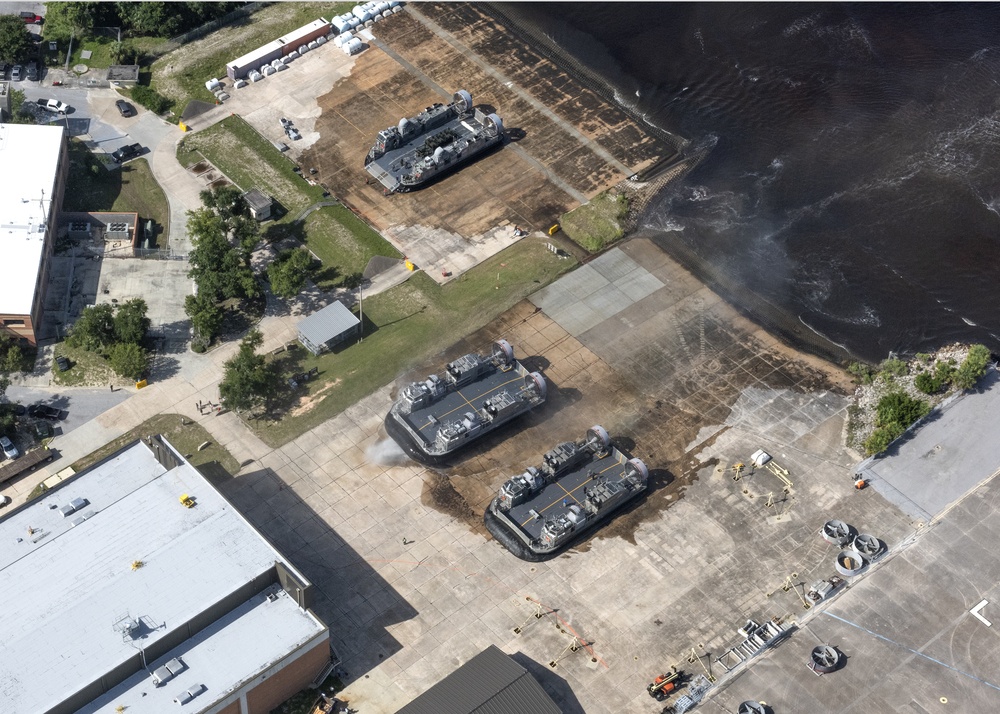
Rolls-Royce Corp. of Indianapolis has won a $48,149,237 firm-fixed-price contract modification to supply spare engines and parts for the Navy's Ship-to-Shore Connector hovercraft fleet, an award the Navy says is funded using shipbuilding money from the One Big Beautiful Bill Act.
Background
The Ship-to-Shore Connector, designated LCAC-100, is the Navy's next-generation air-cushion landing craft, replacing the aging LCAC fleet that has carried tanks, troops, and equipment from amphibious ships onto beaches since the 1980s. Textron Systems, based in Slidell, Louisiana, builds the hulls as the program's sole production facility. Rolls-Royce supplies the MT7 marine gas turbine engine that powers each craft, an engine derived from the same turboshaft family that powers the V-22 Osprey.
The Navy is procuring four LCAC-100 craft per year through 2031, with deliveries continuing to 2036, for a planned fleet of 72 hovercraft. Unit cost has climbed sharply over the program's life, from roughly $65 million per craft in fiscal 2020 to an estimated $183.5 million in fiscal 2027, and cumulative obligation authority for the program now exceeds $10.5 billion. The Aug. 14, 2026 spares order is a modification to an existing contract, N00024-25-C-2405, rather than a new competition.
Spares orders like this one typically lag behind hull deliveries by design. As more LCAC-100 craft enter the fleet and accumulate operating hours, the Navy needs a growing pool of ready-to-install engines and parts to keep availability rates up without pulling craft out of service for extended maintenance. Six spare MT7 engines represent a meaningful hedge against unscheduled removals across a fleet that is still ramping toward its full complement of 72 craft.
The One Big Beautiful Bill Act, Public Law 119-21, directed appropriations toward Navy shipbuilding and the industrial base supporting it. The Navy's contract announcement explicitly ties the Rolls-Royce spares order to that law, marking it as a concrete example of how the legislation's money is reaching individual contract actions rather than sitting in broader program accounts. The same day's Navy contract release also listed a separate $19,689,621 modification to Lockheed Martin Rotary and Mission Systems for sonar-system hardware spares, funded instead through standard fiscal 2026 procurement dollars that do expire at year-end, an adjacent example of how the two funding streams are now running side by side in the same daily announcement.
Key Details
- Rolls-Royce Corp., Indianapolis, Indiana, received a $48,149,237 firm-fixed-price modification to contract N00024-25-C-2405.
- The order covers spares supporting the Ship-to-Shore Connector program: fiscal 2025 base installation and checkout spares, fiscal 2025 base fleet spares, fiscal 2026 spares, and six spare MT7 turboshaft engines with ancillary parts and installation kits.
- The contract announcement states the full $48,149,237 was obligated at time of award using One Big Beautiful Bill Act funds, which the Navy notes will not expire at the end of the current fiscal year, unlike standard annual operations and maintenance money.
- The Navy's release describes the order as directly supporting "the national effort to revitalize and rebuild American shipbuilding," language tying the spending to the law's stated purpose.
- Work will be performed in Indianapolis, with an estimated completion date of December 2029.
- Naval Sea Systems Command in Washington, D.C. is the contracting activity.
- The order was announced Aug. 14, 2026, as part of the Department of War's daily contract announcements.
What It Means for Contractors
The most immediate signal for contractors is procedural, not just financial. This is a sole-source-style modification to a fielded engine's existing supply contract, not a new competition, and the Navy has shown it is willing to route One Big Beautiful Bill Act shipbuilding money through exactly that kind of vehicle. Companies that already hold production or sustainment contracts tied to Navy shipbuilding programs, engine suppliers, hull builders, and their subcontractors, have a concrete example to point to when arguing that new law funds can flow through existing modifications rather than waiting for fresh solicitations.
The non-expiring nature of the funding matters operationally. Because the money does not lapse at fiscal year-end, the Navy can obligate it against multi-year spares buys and long-lead items without the usual pressure to spend annual O&M dollars before September 30. For suppliers, that reduces some of the boom-and-bust ordering pattern tied to the federal fiscal calendar and creates room for larger, less rushed spares and long-lead-time procurement actions later in the year.
Engine and propulsion suppliers to other Navy shipbuilding programs should watch for similar modifications citing the same law. If the pattern holds, established suppliers on other Navy shipbuilding programs could see comparable spares and long-lead orders funded the same way, particularly where a program already has escalating unit costs that make advance spares purchases attractive.
The steep rise in LCAC-100 unit cost, more than doubling from the first production lot to the fiscal 2027 estimate, is also worth tracking independently of this award. Suppliers bidding into follow-on lots or spares competitions should expect continued scrutiny of that cost trajectory from Congress and from Navy leadership, even as the shipbuilding law's funds ease near-term budget pressure. A program drawing extra funding to stabilize its supply chain is not the same as a program whose cost growth has been resolved, and firms pricing future work into the Ship-to-Shore Connector line should account for both realities.
For small and mid-tier suppliers further down the LCAC-100 supply chain, the practical takeaway is to confirm whether their own subcontracts or purchase orders under N00024-25-C-2405 are eligible to draw on the same non-expiring funds, and to ask prime contractors directly rather than assuming standard annual funding rules apply. The distinction can affect payment timing and the urgency, or lack of it, around year-end deliveries.
Contractors tracking One Big Beautiful Bill Act spending more broadly should treat this award as a template for how the Navy plans to document these obligations in its public contract announcements: an explicit citation to Public Law 119-21, a note that the funds do not expire, and language linking the specific procurement to the shipbuilding industrial base. Firms competing for future spares, sustainment, or long-lead-item work on Navy amphibious and surface programs can watch the Department of War's daily contract release for that same phrasing as an indicator of where the law's remaining funds are being directed.
