
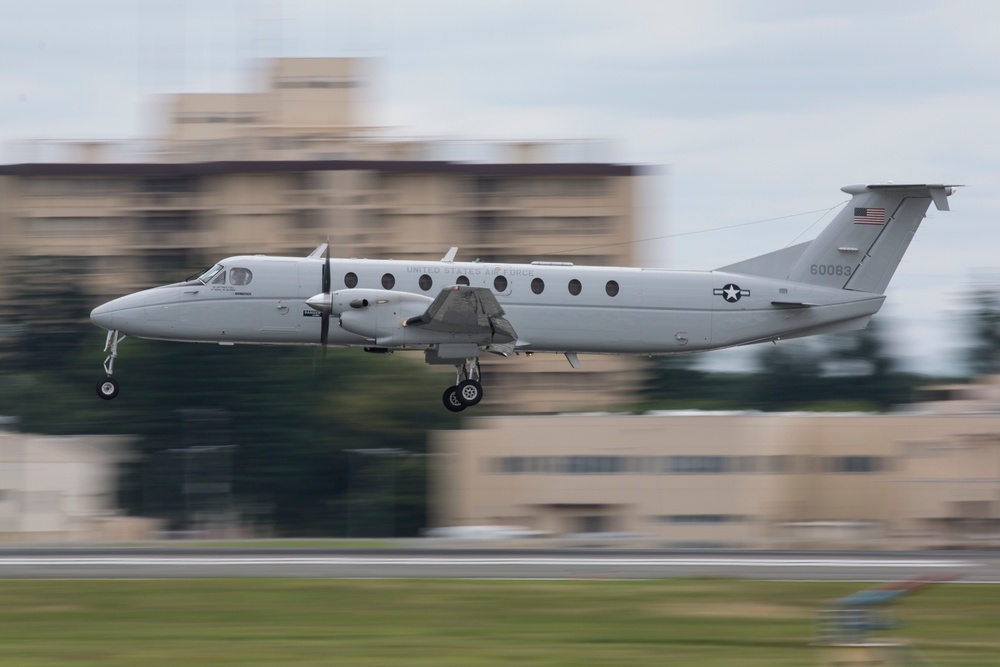
The Air Force has handed Vertex Aerospace LLC a firm-fixed-price contract worth up to $500 million to keep its worldwide C-12 fleet flying, according to the Department of War's June 26, 2026 contract announcement. The indefinite-delivery/indefinite-quantity (IDIQ) award makes the Madison, Mississippi firm responsible for contractor logistics support across U.S. bases and 16 countries through the middle of 2031.
Background
The C-12 is the military designation for the Beechcraft King Air, a twin-turboprop utility aircraft the services use to move people and cargo quickly, fly medical evacuation missions, and support flight-test programs. Its small footprint, short-runway performance, and low operating cost make it the airframe the Air Force reaches for when a larger transport would be overkill. Keeping that fleet mission-ready depends less on the airframes themselves than on the maintenance, supply, and field-service contract that wraps around them.
Sustaining that fleet is the job this contract funds. The $500 million ceiling and five-year term signal that the Air Force intends to keep its light utility fleet flying rather than draw down the support behind it. Because the aircraft operate in austere and far-flung locations, continuity of support matters: the work demands a contractor that understands the airframe, the spares pipeline, and the field sites well enough to hold readiness across a global footprint.
Contractor logistics support, or CLS, is how the services sustain many smaller fleets that do not justify a full organic depot line. Instead of standing up government maintenance and supply infrastructure for a few dozen utility aircraft, the Air Force pays a prime to hold availability and absorb the day-to-day logistics burden. That model puts a premium on a contractor's ability to forecast demand, position parts ahead of need, and keep technicians where the aircraft actually fly.
Key Details
The award, contract number FA8134-26-D-B004, is a firm-fixed-price IDIQ with a ceiling of $500,000,000. The Air Force Life Cycle Management Center at Tinker Air Force Base, Oklahoma, is the contracting activity, and work is scheduled to run through June 30, 2031. The announcement notes this was a competitive acquisition that drew three offers, so Vertex won the work against other bidders rather than taking it on a sole-source basis. The contract also involves Foreign Military Sales.
The statement of work is broad. Vertex will provide contractor logistics support that includes time-sensitive movement of personnel and cargo, medical evacuation, and test support for customers that span Air Force Materiel Command, the Defense Intelligence Agency, the Defense Security Cooperation Agency, and Pacific Air Forces. That mix reflects how the services actually use the aircraft — one day shuttling personnel, the next standing by for an aeromedical mission or backing a test campaign that needs a reliable utility platform on call.
The geographic spread is what makes the contract demanding. Work locations span U.S. installations in Alaska, California, Maryland, Mississippi, New Mexico, Oklahoma, and Texas, plus 16 international sites. Those overseas locations include Argentina, Botswana, Brazil, Colombia, Egypt, Ghana, Honduras, Hungary, Japan, Kenya, Morocco, the Philippines, Saudi Arabia, Thailand, Turkey, and Norway — a footprint that tracks the C-12's role supporting embassies, security-cooperation missions, and forward detachments. Sustaining a small fleet scattered across that many countries means positioning parts, technicians, and tooling far from any central depot, then holding aircraft availability high regardless of local conditions or supply distance.
What It Means for Contractors
The first signal is the ceiling itself. A $500 million ceiling on a single light-aircraft logistics vehicle tells the market the Air Force expects to keep investing in its light fixed-wing utility fleet rather than divesting it. For sustainment-focused contractors, light-aircraft logistics remains a durable line of business even as headlines chase larger platforms and new-start programs.
The second signal is that the work was competed. Three offers on a contractor-logistics-support award show that this kind of vehicle is open to challengers, not wired for a single provider. Companies that can credibly stand up a global parts-and-maintenance network have a path to bid, and the presence of multiple offers gives the government leverage on price and terms. Firms eyeing future fleet-sustainment competitions should read the three-offer count as evidence that the Air Force will entertain alternatives when the field is qualified.
Third, the international footprint sets a high bar. A bidder cannot simply promise stateside depot capacity; it must demonstrate the ability to support aircraft in Argentina, Egypt, Japan, Saudi Arabia, and beyond, with the export-control compliance, host-nation coordination, and surge logistics that implies. For subcontractors and parts suppliers, the award creates a multi-year demand stream tied to a single prime, and the breadth of locations opens flow-down opportunities in regional maintenance, spares pooling, and field-service staffing.
Finally, the structure rewards readiness over volume. As a firm-fixed-price IDIQ, the contract pushes performance risk onto Vertex: the company is paid to deliver availability, not billable hours. That favors contractors with mature supply forecasting and disciplined cost control, and it is a reminder that on long-running sustainment vehicles the winning edge is operational reliability across a five-year horizon, not the lowest sticker price on day one. Teams competing for similar CLS work should build their proposals around demonstrated uptime and global reach, because that is what the Air Force is buying here.
