
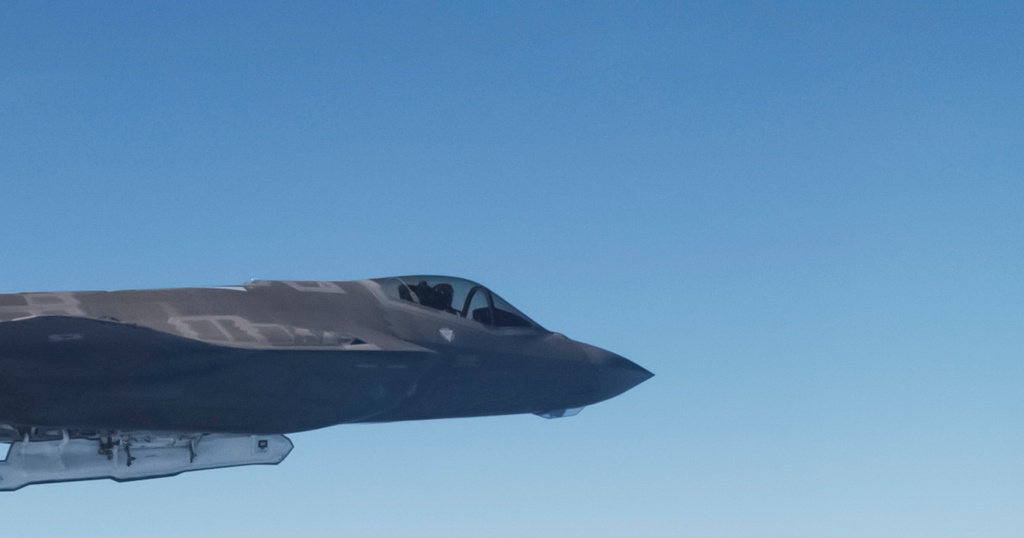
The Air Force Life Cycle Management Center at Robins Air Force Base, Georgia, awarded Raytheon Co. of Tucson, Arizona, a $398,691,358 undefinitized contract action on June 23, 2026, to begin development of the Advanced Medium Range Air-to-Air Missile D4/C9 variant. The award covers system requirements review and preliminary design review activities — the first major milestones in a new AMRAAM development cycle — and obligates $104.1 million in foreign military sales funds at award for a program that counts 31 allied air forces as partner nations.
Background
The AIM-120 Advanced Medium Range Air-to-Air Missile has served as the NATO standard beyond-visual-range air-to-air weapon since entering operational service in the early 1990s. Raytheon is the primary U.S. manufacturer of the AIM-120, a modern beyond-visual-range missile operated by 43 allied nations in addition to U.S. forces, according to Air & Space Forces Magazine. The missile is certified for carriage on the F-15, F-16, F/A-18, F-35, Eurofighter Typhoon, JAS-39 Gripen, and a broad range of allied aircraft. Over three decades, the program has progressed through successive production lots — the C-5, C-6, C-7, and C-8 — each introducing updates to seeker performance, electronic counter-countermeasure resistance, and guidance processing. The D4/C9 designation marks a new and distinct development path, separate from the current C-7 and C-8 production baseline.
The government has not publicly described the specific capability improvements the D4/C9 will introduce. However, the contract's scope — system requirements review and preliminary design review, including proof of design and proof of manufacturing — represents the earliest and most foundational phases of a DoD major defense acquisition program. These milestones establish what the new variant must do, confirm the design can achieve those requirements, and verify the manufacturing approach can deliver it at scale. Including proof-of-manufacturing activities this early signals deliberate attention to production capacity alongside performance, a lesson the department absorbed from programs where engineering development succeeded but industrial ramp fell short.
The contract is structured as cost-plus-fixed-fee and cost-reimbursement — the standard vehicle for development-phase work where technical risk is high and the full engineering scope is not yet defined. The undefinitized contract action format allows the government to authorize work to proceed before all contract terms and pricing are finalized. AFLCMC uses this mechanism when time-to-contract exceeds acceptable delay, permitting Raytheon to begin immediately while definitization negotiations continue in parallel.
Key Details
Contract number FA8556-26-C-B003 carries a total ceiling of $398,691,358, with $104.1 million in FMS funds obligated at the time of award. Work is performed in Tucson, Arizona, at Raytheon Missiles & Defense's primary missile development and production complex. The Air Force Life Cycle Management Center at Robins Air Force Base, Georgia, serves as the contracting activity. Estimated contract completion is December 11, 2027, covering the requirements and preliminary design phases across an approximately 18-month execution window.
The 31 FMS partner nations named in the award span NATO Europe, the Indo-Pacific, the Middle East, and Latin America: United Arab Emirates, Argentina, Australia, Belgium, Bulgaria, Canada, Denmark, Estonia, Finland, Germany, Hungary, Israel, Italy, Japan, South Korea, Kuwait, Lithuania, Morocco, Netherlands, Norway, Peru, Poland, Romania, Singapore, Spain, Saudi Arabia, Sweden, Switzerland, Turkey, Taiwan, and the United Kingdom. Together these nations represent the principal F-15, F-16, F/A-18, and F-35 operators that already carry the AIM-120 on their current inventories and will field the D4/C9 once it reaches production.
The D4/C9 is distinct from current in-production C-7 and C-8 lots. Rather than a product improvement on an existing configuration, the contract structure — requiring a system requirements review from scratch and a preliminary design review before any production commitment — indicates the government treats D4/C9 as a new development program with its own requirements baseline. This is consistent with how AFLCMC has structured other next-generation munition development efforts under its portfolio.
What It Means for Contractors
For Raytheon, the award extends its position as AMRAAM developer and manufacturer through what will be a fourth decade of production. Because the AIM-120 is fielded by more air forces on more aircraft types than any comparable beyond-visual-range air-to-air missile, each new variant development contract secures Raytheon's production position for the next generation with a committed international customer base built in at program inception. The 31-nation partner list at award — before a single engineering requirement is baselined — ensures the nonrecurring development investment will be amortized across a large eventual production run.
The FMS co-investment structure carries broader implications. Obligating $104.1 million in allied funds at award reduces the nonrecurring engineering cost burden on the U.S. Air Force procurement account and aligns allied air forces' procurement planning with the U.S. development schedule. Allies who co-invest at the requirements phase gain access to the latest variant at production without independently funding development; the U.S. benefits from a larger production base, which drives down per-unit cost when the D4/C9 enters procurement. This arrangement is increasingly the Air Force's preferred template for multinational munitions programs.
For the broader defense industrial base, this contract illustrates AFLCMC's model for structuring large multinational munitions development efforts: front-load allied participation at the requirements phase, apply the UCA mechanism to compress time from requirement to authorized work start, and lock in a defined international customer list before engineering baselines are established. Companies pursuing development contracts for air-to-air, surface-to-air, or precision-strike munitions with FMS applicability should study this vehicle structure. The 31-nation co-investment model also signals to allied defense ministries that early programmatic commitment — not just production-phase buy-in — is how the U.S. now structures long-cycle munitions development.
The timing tracks with demand signals visible across the alliance. The sustained pace of European air defense procurement has drawn down existing AMRAAM inventories. Starting D4/C9 development now, with allied funding secured, gives the program a path to a new production baseline before current C-7 and C-8 lots reach end of procurement.
Subcontractor opportunities in seeker electronics, guidance software, airframe manufacturing, energetics, and propulsion will emerge as design requirements are established through the system requirements review and mature through the preliminary design review into subsequent critical design phases. Companies with existing positions in the Raytheon Missiles & Defense supply chain in Tucson — as well as allied defense firms in partner nations seeking industrial participation agreements — should monitor the definitization timeline as the UCA transitions to a fully definitized contract structure.
