
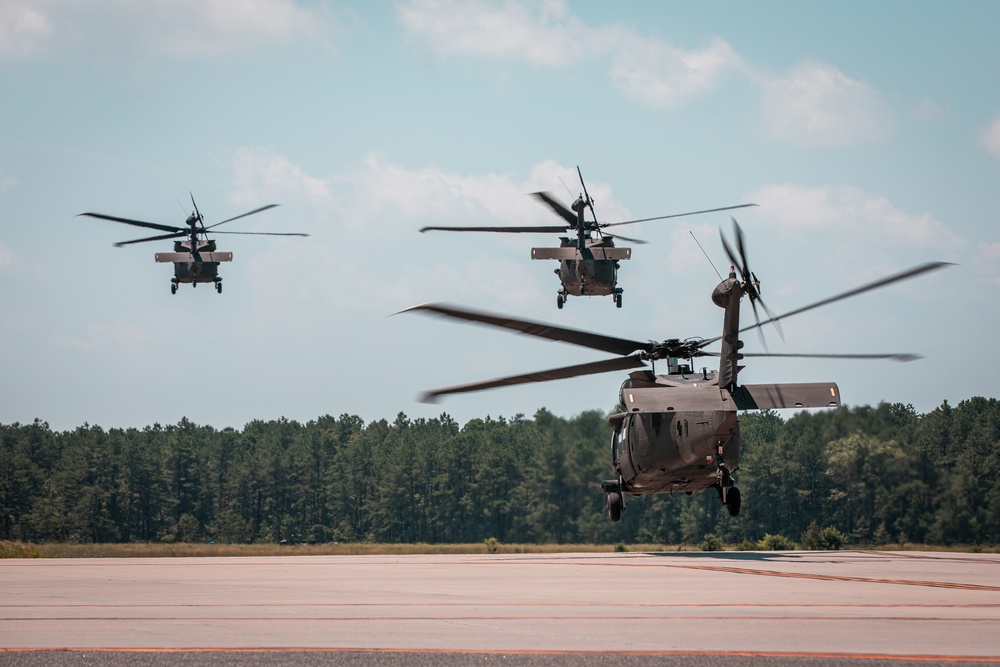
The Army has committed $234.5 million to build 16 more UH-60M Black Hawk helicopters, a move aimed at keeping Sikorsky's Stratford, Connecticut, production line running while the current multiyear contract winds down. The Sept. 17, 2026 Defense Department contract announcement lists a fixed-price-incentive, undefinitized modification for Sikorsky, a Lockheed Martin company, on contract W58RGZ-26-C-0008. Defence Blog reports the modification brings the contract's total value to $356.3 million.
Army Contracting Command at Redstone Arsenal, Alabama, is the contracting activity. Work will be performed in Stratford with an estimated completion date of June 30, 2028. Defence Blog reports the Army obligated the full $234.5 million in fiscal 2026 aircraft procurement funds at the time of award.
What the $234M Modification Buys
The modification pays for 16 UH-60M aircraft, the Army's current-production utility Black Hawk. The award is fixed-price-incentive, which ties Sikorsky's final profit to how its costs compare with agreed targets. It is also undefinitized, so Sikorsky can start work while the Army and the company keep negotiating the final price. The sources reviewed for this article give no target price, ceiling price or definitization deadline, and this article does not estimate them.
Breaking Defense reports that the first 16 aircraft are scheduled for delivery in fiscal 2028, and that leftover fiscal 2025 and fiscal 2026 appropriations fund them.
Money is only half the story. The award exists so the line does not go quiet. Breaking Defense reports that Sikorsky's 10th multiyear contract, awarded in 2022, concludes by the end of 2027. A multiyear contract commits the Army to a block of aircraft, and once that block is delivered, the next order has to be in place or the workforce and supplier base begin to drift. Sikorsky vice president Rich Benton framed the speed of this deal in those terms, according to Breaking Defense: "They needed us to be agile. They needed us to contract quickly, and they needed [us] to maintain continuous production."
How a $65M April Deal Grew to $356M
Contract W58RGZ-26-C-0008 started small. Defence Blog reports that it began in April 2026 as a $65 million advance-procurement deal covering materials and long-lead items for 10 UH-60Ms, meant to reduce schedule risk before full-rate production.
The arithmetic shows how far it has moved. Subtracting the $234.5 million modification from the $356.3 million total leaves roughly $121.8 million in value on the contract before this modification. That is nearly double the $65 million April figure, at about 1.9 times. The published sources do not itemize what the earlier modifications covered, so the gap between the two numbers is unexplained in the public record.
The change in quantity is also visible. The April deal supported long-lead items for 10 aircraft. The new modification funds production of 16. The undefinitized structure lets Sikorsky begin work while price talks continue, which favors speed over price certainty.
The 150-Aircraft Follow-On Behind the 16-Helicopter Order
The 16 aircraft in this modification look modest next to what Sikorsky says is coming. Breaking Defense reports that Benton predicted the deal could eventually encompass "as many as 150 aircraft as part of the deal over the next three to four years," with some going to the National Guard and to foreign military sales customers.
FlightGlobal reported on Sept. 18 that Sikorsky reached a deal with the Army to extend Black Hawk production beyond the previous manufacturing contract, which covered U.S. and foreign military sales customers and was scheduled to end in 2027. The FlightGlobal article is paywalled, and only its headline and introduction were readable for this report. Its confirmed point is the extension itself, not the terms.
The 150-aircraft number is a Sikorsky projection, not an Army commitment. The contract action reported by Defence Blog funds 16 helicopters, and the sources reviewed for this article do not describe a larger Army order. Treat 150 as a planning assumption until an Army contract action puts numbers on paper. The initial 16 aircraft do not arrive until fiscal 2028, so any follow-on agreement will set the production pace for the years after that first batch, including how many aircraft go to Guard units and foreign buyers.
Foreign demand is visible elsewhere. Defence Blog reports a separate State Department-approved foreign military sale of four UH-60L Black Hawks to Argentina, valued at $140 million, approved on Sept. 11, 2026. That is the older UH-60L variant and a separate transaction from the Army's UH-60M order, but it is one example of the international interest that could help fill out any follow-on quantity.
What It Means for Contractors
For Sikorsky's supply chain, the practical message is that orders are expected to continue past 2027. Suppliers that feed the Stratford line can reasonably plan on a production rate that does not collapse when the 10th multiyear contract ends, although the size and structure of the follow-on are not yet public. The obligation of $234.5 million in fiscal 2026 funds gives them a firm anchor even though the price is not final.
Subcontractors should expect flow-down pressure. Fixed-price-incentive terms reward Sikorsky for holding costs under target, and prime contractors often pass that discipline to their own suppliers. An undefinitized modification adds another wrinkle: until the Army and Sikorsky settle the final price, the prime carries some uncertainty about margin, and suppliers should read purchase-order terms accordingly.
For companies outside the Black Hawk supply base, the award shows one way the Army can bridge gaps between multiyear contracts. Rather than leaving a production line idle, it grew a single contract from a $65 million advance-procurement deal into a $356 million vehicle carrying a $234.5 million production modification. Contractors with programs nearing a contract boundary can study the pattern: a small advance buy followed by a larger undefinitized action can carry production across a funding transition.
Two things bear watching. The first is definitization: when the Army and Sikorsky agree on a final price, the value of W58RGZ-26-C-0008 may change, and any change would show up in later Defense Department contract announcements. The second is the follow-on itself. If the Army does pursue an agreement of roughly 150 aircraft, it would succeed the 10th multiyear contract, and its structure, whether multiyear or annual, will determine how much certainty suppliers get past 2028.
