
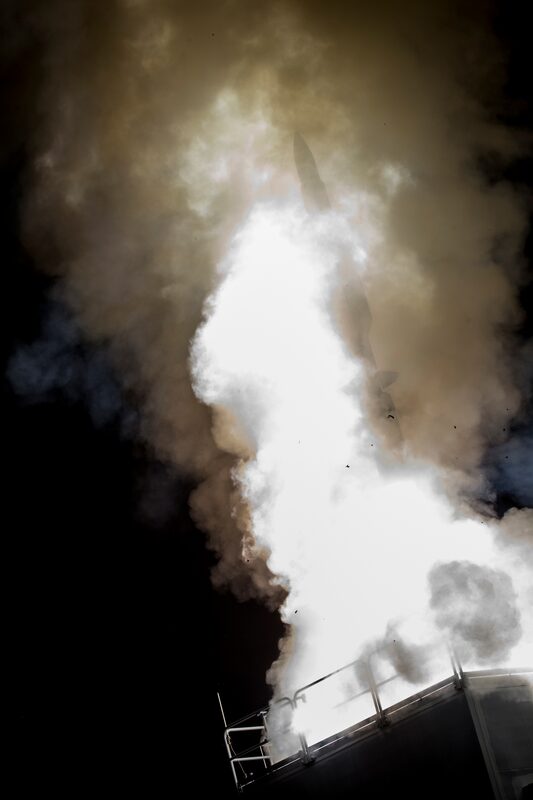
The Missile Defense Agency awarded Raytheon a $745.4 million contract to build Standard Missile-3 Block IIA all-up rounds, the agency's daily contracts announcement for Aug. 7, 2026 shows. The noncompetitive, undefinitized contract action funds interceptor production supporting both U.S. missile defense requirements and Japan's Ministry of Defense, with work running through February 2031.
Background
The SM-3 Block IIA is the largest and longest-range interceptor in the Standard Missile family, built to knock down medium- and intermediate-range ballistic missiles above the atmosphere during their midcourse phase. Raytheon has produced the missile jointly with Japan under a long-running co-development arrangement, splitting manufacturing and cost across defense industrial bases in both nations. The interceptor is fielded on Aegis-equipped Navy destroyers and cruisers.
This award follows a separate action in March 2026, when the Missile Defense Agency raised the overall ceiling on Raytheon's SM-3 program to $11.74 billion, already reported by GovConFeed at the time. That ceiling increase set an upper limit on how much work MDA could order under the broader SM-3 contract vehicle over its life; the $745.4 million action announced Aug. 7 is a distinct, specific production order placed against that vehicle, not a new ceiling. The two events are related but should not be conflated: one set the outer boundary for future orders, the other puts real production dollars on contract now.
Japan is the sole named Foreign Military Sales partner in this SM-3 Block IIA production award, consistent with its long-running role as co-developer of the interceptor alongside Raytheon. That arrangement helps explain why this production award carries a Foreign Military Sales component from the outset rather than as a later add-on: the contract's own funding lines show Japan's purchase and the U.S. government's procurement moving through the same Tucson and Huntsville production award together. Because both governments' interceptors come off the same production award, funding shortfalls or schedule slips on either side of the partnership could affect delivery timelines for both militaries.
Key Details
The $745.4 million figure is the contract's base value — the ceiling MDA authorized for this production lot. At time of award, the agency obligated a combined $553.3 million: $275.6 million in fiscal 2026 procurement funds covering interceptors bound for U.S. inventory, plus $277.7 million in Foreign Military Sales funds reflecting Japan's continued purchase of the interceptor it helped design. Work will be performed at Raytheon facilities in Tucson, Arizona, and Huntsville, Alabama, with the contract scheduled to run to completion by Feb. 28, 2031.
MDA structured the award as a noncompetitive, undefinitized contract action, meaning Raytheon can begin manufacturing and assembly work before the government and contractor finish negotiating final contract terms and price. Undefinitized actions are common for legacy interceptor programs where a single qualified producer exists and schedule pressure outweighs the benefit of a lengthy pre-negotiation process; the government caps Raytheon's initial spending authority and negotiates a definitized price later.
The noncompetitive designation reflects that Raytheon is the sole producer of the SM-3 Block IIA all-up round. No other manufacturer maintains the tooling, test infrastructure, or design authority needed to build the interceptor, so MDA does not solicit competing bids for production lots. That single-source position gives Raytheon durable revenue visibility on the program but also means the government has limited leverage to negotiate price through competition, relying instead on cost and pricing data reviews during definitization.
ExecutiveBiz reported the award citing the Department of War's contracts announcement page, which lists routine daily contract actions across the department. The article identifies the SM-3 Block IIA all-up round production scope, the two funding lines, and the performance locations and end date now on the public record.
What It Means for Contractors
The award keeps Raytheon's SM-3 production line running at Tucson and Huntsville through the end of the decade, a steady demand signal for the interceptor's supplier base. Subcontractors supplying seeker, propulsion, and kinetic warhead components for the Block IIA variant are well positioned for continued order flow tied to both U.S. procurement and Japan's FMS purchases, since the two funding streams move together on a single production contract rather than separate buys.
The FMS funding split is also a reminder that this particular buy leans heavily on allied money: roughly 37% of the contract's $745.4 million base value is tied to Japan's Foreign Military Sales case rather than U.S. appropriations. Companies positioning for roles on missile defense programs with international partners should note that funding split as a data point on how MDA structures allied interceptor purchases.
Because the action is undefinitized, the $745.4 million figure represents the government's authorized not-to-exceed ceiling for this specific order rather than a fully negotiated final price, and the funds obligated at award — $553.3 million combined — cover only part of that ceiling for now. Contractors tracking MDA's SM-3 spending should expect a follow-on definitization action once Raytheon and the agency settle final terms, which will set the binding contract value and may adjust the figure. The March 2026 ceiling increase to $11.74 billion gives MDA substantial remaining room to place further production orders against the same vehicle before that upper limit is reached, suggesting additional SM-3 Block IIA buys are possible as the interceptor's production schedule extends toward 2031.
Prime contractors on adjacent missile defense programs should also watch how MDA continues splitting funding lines between domestic procurement accounts and FMS cases on a single contract action. That structure lets the agency move faster than negotiating separate U.S. and allied contracts, and it may signal to potential FMS customers elsewhere that buying into an existing production line, rather than standing up a new one, is a path MDA is comfortable repeating for allied interceptor sales.
For companies evaluating the missile defense sector broadly, this award is a reminder that single-source interceptor programs like SM-3 continue to generate large, predictable production contracts even without competition, rewarding firms with established qualified-manufacturer status over new entrants. Raytheon remains the sole producer of the SM-3 family, and MDA's reliance on undefinitized actions to keep that line moving signals the agency's priority on maintaining interceptor inventory over procurement process speed.
