
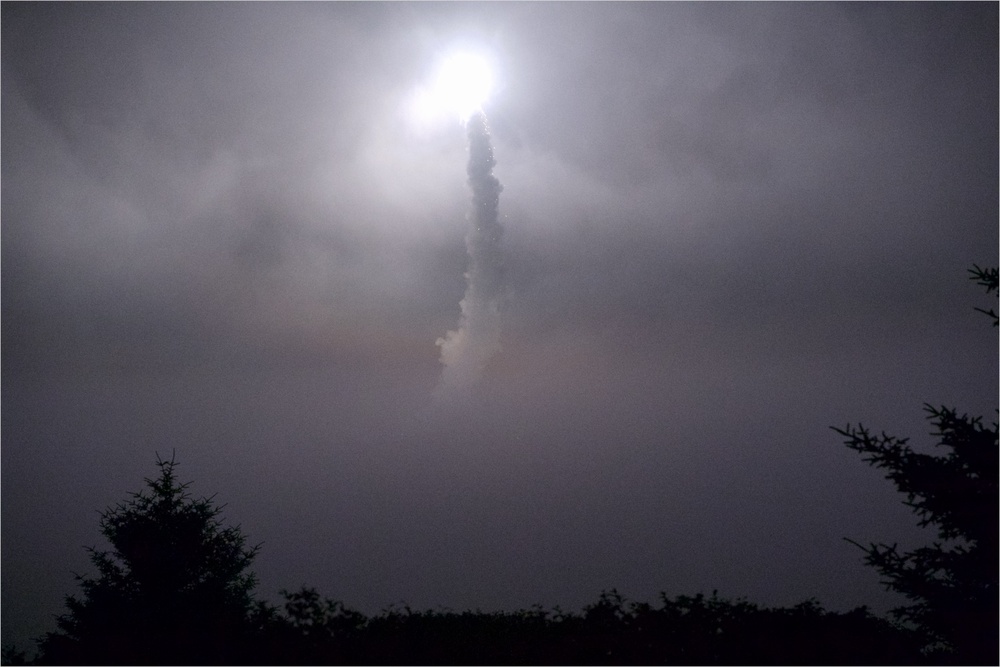
The Missile Defense Agency awarded Lockheed Martin Corp. Missiles and Fire Control a $35,327,237,604 undefinitized contract action on June 24, 2026, to dramatically scale production of the Terminal High Altitude Area Defense interceptor — the first major multiyear procurement executed under the Department of War's Acquisition Transformation Strategy. The award appears in the Department of War's daily contracts announcement for June 24, 2026, and locks in seven years of accelerated production through FY2032, establishing a new model for large-scale munitions procurement under sustained operational demand.
Background
THAAD is the only U.S. missile defense system certified to intercept ballistic missiles both inside and outside the atmosphere, a capability that places it at the apex of the terminal-phase defense architecture. No other fielded U.S. system matches that engagement envelope, making THAAD irreplaceable in the current missile defense layering strategy. Lockheed Martin has manufactured THAAD interceptors for over two decades, and the platform has been exported to allies including Saudi Arabia and South Korea, where it serves as a frontline deterrent against regional ballistic threats.
At approximately 96 interceptors per year, the current production rate has fallen short of what U.S. planners require to reconstitute stockpiles depleted through operational use. Sustaining adequate interceptor inventories requires production capacity that meaningfully exceeds drawdown rates — a gap that long-lead manufacturing timelines and annual contract cycles have historically made difficult to close quickly. Multiyear procurement authority addresses that structural problem by enabling the government and industry to align on production volumes and pricing before capital commitments must be made, rather than renegotiating terms annually against an uncertain demand signal.
In January 2026, the Department of War formalized a framework agreement with Lockheed Martin establishing preconditions for a multiyear procurement. Multiyear contracting authority allows the government to commit to production volumes and pricing across several fiscal years at once, enabling Lockheed Martin and its supply chain to invest in capacity that would be economically impractical to fund against annual contract renewals. The DoW designated the resulting June 24 award the first major multiyear procurement under its Acquisition Transformation Strategy — a program designed to compress the timeline from planning to production by pre-positioning industry before formal contract execution.
Key Details
The $35,327,237,604 contract runs through FY2032 and is structured as fixed-priced contract line item numbers. Production climbs from approximately 96 THAAD interceptors per year to 400 annually — a roughly 4.2x increase that represents a step-change in industrial capacity, not an incremental adjustment. The Missile Defense Agency in Huntsville, Alabama is the contracting activity. Spanning seven fiscal years, the contract window aligns with the full capital cycle required to build, staff, and operate the new manufacturing facilities coming online in Alabama and Arkansas.
Work spans four sites across four states. Lockheed Martin's established facilities in Dallas, Texas and Sunnyvale, California continue their program roles. Two purpose-built manufacturing centers expand capacity: the Munitions Production Center in Troy, Alabama, which broke ground in March 2026, and the Munitions Acceleration Center in Camden, Arkansas, which opened in January 2026. The four-state footprint reduces single-point-of-failure risk in a program with no redundant prime contractor and distributes the economic impact of the production ramp across a broader geographic base.
Lockheed Martin and its supply chain partners have committed more than $9 billion in associated industrial investment across more than 20 facilities through 2030. The company's press release described the award as reflecting "our shared vision with the Department of War to strengthen America's Arsenal of Freedom" and projected it will create "tens of thousands" of manufacturing, engineering, and skilled-trades jobs. The Camden Munitions Acceleration Center opened in January 2026, months before the contract was signed, illustrating that substantial capital commitment preceded formal award.
The contract carries undefinitized status at signing, a standard mechanism that allows work to begin while final pricing terms are negotiated. UCAs are used when operational urgency or industrial lead times make it impractical to delay production until negotiations are complete. The fixed-price CLIN structure anticipated at definitization will cap the government's cost exposure through FY2032.
What It Means for Contractors
At $35.3 billion over seven years, this represents the largest single THAAD procurement by dollar value on record. The multiyear structure gives the entire interceptor supply chain — solid rocket motor producers, composite structure manufacturers, guidance and seeker electronics suppliers, and ground support equipment integrators — a confirmed production schedule through 2032 that supports the long-lead material commitments and workforce investments high-rate production requires. No supplier can responsibly plan a major capacity expansion against a one-year contract horizon; the seven-year visibility removes that constraint.
That benefit is especially consequential for solid rocket motor production, which carries manufacturing lead times that can span a year or more. Without a multiyear demand signal, motor producers face the choice of absorbing capital risk or limiting output capacity — a dynamic that has historically constrained missile production rates across the defense industrial base. This contract eliminates that constraint for THAAD through FY2032 and provides the demand certainty suppliers need to justify workforce expansion and tooling investment at scale.
The Troy and Camden facilities create direct subcontracting demand in Alabama and Arkansas alongside the established Texas and California base. Both are greenfield operations requiring tooling, precision manufacturing equipment, and specialized staffing, generating cascading demand through regional supply chains. Defense manufacturers with propulsion, electronics, or precision munitions capabilities in the Southeast and Mid-South should monitor SAM.gov for solicitations tied to the production ramp at both new sites.
The UCA structure pushes subcontract awards out early — production must start before definitization completes, compressing the timeline for lower-tier procurement. Suppliers already qualified in the THAAD supply chain are best positioned to capture incremental volume in the initial ramp phase; new entrants face qualification and lead-time constraints that make near-term participation at volume difficult.
This award is sole-source to Lockheed Martin as the only qualified THAAD interceptor prime. Competition sits at the supply chain and component levels. The $9 billion in committed industrial investment spanning more than 20 facilities creates a supply base with the scale to sustain 400 interceptors annually through FY2032, and confirms that the barrier to entry for new prime-level THAAD competition remains high. With missile defense demand sustained through the decade, this contract marks the largest single expression of that trend — and is unlikely to be the last major missile defense award in the near term.
