
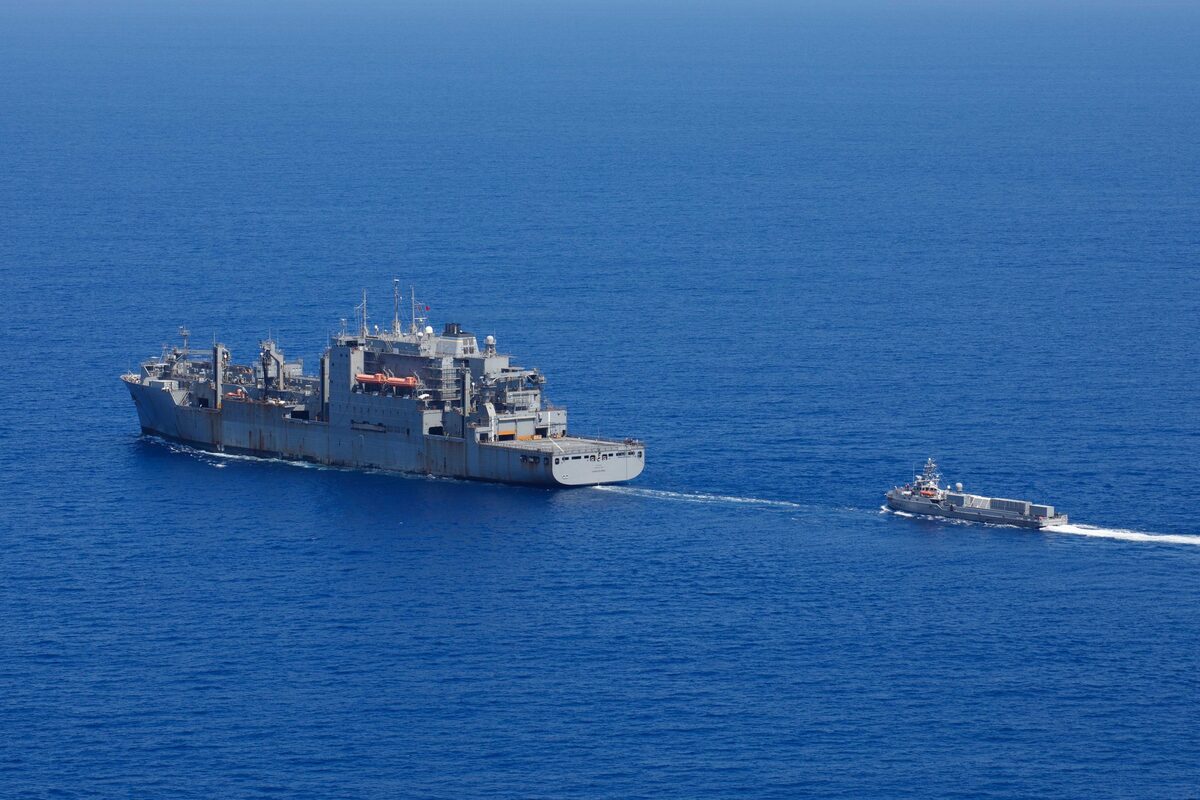
The United States has transferred four Triton autonomous underwater and surface vehicles, valued at roughly $13 million, to the Philippine Navy, the U.S. Embassy in Manila announced. Built by Mississippi-based Ocean Aero, the solar-powered drones went to the Philippine Navy's newly stood-up Unmanned Surface Vessel Unit One during a handover at Naval Operating Base Subic Bay on June 23, 2026.
The package, worth 754 million pesos, lands at a tense moment in the West Philippine Sea, where Manila and Beijing have traded protests over Chinese activity inside the Philippine exclusive economic zone. The Tritons are meant to give the Philippine Navy a persistent, low-signature set of eyes across waters it struggles to monitor with crewed ships alone.
Background
The transfer follows a sharp escalation at Scarborough Shoal. In late May 2026, China placed a six-by-six-meter, antenna-equipped floating platform at the shoal, well inside the Philippine EEZ. Manila protested the move; Beijing later removed the platform. The episode underscored how quickly fixtures can appear in contested waters and how thin the Philippines' surveillance coverage has been across its western maritime approaches.
Washington has steadily deepened its security commitment to Manila. The U.S. Senate earmarked $2.5 billion in December 2025 for Philippine military modernization through 2030, a funding stream that frames smaller, fielded capabilities like the Triton transfer as down payments on a larger buildout. The drones were shown publicly during the U.S.-Philippine Exercise Balikatan, signaling that unmanned systems are moving from demonstration to operational use rather than sitting in a test pipeline.
Ocean Aero, headquartered in Gulfport, Mississippi, produces the Triton as a dual-mode vehicle that can operate on the surface and submerge, blurring the line between unmanned surface vessel and unmanned underwater vehicle. That hybrid design is the core of what the company markets as an autonomous, environmentally powered platform able to stay on station without refueling or a tending ship.
Key Details
Each Triton is solar-powered and can patrol on the surface for up to 30 days. The vehicles can dive to 100 meters and remain submerged for up to 10 days, allowing them to switch between persistent surface surveillance and quieter subsurface operation. According to the embassy, the systems support intelligence, surveillance and reconnaissance and mine countermeasures; C4ISRNET reported the Triton's broader mission set also spans anti-submarine warfare and maritime strike.
The Philippine Navy plans to put the four drones to specific tasks: protecting subsea cables, monitoring gas pipelines, and detecting incursions in the West Philippine Sea. Those missions map directly onto the kinds of gray-zone activity Manila has documented near Scarborough Shoal and other contested features, where the challenge is less about firepower than about consistent, verifiable observation.
The handover to Unmanned Surface Vessel Unit One is notable on its own. The unit represents a dedicated organizational home for autonomous maritime systems inside the Philippine Navy, rather than a loose collection of demonstrators parceled out across existing commands. Standing up a single unit to receive, operate and sustain the Tritons gives the service a focal point for building doctrine, training crews and managing the data the drones collect.
The four Tritons were handed over at Naval Operating Base Subic Bay, a strategically located facility on the western side of Luzon that puts the unit close to the contested waters it will be watching. C4ISRNET reported the drones were displayed during Exercise Balikatan, the recurring bilateral exercise that has become a showcase for U.S.-Philippine interoperability.
What It Means for Contractors
The Triton transfer is a concrete signal that small, autonomous maritime platforms are becoming a preferred tool for U.S. security cooperation in the Indo-Pacific, and that creates openings well beyond Ocean Aero. The value here is modest in defense terms, but the strategic logic is repeatable: relatively inexpensive unmanned systems delivered quickly into allied hands to fill surveillance gaps that would otherwise require crewed ships the partner navy cannot afford to keep at sea.
For uncrewed systems builders, the mission set described in the reporting is the addressable market. ISR, anti-submarine warfare, maritime strike and mine countermeasures are exactly the payload and autonomy areas where allied navies are shopping, and the Philippine tasking list, subsea cable protection, pipeline monitoring and incursion detection, points to demand for sensors, communications and data-handling tailored to critical-infrastructure surveillance. Vendors who can package endurance, autonomy and a clean operator workflow into an exportable system have a clearer path than those selling exquisite, hard-to-release platforms.
The $2.5 billion the Senate set aside for Philippine modernization through 2030 frames the longer opportunity. Initial transfers like this one establish a foothold, build operator familiarity and create sustainment, training and spares demand that follow-on awards tend to reinforce. Companies that support the first delivery, whether through maintenance, mission software, communications relays or training, position themselves for the recurring work that comes with a standing unmanned unit.
The deal also reinforces a pattern contractors should track: U.S. security-assistance funding increasingly flows toward fielding unmanned capability with allied partners rather than only buying for U.S. forces. Firms with products that are affordable, exportable and quick to integrate, and that fit a defined surveillance or infrastructure-protection gap, are best aligned with where this funding is heading across the Indo-Pacific.
Sources
- United States Provides Triton Unmanned Systems to Strengthen Philippines' Maritime Domain Awareness (U.S. Embassy in the Philippines)
- Philippines deploys US-made Triton naval drones in its western waters to scout for intruders (C4ISRNET)
- U.S. Transfers Ocean Aero Tritons to Philippine Navy USV Unit (Naval News)
